
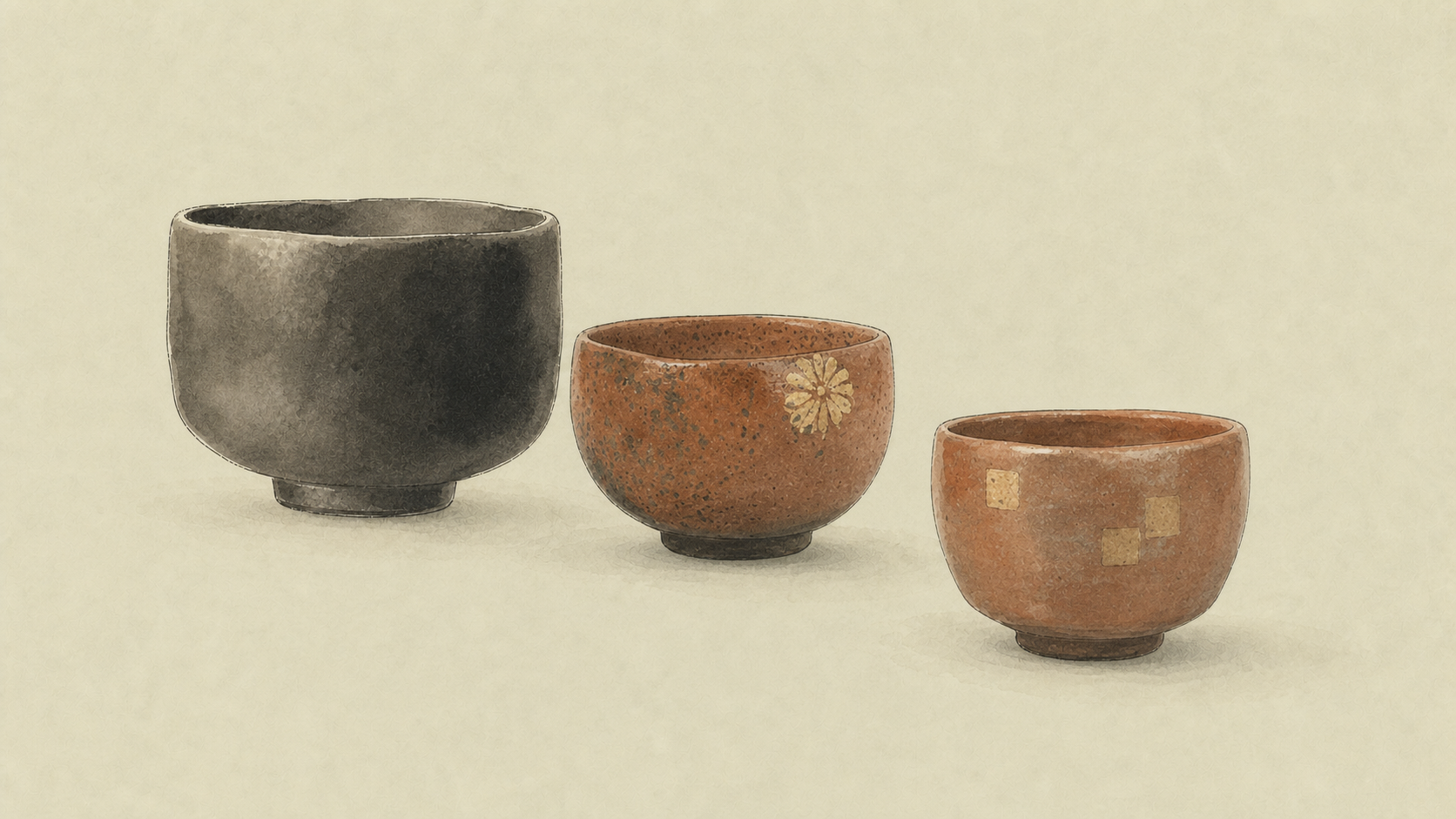
Raku tea bowls have no single outline that makes them look as if they came from one mold. Some are quietly black. Others show glazes that have moved dramatically. We still recognize a continuity in them. To see what sustains it across these differences, start with the conditions under which the bowls take shape.
How Raku continues beyond a single shape
Tradition can suggest taking an early masterpiece as a model and preserving its form accurately. Look for one Raku outline and you soon run into differences in rim height, the swell and taper of the body, the size of the foot, and the sheen of the glaze.
Setting those differences aside as exceptions would make the history easy to tell at a cost to the richness of the objects. Variation has a place in the process of making Raku from the outset.
The process holds the work together. The maker forms the clay by hand, trims it, glazes and fires it, and gives it a form that works as a tea bowl. Within those conditions there is room to make choices each time.
Variation then comes from decisions the maker has to make with each bowl, rather than from fashions at the surface.
I think of Raku as a tradition in which people can ask the same questions again by making something. What continues across different shapes is the framework for making them.
Hand shaping leaves the form open
Raku is known for hand shaping without a wheel. On a wheel, rotation sets a center and circumference. Working the clay with fingers and palms, the potter brings the inside and outside into relation a little at a time.
Where might the rim rise? Where should the wall stay thick? How do the areas that sit in the palm join one another? A series of small choices around the bowl produces an outline that need not be symmetrical.
A mold makes it easier to repeat an outline. Working by hand makes it difficult to return to exactly the same form. That difficulty opens up room for change. The clay’s firmness and moisture and the pressure of the hands help the maker find the balance of each bowl as it takes shape.
A hand mark alone does little to explain Raku. The adjustments made by hand matter where they connect the rim, body, lower body, and foot.
A slight change in rim height can look insignificant in a photograph and still change where the fingers move when the bowl turns in both hands. You can see what hand shaping does in movement as well as in a view.
Trimming shapes what we see and hold
The maker trims the hand-shaped clay with a tool as the clay dries. Trimming reduces thickness, moves weight, and brings the outside contour into relation with the interior.
Strong marks can draw the eye in a photograph. Think of how the bowl is used and the clay left behind becomes just as important. The rim meets the lips, the body rests in the palm, and the weight falls through the lower body toward the foot. Trimming affects each of these.
A bold outer form with too narrow an interior makes the whisk hard to move. Excessive thinness can make a bowl feel insubstantial in the palm. Both sculptural effect and use depend on how much thickness is left.
What the maker leaves behind changes from bowl to bowl, even with the same starting method. Look at where the weight comes together before following one prominent line.
The foot concentrates many of these decisions. It takes the weight on the tatami and meets the fingertips when the bowl is lifted. Its size and height matter, as does the angle of the surface leading to it, which can make the body appear settled or slightly raised.
Trimming also affects the interior. The base needs room for the whisk, and the inner slope has to let tea run to the mouth. Consider inside and outside together to see what the marks do for the bowl beyond giving it the look of a maker’s signature.
Glaze and fire leave room for variation
Black and red Raku differ broadly. Within either color there can be sheen, cloudiness, brown patches, changes in glaze thickness, and traces of firing. The color name only begins to describe what a bowl looks like.
Glaze adds a layer to the outline. The same body can seem fuller in one place than another as the light is reflected or absorbed. A thin glaze can bring out a rim’s line. A pool of glaze can soften it. The surface gives the shaped clay another emphasis.
The fire changes hand-shaped clay and glaze in ways the maker cannot fully predict. Preparing the clay, glaze, and firing sets a range in which changes can occur. The maker then has to take what comes out of the kiln as a bowl.
Raku’s variation takes shape between the maker’s choices and the way the materials respond in the fire.
Even a quiet surface records what happened. Look at how it takes light or at the place where the glaze meets the clay.
The bowl’s work in the hands supports change
However far the form or glaze may vary, this is a bowl for making and drinking tea. That use sets the bounds within which it can change.
Guests receive the bowl in both hands, turn its front away before drinking, and examine it at close range afterward. The host moves the whisk within the bowl and offers the tea to the guest. The contours of the bowl belong with these actions.
The rim, body, interior, and foot connect the hand, mouth, and tatami. Does an angular outer surface leave a place for the hands? Will a small foot support the weight? Does a dramatic interior still work when it holds tea? Imagining use makes these questions concrete.
I think this physical frame is the main reason Raku can keep changing. Bring the bowl back to the acts of using it and you can ask how far the form works without needing to fix it in advance.
A bowl that looks sculptural behind glass can be considered in terms of what it asks of the body. Use gives us a way to measure what a change achieves.
What makes the bowls Raku emerges in their differences
Look only for shared traits and Raku can shrink to a short definition: hand shaping, low firing, black and red. Such a definition has its uses. It can also hide the differences among works.
Compare two bowls from similar angles and under similar light, following the same route around each. Trace the rim, then move down from the body toward the lower curve. Look inside and under the foot. Finally, consider how the glaze alters the outline.
One bowl might bring the weight toward its center while another opens outward. One black surface may swallow light and another draw the eye to moving glaze. Read those differences as different responses to the work of making a bowl.
A tradition can emerge through the range of choices you can see when the pieces are kept distinct. Raku’s character resides in the room it has to vary.
Move back and forth between two bowls with different characters. The greater the difference, the more reason to look for the framework that makes both possible.
Conclusion: A process with room for change
Raku bowls continue through the work of shaping clay by hand, trimming it, letting glaze and fire take effect, and bringing the result back to the body as a tea bowl. That framework can accommodate different choices every time.
A fixed model would give the work less room to change. Hand shaping, clay thickness, glaze, fire, and what the body has to do still give each change something to answer to.
Look at where a bowl leaves an earlier answer behind and what makes it work again as a tea bowl. As the framework beneath the changes comes into view, the continuity of Raku becomes something you can see in the shape.
 What Did Sen no Rikyū Design? The Relationships Inside a Tea Gathering