
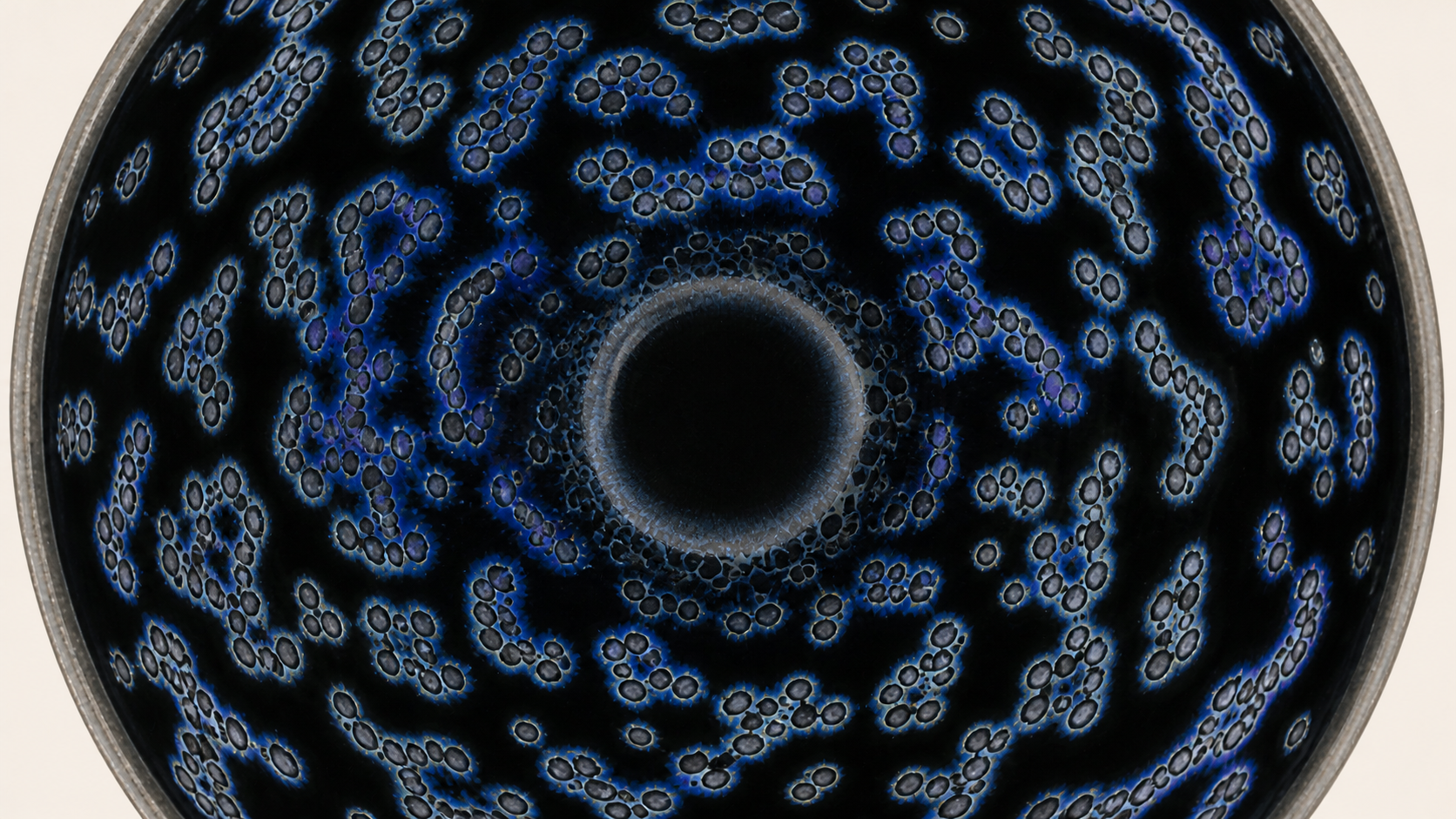
Five tenmoku tea bowls are National Treasures: three yōhen, one yuteki, and one taihi. How do rings of light, metallic spots, and floral designs differ on these black-glazed bowls? Look at the five one by one.
What is a tenmoku tea bowl?
In Japan, tenmoku refers chiefly to black-glazed tea bowls from China. Bowls fired at Song-dynasty kilns such as Jian and Jizhou traveled to Japan through trade and exchanges among Zen monks. Tea practitioners prized them as imported Chinese utensils. Tenmoku covers different kilns, glazes, and designs.
Many bowls from the Jian kilns narrow slightly below the rim and taper to a small, low foot. A continuous black glaze makes one dark space of the deep interior. The spots and streaks made in firing can then read as light with depth rather than a flat design.
At the Jizhou kilns, makers developed ways to layer glazes over black and produce mottling like tortoiseshell and designs of flowers or birds using paper stencils. Where Jian ware draws the eye to crystalline effects and iridescence, Jizhou ware brings the layering of glazes and the placement of patterns forward. The difference in kilns and techniques gives us a starting point for yōhen, yuteki, and taihi.
Some tenmoku bowls have a metal band around the rim and are set on a tenmoku stand. The band protects the mouth and gives a narrow line of light beside the black glaze. The stand receives the small foot, changing the height of the bowl and where the hands meet it. Look at the shape, band, and stand as a set alongside the glaze.
A national designation can put an object at a distance. Each bowl is sized for one person to drink from. The bowls crossed the sea from Chinese kilns and passed through shogunal and daimyō families, temples, and modern collections. Their forms and the histories that survive with them matter alongside their unusual colors.
Five National Treasure tenmoku bowls in three types
Five tenmoku tea bowls are designated National Treasures. There are three surviving complete yōhen bowls, one yuteki bowl, and one taihi bowl. The five works belong to three types.
| Type | Work and collection | What to look for |
|---|---|---|
| Yōhen tenmoku | Yōhen Tenmoku, known as Inaba Tenmoku, Seikado Bunko Art Museum | Vivid iridescence across the interior |
| Yōhen tenmoku | Yōhen Tenmoku tea bowl, Fujita Museum | Iridescence inside and outside, and a broad mouth |
| Yōhen tenmoku | Yōhen Tenmoku tea bowl, Ryūkōin, Daitokuji Temple | Small star-like spots and subdued blue light |
| Yuteki tenmoku | Yuteki Tenmoku tea bowl, Museum of Oriental Ceramics, Osaka | Metallic spots across the inside and outside |
| Taihi tenmoku | Taihi Tenmoku tea bowl with scattered flowers, Shōkokuji Temple | Fifteen round floral motifs inside and flowing mottling outside |
All three yōhen bowls are thought to have been fired at the Jian kilns during China’s Southern Song dynasty. The spots differ in size and density, the blue and purple light appears in different places, and each bowl leaves a different amount of black in view.
The yuteki bowl at the Museum of Oriental Ceramics, Osaka, is also a Jian product. It has spots on black glaze, but the metallic light is concentrated in each spot rather than spreading around it in a ring. Shōkokuji’s taihi bowl comes from Jizhou, where pale yellowish glaze was layered over black to make floral motifs and tortoiseshell-like mottling.
A list of treasures tells us what they are called. Looking at whether light appears around a spot, on a spot, or whether a design emerges between light and dark glazes connects the three techniques to the individual bowls.
Yōhen tenmoku: Three bowls with different kinds of light
On yōhen, spots of different sizes appear on the black glaze, with blue, purple, and sometimes yellowish iridescence around them. The color can extend beyond the spot in a ring, and the balance between dark and luminous passages changes with the angle. All three complete bowls are National Treasures, and each organizes the light differently.
Seikado Bunko Art Museum: Inaba Tenmoku
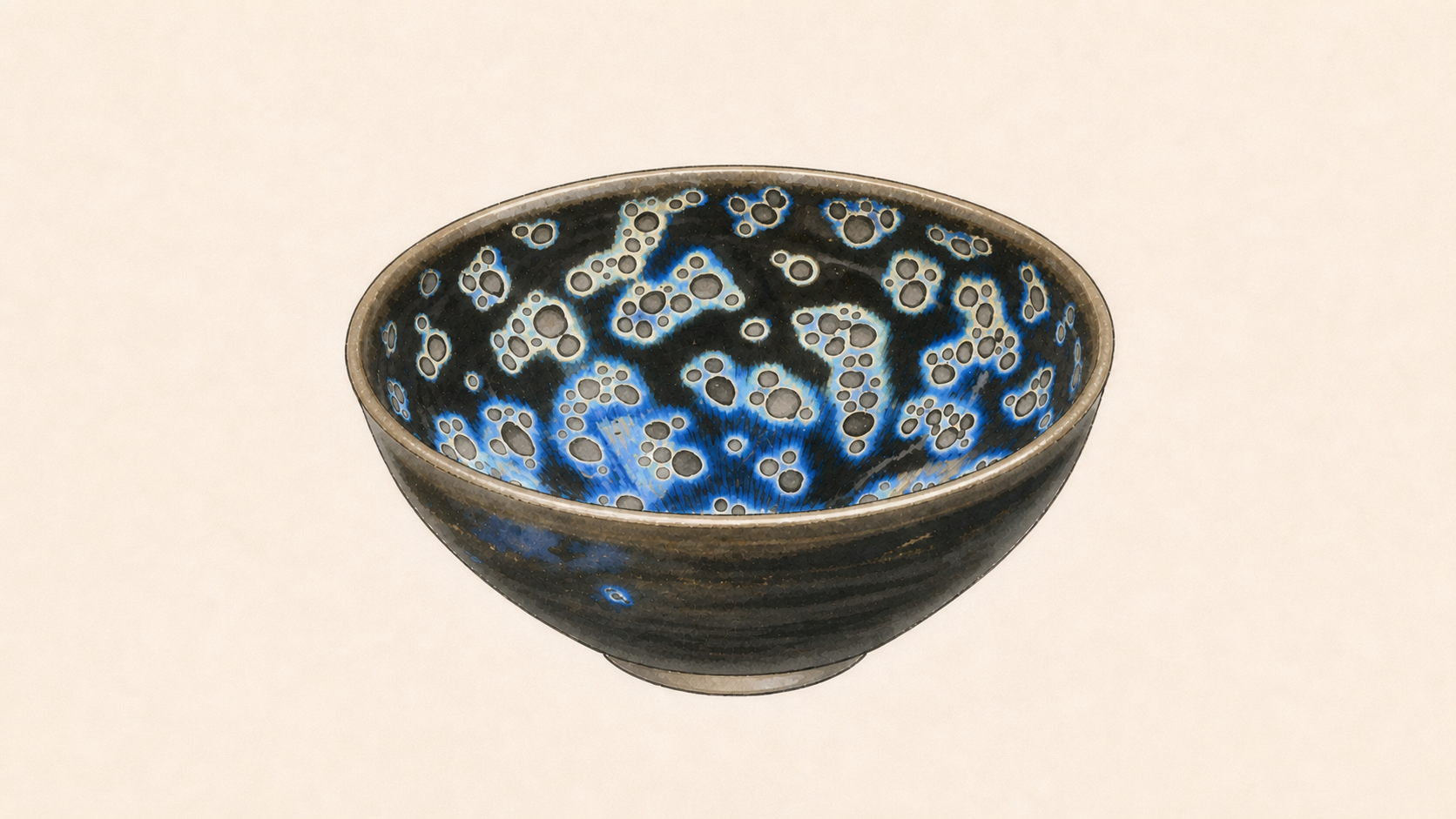
The best-known example is Inaba Tenmoku at the Seikado Bunko Art Museum. Clusters of spots cover almost the entire interior and show vivid, predominantly blue iridescence. A faint halo spreads from one spot and overlaps the next. Enough darkness remains between them to give the inside of the bowl depth.
The name comes from its former owners, the Inaba family, lords of the Yodo domain. The museum says the Tokugawa shogunal family bestowed it upon Kasuga no Tsubone before it passed to the Inaba. It later entered the Iwasaki collection. A tea utensil became a family treasure, an important part of a modern collection, and a National Treasure.
Fujita Museum: Yōhen Tenmoku tea bowl
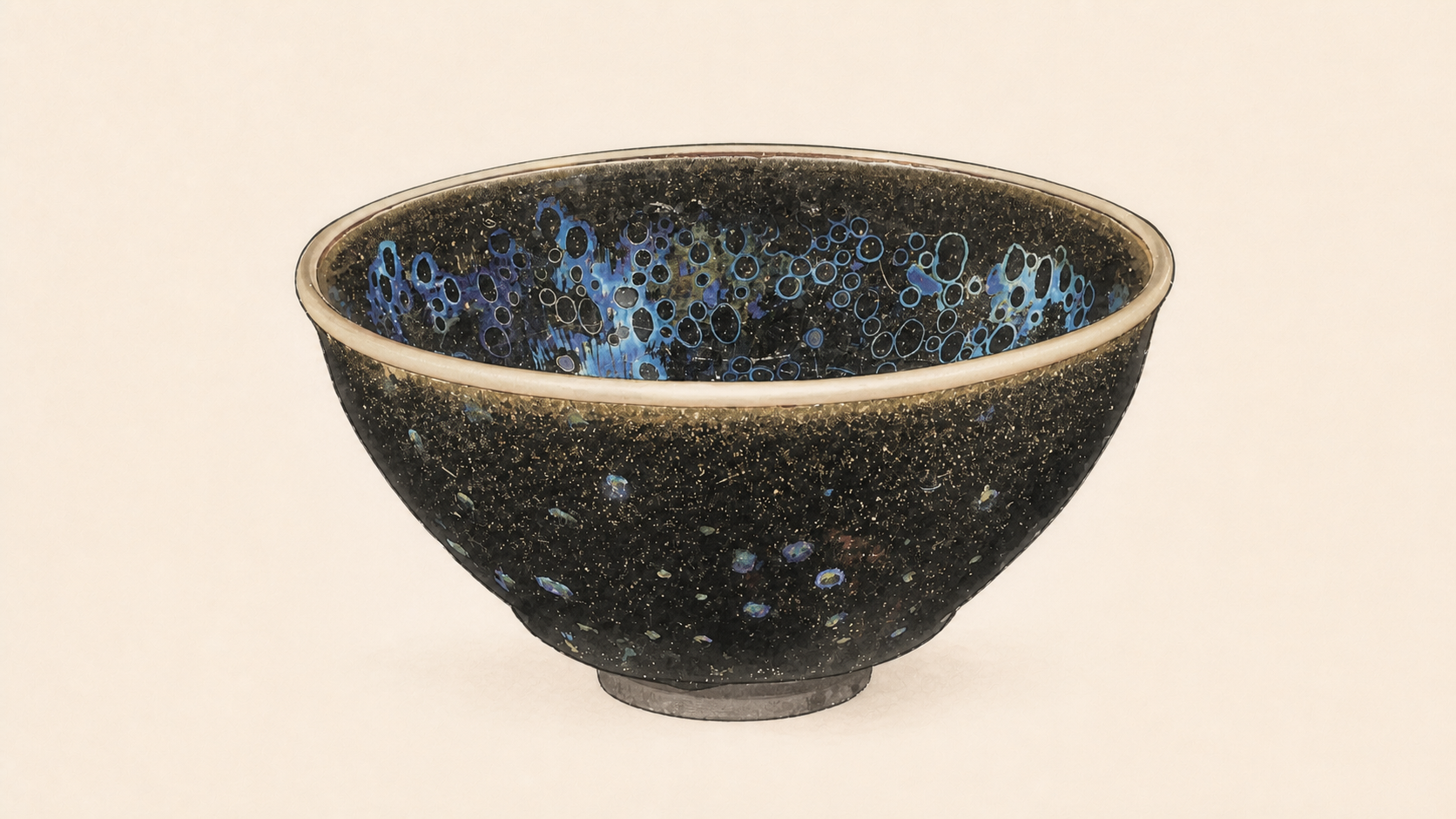
The Fujita Museum bowl has a comparatively wide mouth and iridescence on the outside as well as the inside. The national database describes it as the only one of the three with striking yōhen on both surfaces. There is light you see by looking down into the bowl and light you can follow around the outside.
It formerly belonged to the Mito Tokugawa family and later entered the Fujita family collection. Beside the brilliant interior of Inaba Tenmoku, look at where the spots appear as well as how bright they are. The drinker sees the inside. Other guests can see the outside. The bowl changes character when it is set down or held up.
Ryūkōin, Daitokuji Temple: Yōhen Tenmoku tea bowl
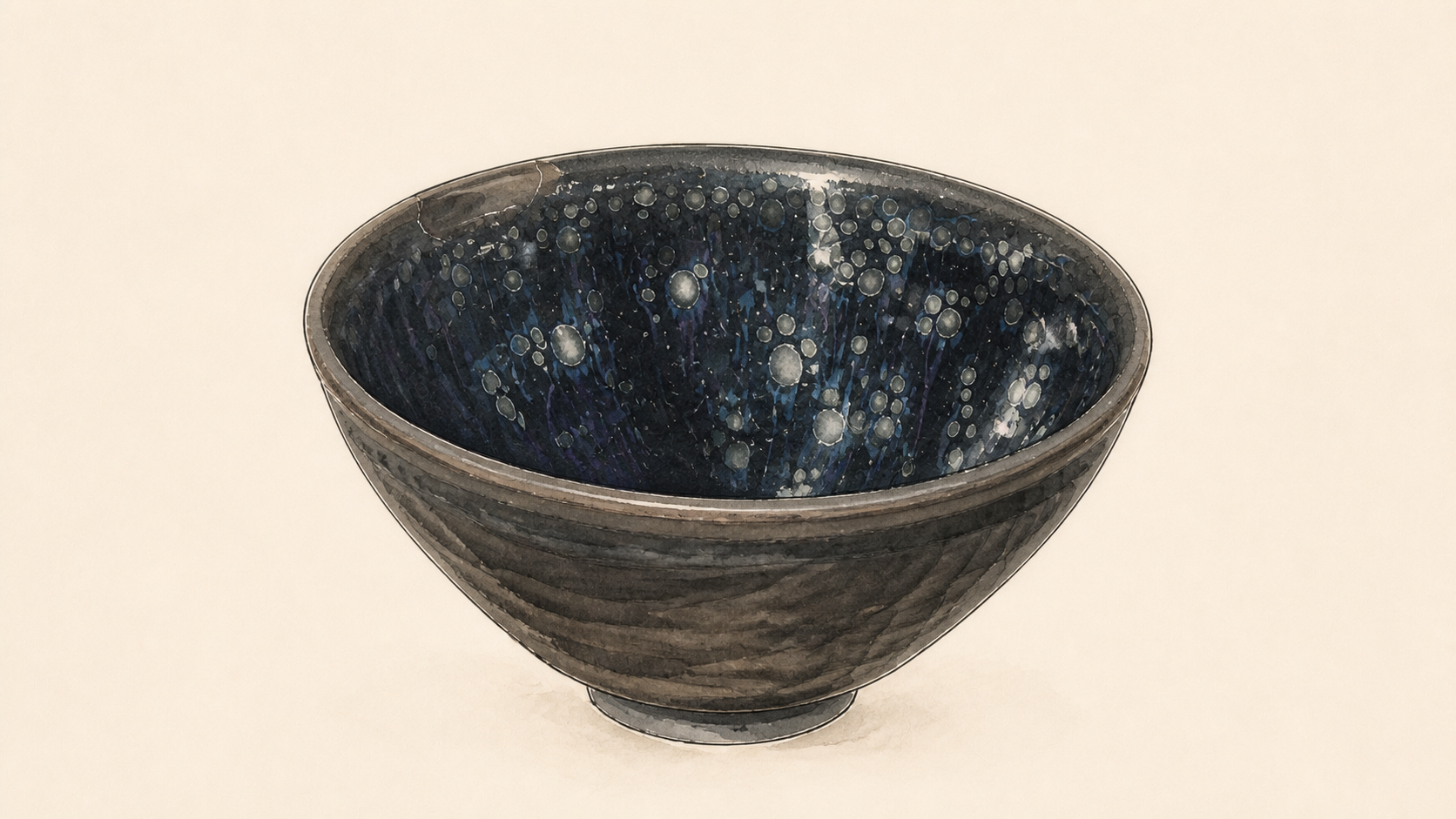
The bowl kept at Ryūkōin has small star-like spots and narrow, short passages of blue light. Small points emerge from deep black. The intervals separating them give the bowl a presence of its own.
Here the amount of blue explains only part of the effect. More of the dark glaze remains visible and the eye can stay longer on an individual spot. Inaba Tenmoku spreads light across the interior, the Fujita bowl carries it around the inside and outside, and Ryūkōin leaves points of light amid the black.
Beyond “the universe in a bowl”
Yōhen tenmoku has often been called “the universe in a bowl.” The phrase conveys lights floating in a dark interior but can make the three bowls sound alike. Look for where spots cluster, how far the black stretches from the rim toward the center, and whether the light continues outside.
Irregular spots and colored halos from the firing spread across the inside of a simple tenmoku form. How much black remains affects the strength of the halos, and the taper of the bowl leads the eye inward. Seeing the effects of firing together with the structure of the vessel gives us a way to distinguish all three.
Yuteki tenmoku: The spots themselves reflect light
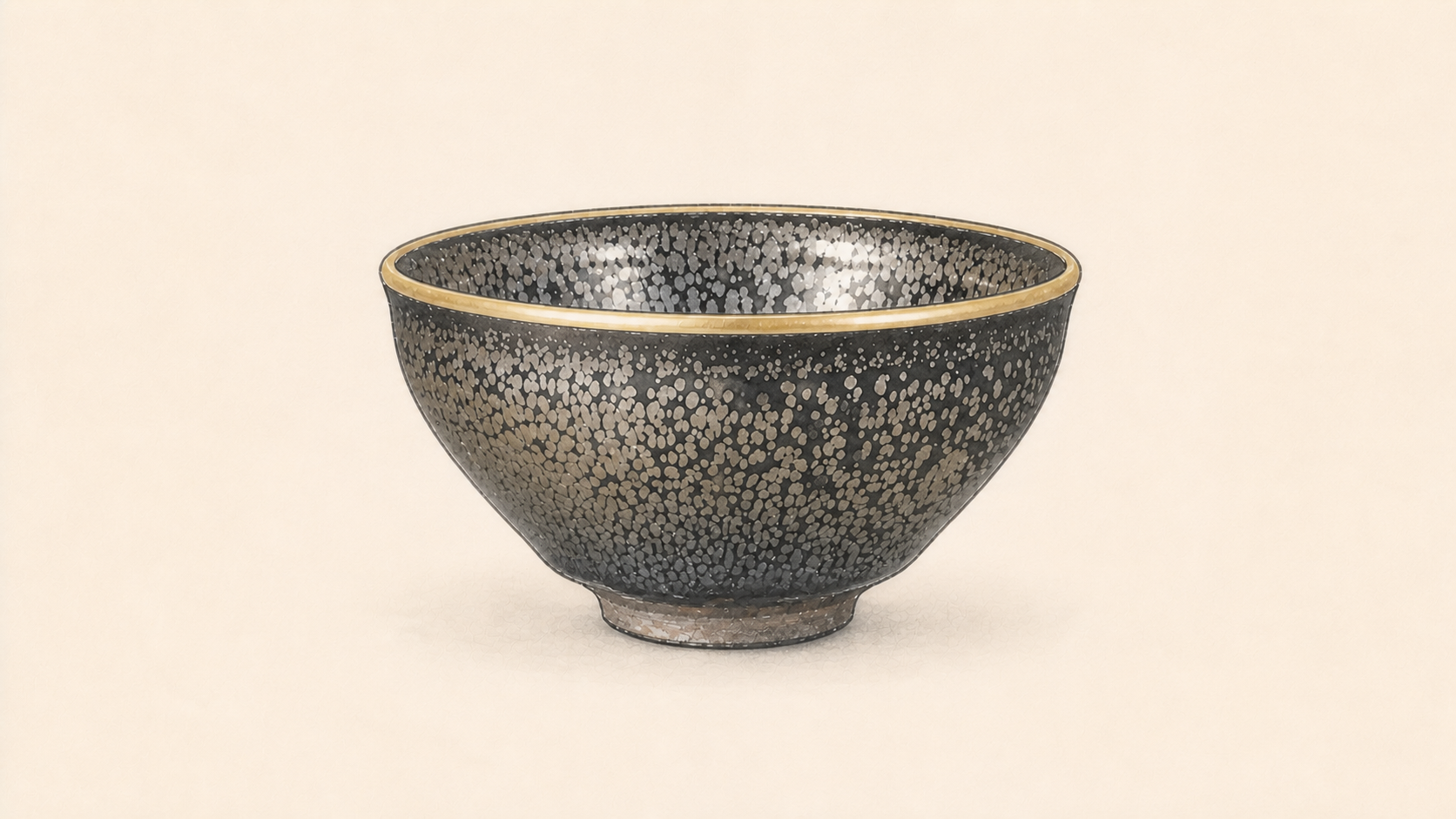
Osaka’s Yuteki Tenmoku was fired at the Jian kilns during China’s Southern Song dynasty. Dense spots inside and out reflect a metallic silver, gold, or deep blue. The Japanese name yuteki, “oil spot,” comes from their resemblance to drops of oil floating on water.
Yōhen and yuteki can look alike in photographs because both show spots on black glaze. Look at the area immediately around a spot. Yōhen spreads a blue or purple halo beyond the edge. In yuteki, the rounded spot itself reflects light strongly, like a metallic point against black.
On this bowl, large oil spots are densely distributed on both surfaces. They cluster along the deep interior and follow the outside curve. Turn the bowl and the reflections change. The movement of the light lets the viewer see the roundness beneath so many spots.
A gold band circles the rim and three lacquered tenmoku stands accompany the bowl. The rim gives a single continuous line of light alongside the scattered glints in the glaze. Its line holds the outline together while the irregular spots shift within it.
Tradition associates the bowl with the regent Toyotomi Hidetsugu. It then passed through such owners as Nishi Honganji, the Kyoto Mitsui family, and the Sakai family of Wakasa before entering the City of Osaka’s collection. It is a representative work of the museum and has been shown in a dedicated case. What was once a private treasure can now be seen from several angles by a wide public.
The size and density of the spots, their reach across both surfaces, and their relation to the rim give yuteki an effect of its own. Yōhen brings halos out of a dark ground. Yuteki distributes points of light over the black.
Taihi tenmoku with scattered flowers: Where pattern meets glaze
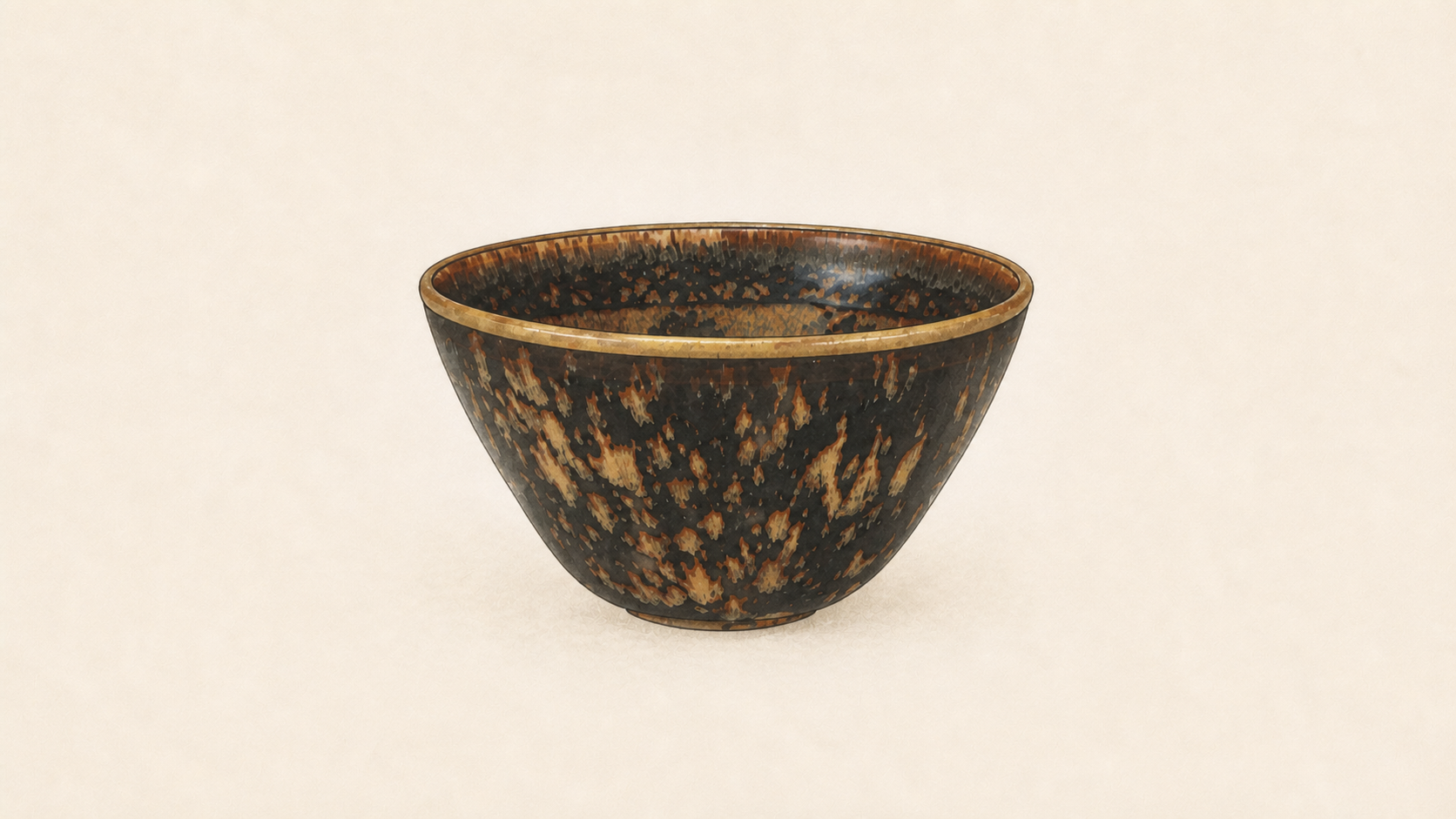
The Jōtenkaku Museum identifies Shōkokuji’s National Treasure Taihi Tenmoku as a tea bowl with scattered floral designs. This small bowl was fired at the Jizhou kilns in Jiangxi during the Southern Song. Pale yellow-white straw-ash glaze was layered over black tenmoku glaze to produce the design and mottling.
Fifteen round floral motifs appear inside, surrounded by a band of scrolling foliage. The Agency for Cultural Affairs explains that the upper straw-ash glaze was kept off the areas that form the design, leaving the lower black glaze visible as flowers. The pattern appears where the pale glaze is absent.
The motifs inside have set positions and intervals. On the outside, sprinkled straw-ash glaze creates irregular dark and yellow-brown mottling. The name taihi refers to its resemblance to tortoiseshell. A regular design inside shares the bowl with a flow of glaze outside.
Yōhen and yuteki are seen through the play of spots and light produced by firing. Taihi holds together fifteen flowers set out before firing and glaze that changed in the kiln. A controlled pattern and less predictable surface meet in one vessel.
A slightly turned rim and a small low foot give the bowl a tenmoku shape. A brass band circles the rim. In an opening less than twelve centimeters across, the metal line keeps the outline clear and the fifteen flowers set intervals for the eye.
The bowl is said to have belonged to Ueda Saburōemon of Osaka in the middle Edo period. Matsudaira Fumai, lord of Matsue and a tea practitioner, later acquired and prized it as an especially celebrated utensil. It is now held at Shōkokuji. Its route from Jizhou through Japanese collectors to a Zen temple brings the design, use in tea, and temple culture together.
What black does in each of the five bowls
Black glaze is the starting point in all five. In yōhen, darkness gives space and depth to blue or purple halos. In yuteki, it separates metallic spots. In taihi, black itself forms the flowers against the yellow-brown glaze.
First, look just beyond a spot. Yōhen spreads light outward. Yuteki reflects it from the spot itself. Taihi moves across light and dark fields of glaze. The boundary between light and black tells us how each surface works.
Second, look inside and outside separately. Seikado’s yōhen concentrates iridescence in the interior. The Fujita bowl carries it inside and out. Yuteki densely covers both surfaces with spots, and taihi uses flowers inside and mottling outside. Each draws the eye differently when you look down into it or move around it.
Third, notice form and accessories. The three yōhen bowls differ in mouth width and the opening of the body. The yuteki has a gold rim and three stands, and the taihi a rim of brass. A close-up of glaze alone leaves out the contour that supports it and the bowl’s place as a utensil.
Provenance also describes a change in the way people saw the bowls. Made for tea in Chinese kilns, they became treasures of the shogunate or daimyō families in Japan, or passed into a temple or public museum collection. Each followed a different route. How frequently and in what kind of display we can see a bowl changes the encounter today.
I like to see them as five ways to work with black glaze. How much darkness remains? Does light appear as points, rings, or broad surfaces? Do inside and outside show the same effect? Each bowl brings what happened in the kiln into relation with a different form.
Conclusion: Five different bowls to look at
There are three yōhen National Treasure bowls, one yuteki, and one taihi. The count gives us a place to begin. Three yōhen bowls have different effects, and yuteki and taihi work with light and pattern in other ways.
On the Seikado bowl, see how iridescence spreads across the interior. In the Fujita work it goes around the inside and outside. In Ryūkōin, small star-like spots remain in the black. The Osaka bowl lets the spots themselves reflect light, and Shōkokuji’s fifteen flowers meet flowing glaze. Each bowl gives black a different part to play.
Look beyond the brightest areas to the black that remains, the form leading from rim to interior, and the glaze on the outside. The metal rim and stand also belong to the ensemble. Across the five bowls, black gives particular kinds of light and pattern a place to appear.
Main References
- Cultural Heritage Online, “Yōhen Tenmoku Tea Bowl, Seikado Bunko Art Museum”
- Seikado Bunko Art Museum, “Yōhen Tenmoku, Known as Inaba Tenmoku”
- Database of National Cultural Properties, “Yōhen Tenmoku Tea Bowl, Fujita Museum”
- Fujita Museum, “A Mysterious Beauty That Captivates”
- Database of National Cultural Properties, “Yōhen Tenmoku Tea Bowl, Ryūkōin”
- Database of National Cultural Properties, “Yuteki Tenmoku Tea Bowl”
- Museum of Oriental Ceramics, Osaka, “National Treasure: Yuteki Tenmoku Tea Bowl”
- Cultural Heritage Online, “Taihi Tenmoku Tea Bowl”
- Shōkokuji Jōtenkaku Museum, “Highlights of the Collection”