
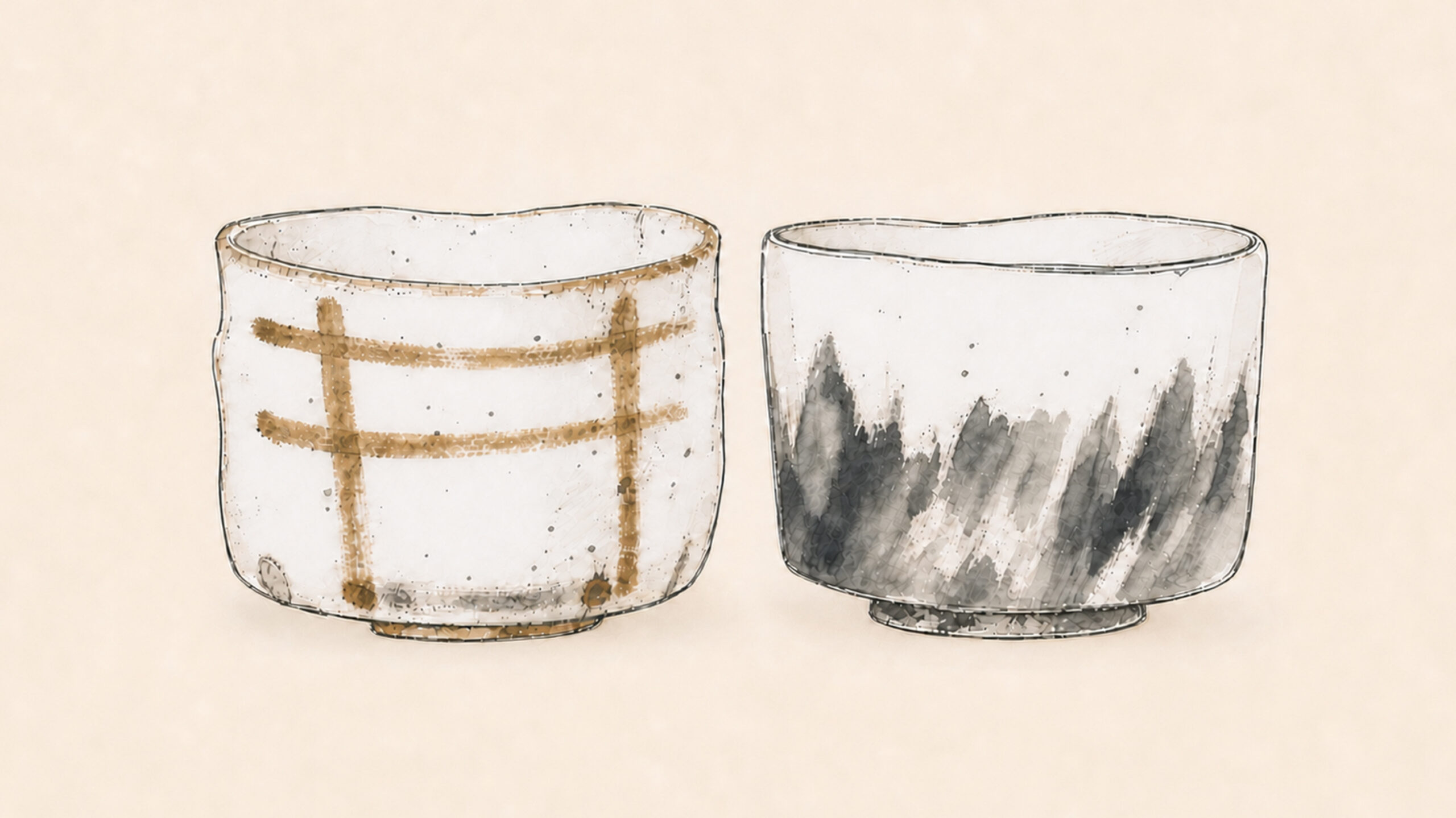
Only two tea bowls fired in Japan have been designated National Treasures: Unohanagaki, a Momoyama Shino bowl, and Fujisan, a Raku bowl by Hon’ami Kōetsu. The two were made in very different ways. Together, they offer two ways to understand the aesthetic of Japanese tea bowls.
Japan’s two domestically made National Treasure tea bowls
Yōhen and yuteki tenmoku and Ido bowls may come to mind when you think of National Treasure tea bowls. All have been treasured in Japanese tea. If you count only bowls fired in Japan, just two have been designated National Treasures.
One is the Momoyama Shino bowl Unohanagaki, fired in Mino. The other is Fujisan, made by Hon’ami Kōetsu in the early Edo period. The Mitsui Memorial Museum also identifies these as the only two National Treasure tea bowls fired in Japan.
The two bowls grew out of different values and ways of making. Unohanagaki came from work shared at a kiln and from what happened in the firing. Its maker’s name has not come down to us. The identity of Hon’ami Kōetsu remains closely bound to Fujisan. The bowls were shaped and finished differently, and their colors appeared in different ways.
Their designation brings two distinct approaches to making a Japanese tea bowl into view. Comparing them lets us follow two paths by which the form developed.
Under Japan’s system for protecting cultural properties, significant tangible cultural properties may be designated Important Cultural Properties. Works of outstanding cultural and historical value among them may be designated National Treasures. Unohanagaki was designated in 1959 and Fujisan in 1952. The earlier date gives neither precedence as a work. Both have stood among Japan’s representative crafts since the early years of the postwar protection system.
The label “National Treasure” can put an object at a distance. Both bowls were made on the scale of drinking tea. Each is under ten centimeters tall and fits between two hands. There is a striking distance between a national designation and a small vessel touched by one person’s lips.
Unohanagaki: An unnamed maker and a kiln tradition
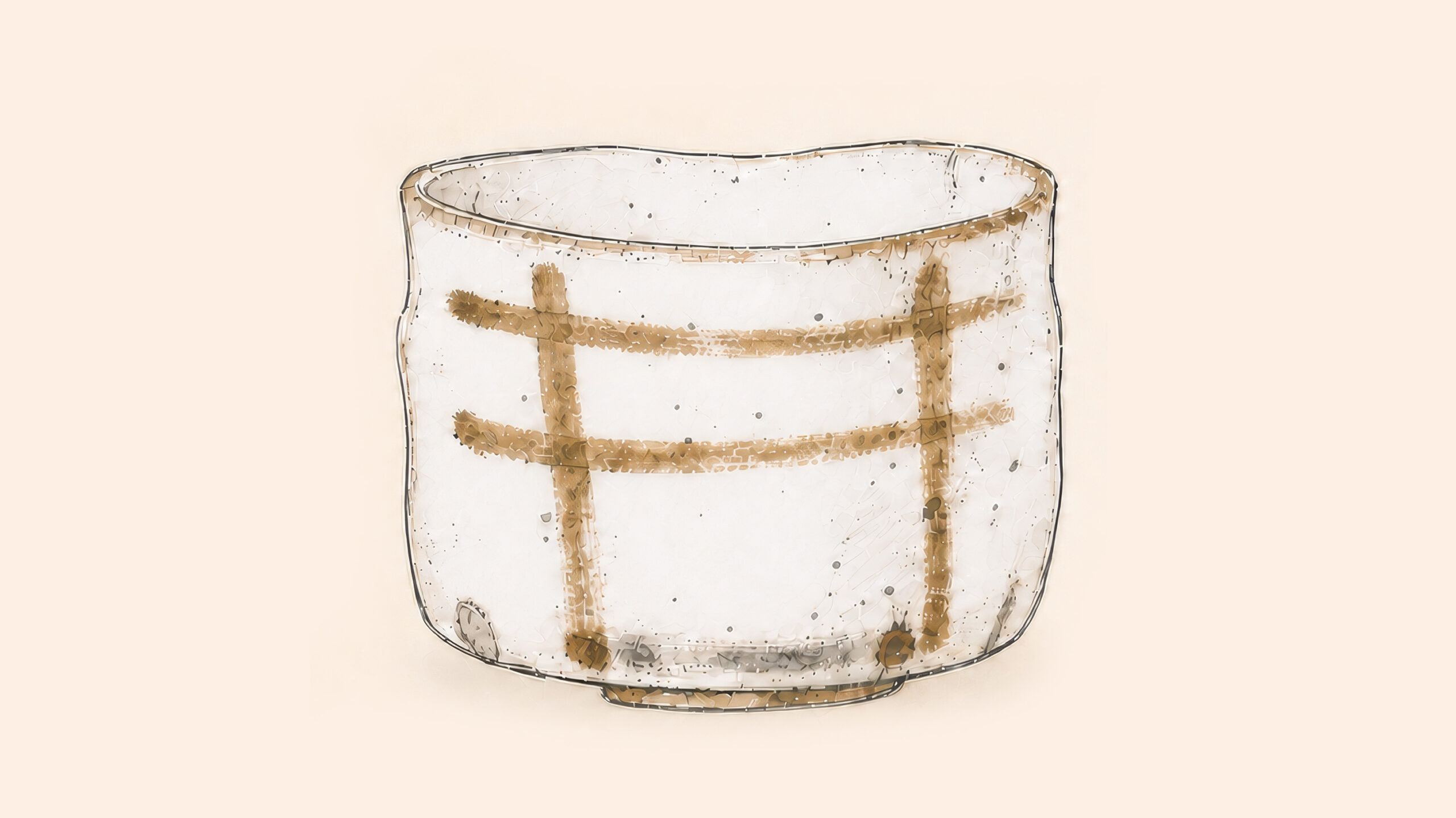
Unohanagaki is a Momoyama Shino bowl fired in Mino. The Mitsui Memorial Museum attributes it to the Mutabora kiln and lists a height of 9.6 cm, mouth diameters of 10.4 to 11.6 cm, and a foot diameter of 6.0 cm.
The half-cylindrical bowl was wheel-thrown and then reshaped. Seen from above, it resembles a rounded triangle. The body was trimmed with a tool and painted in iron with lines like a fence beneath the white Shino glaze. The glaze is thicker in some places than in others, and areas exposed to more direct heat show a reddish color.
The drawing moves with the form. The fence lines bend around the irregular body and break or blur under the white glaze. Turn the bowl and the intervals between the lines change along with the outline.
Clay, wheel, trimming, iron painting, glaze, and fire acted on the bowl in succession. Each contributes to its appearance. The white Shino glaze forms a substantial layer that receives the changes caused by clay and fire.
The maker’s name is unknown. The bowl carries the accumulated skills of the kiln and the choices of its makers. A work without a signature survives through the strength of its form. That offers another way to understand making in Japan.
The mouth measures 10.4 cm one way and 11.6 cm another, a difference of 1.2 cm, substantial for a bowl this size. Each time you change your grip, the span received by the fingers and palm changes.
The iron lines remain dark in some places, sink under the glaze in others, and leave broad areas of white. The act of turning the bowl gives you time to see the drawing. The form changes how the drawing appears, and the drawing draws attention to the orientation of the form.
Fujisan: White and black shaped by one maker
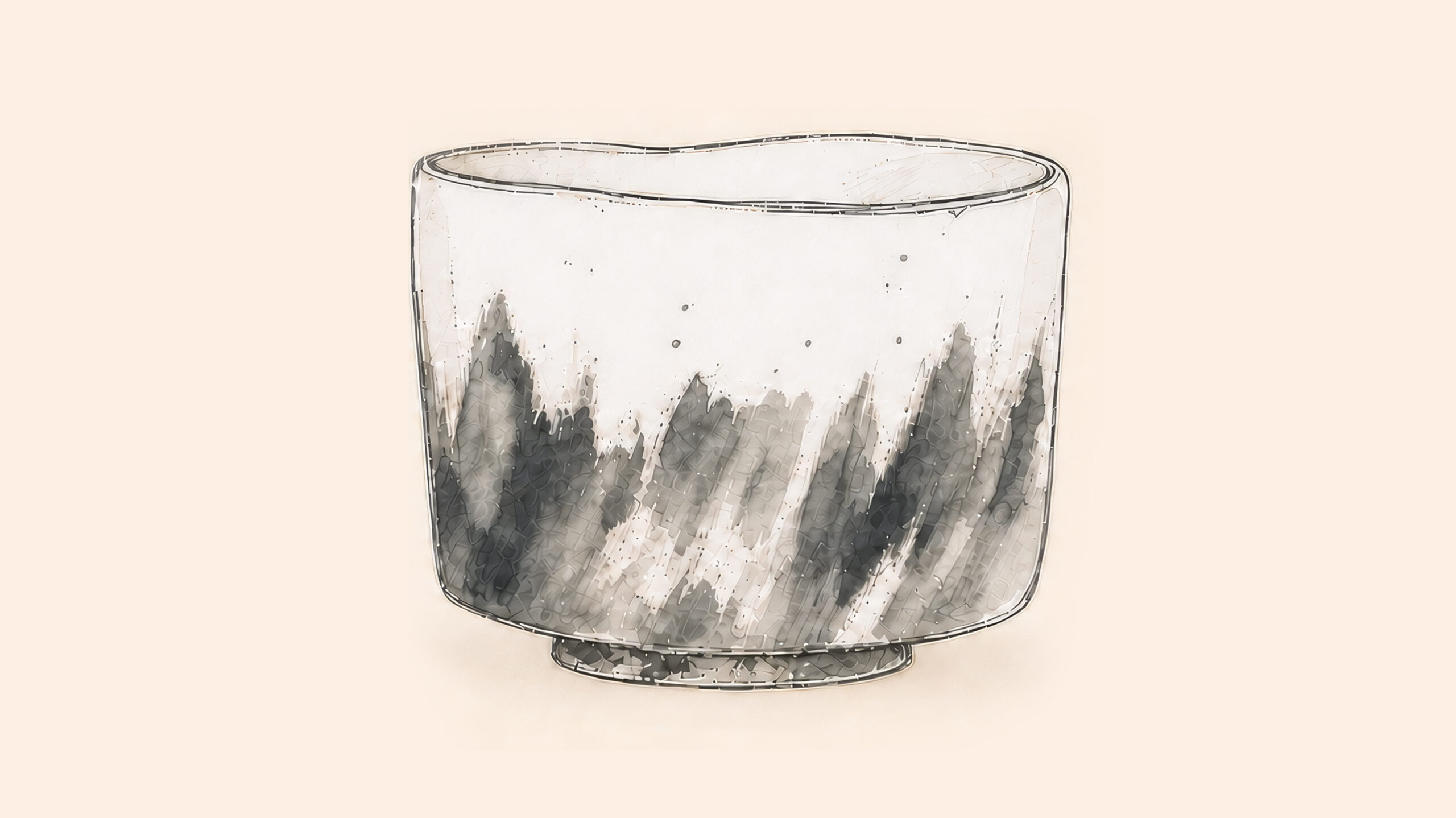
Fujisan is a Raku bowl attributed to Hon’ami Kōetsu. Japan’s Agency for Cultural Affairs lists it at 8.5 cm high with a mouth diameter of 11.5 cm. A cylinder with steep walls, it was formed by hand from white clay containing coarse sand and covered with a thick, fairly opaque white glaze.
The upper half is white and the lower half a dark gray from carbonization. The boundary crosses the bowl unevenly, like a mountain ridge marked by the effects of fire and carbonization.
The thick rim was trimmed to a flat surface that rises and falls. The Agency for Cultural Affairs likens its profile to a mountain path. Its near-vertical sides and low, wide foot give it an architectural clarity. The maker worked the hand-shaped clay into large planes by trimming it.
Kōetsu worked in calligraphy, lacquer, and publishing, among other fields. His other activities do not determine what the form of Fujisan means. Still, the large outlines, planes, and color boundaries show how the material can be treated as a single composition.
The accompanying box lid carries the name Fujisan and a seal attributed to Kōetsu himself. A tradition says his daughter took the bowl with her wrapped in a long-sleeved furisode when she married, and the bowl came to be called the “furisode tea bowl.” The name, box, textile, and provenance have been handed down with the vessel.
At 8.5 cm high and 11.5 cm across the mouth, it is a little lower than Unohanagaki and almost the same width. Yet in photographs Fujisan can look steeper and taller. The vertical planes of the body and the low, wide foot give its outline that force beyond what the measurements alone suggest.
The white and dark gray also move the apparent balance of the bowl. The bright upper section catches light, while the dark lower section seems to settle toward the tatami or display surface. The glaze and carbonization change the way the outline reads.
What comes into view when the bowls are side by side
| Feature | Unohanagaki | Fujisan |
|---|---|---|
| Period | Momoyama period, 16th–17th century | Early Edo period |
| Type | Shino tea bowl | Raku tea bowl |
| Maker | Unknown | Attributed to Hon’ami Kōetsu |
| Shaping | Wheel-thrown, reshaped, and trimmed | Hand-shaped and trimmed |
| Surface | Iron painting beneath white Shino glaze | White and dark gray from white glaze and carbonization |
| Key visual elements | Outline, line, and layers of glaze | Outline, planes, and the boundary between colors |
| Collection | Mitsui Memorial Museum | Sunritz Hattori Museum of Arts |
On Unohanagaki, painted lines lead the eye around the bowl. On Fujisan, the boundary between white and dark gray divides the body into upper and lower sections. One uses lines to suggest turning. The other gives the frontal view a strong presence through broad surfaces.
Imagine taking each in the hand. Unohanagaki changes its outline depending on where you stand. It invites you to follow the fence lines and the glaze as you turn it. The thick rim and upright body of Fujisan give it a definite weight in the hand, and the color boundary can be seen as a broad landscape.
The comparison shows how the words “irregular” and “imperfect” can cover two very different ways of putting a form together.
Behind Unohanagaki is the kiln and the skills built up there. With Fujisan the name Kōetsu comes to the fore. There were individual hands making decisions at the kiln as well, and Kōetsu may not have worked the clay, glaze, and firing entirely on his own. Look at where a name survives and where a technique survives.
The names do different work. Unohanagaki suggests white deutzia blossoms and a fence, inviting you to see a landscape in the iron lines. Fujisan overlays a mountain on a vessel divided into white and gray. Once you know the names, the same lines or boundaries can give you a different scene.
Irregularity as a choice
“The beauty of imperfection” is often used to describe Japanese tea bowls. Look at how these bowls were shaped and it becomes clear how little that phrase explains on its own.
Unohanagaki was thrown and then deliberately pressed out of round before trimming and iron painting. Fujisan combines a hand-shaped cylindrical body, a trimmed rim, and a low, wide foot. The makers brought the bowls into order through features other than a perfect circle.
In design terms, stepping away from a circular form gives a bowl a direction. A perfectly rotational form presents the same outline from every side. Change that outline a little and the host can choose a front while the guest can turn the bowl and see another face.
That change continues into the sequence of setting the bowl down, receiving it, turning it, drinking, and examining it. A changing contour gives the eye and hands a reason to look for differences.
A deviation still has to hold together with the rest of the form. The two bowls offer different balances between what can be controlled and what happens by chance.
Reshaping the clay does not mean every later effect was planned. Clay dries, glaze melts, and kiln temperature and the path of the fire affect the surface. A maker can define the conditions without fixing the final surface millimeter by millimeter. These bowls show how a form can receive variation and keep its coherence.
Consistency matters in present-day manufacturing. A vessel for the hands and lips also needs workable dimensions and strength. Both bowls keep within those practical requirements while preserving differences particular to the individual piece.
What “Made in Japan” leaves out
“Made in Japan” can suggest precision, quality, and uniform finishing. These two bowls give the phrase another meaning. Both preserve the differences that clay and fire bring to a form.
Glaze melted in the kiln on Unohanagaki, leaving varied thicknesses of white and reddish patches. On Fujisan, carbonization darkened half of the body. Neither surface could be drawn out in full in advance. The makers chose the clay, thickness, glaze, and firing conditions in which these results could arise.
Design can also mean making room for a material to change and working with the result. In each bowl, the material and the maker’s choices together determined what came out of the kiln.
The value of the bowls continued to take shape after firing. They were discovered in tea, given names, preserved with boxes and accounts of their histories, and recognized as cultural properties in the modern era. How objects are looked at and passed down also shapes their value.
The National Treasure designation gives us a place to begin asking why these forms survived. Uneven white glaze, a changing rim, interrupted lines, and a rough edge between colors might be rejected during inspection of a manufactured product. Here they are part of what there is to see.
Conclusion: Two bowls, two ways of looking
Unohanagaki and Fujisan are the only two National Treasure tea bowls made in Japan. Their forms show how much variety that shared description contains.
Unohanagaki carries the skill of a kiln and the choices of makers whose names are lost. Fujisan brings Kōetsu’s shaping and the division into white and black into view. Lines and glaze circle one bowl, and planes and color divide the other.
Both give irregularity a role in how a vessel is seen and used. An uneven rim, changes in the glaze, and the effects of firing give us reasons to return to the bowls.
In front of either bowl or a photograph, trace the rim and then follow the lines or color boundary across the body. Going back to where you began may reveal a different outline. The two treasures leave us with two ways to look more closely at a tea bowl.
References
- Agency for Cultural Affairs, Database of National Cultural Properties, “Shino Tea Bowl Named Unohanagaki”
- Mitsui Memorial Museum Collection Database, “Shino Tea Bowl Named Unohanagaki”
- Agency for Cultural Affairs, Database of National Cultural Properties, “Raku Tea Bowl with White Half-Body Glaze, Named Fujisan, by Kōetsu”
- Sunritz Hattori Museum of Arts, “About the Museum”