
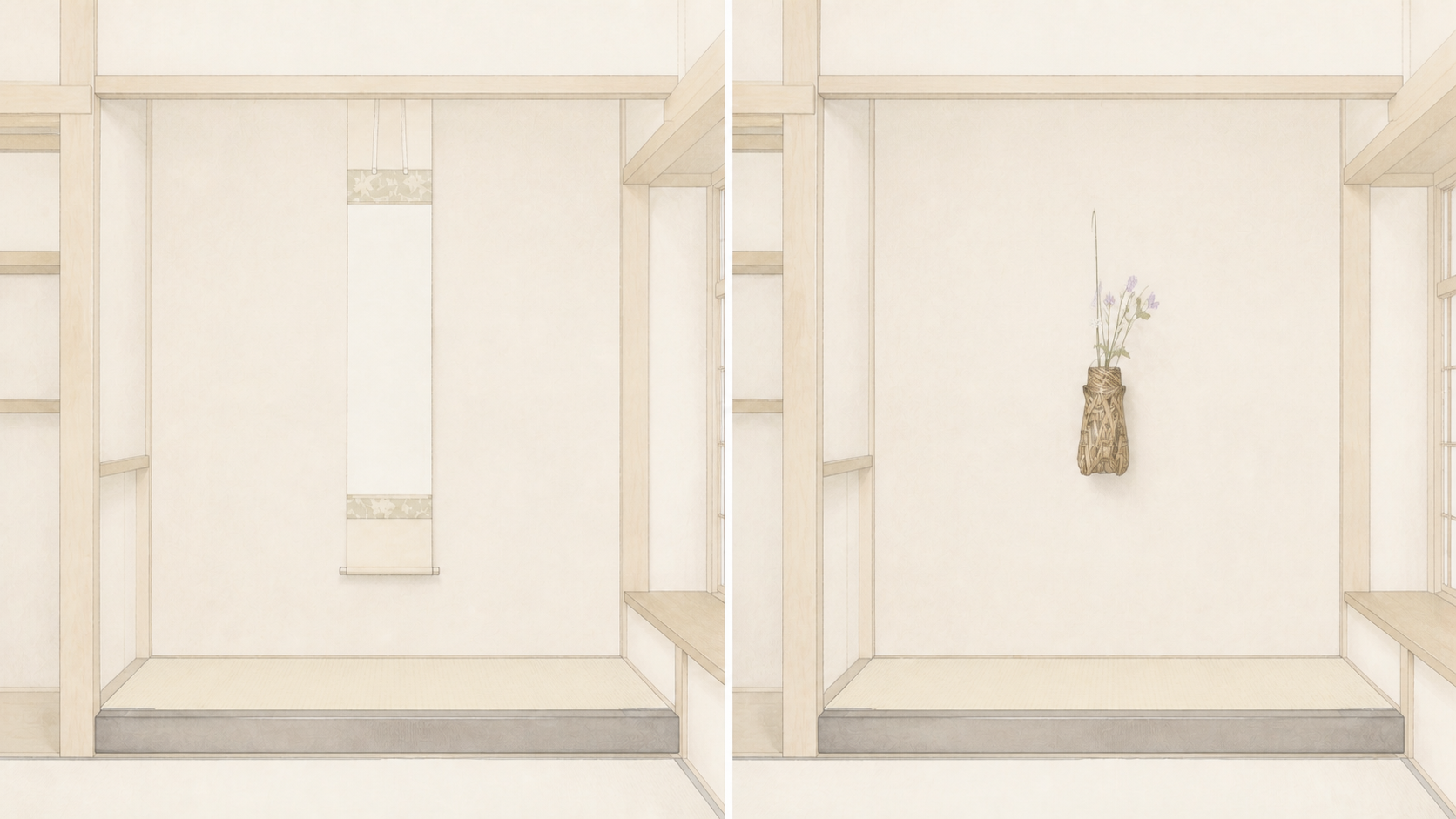
At the first sitting of a formal tea gathering, a scroll hangs in the alcove. Flowers appear only at the second sitting, after the guests have stepped out for a break. This sequence passes the theme of the gathering from words to a living part of the natural world. The timing of the gathering shows how that theme moves from words to flowers.
How the Alcove Changes Between Sittings
A formal tea gathering, or chaji, changes the scene within a single room. At the first sitting the scroll is the focus. After the charcoal procedure and the kaiseki meal, guests step out into the tea garden. When they return after the break, known as nakadachi, an arrangement of flowers has taken the scroll’s place. The small alcove has a different character halfway through the gathering.
To someone new to tea, displaying a scroll and flowers together might look more festive. But with both present, it is harder to tell which one to give your attention to. The first sitting gives words their own time and the second makes room for something alive. Guests can give each their full attention.
The guests return to the same alcove, tatami and walls. Taking down the scroll and bringing in flowers shifts the balance between the light and the objects in the room. Part of the art of a tea gathering lies in changing what the space is about simply by rearranging what is already there or what belongs in it.
Why the Scroll Comes First
A saying in tea gives the hanging scroll first place among the utensils. It is an important means for the host to express an idea. A Zen phrase, calligraphy, a letter or a waka poem can set the tone for the gathering. As well as reading the words, guests notice the speed of the brush, the blank areas of the paper and how the mounting frames the writing. Together these show something of the host’s choice.
Putting words first gives the gathering a tenor of its own beyond the meal and tea. The scroll offers a way to think about how to spend this time together. Its meaning can stay open for the guests to consider over the course of the gathering.
Putting up the scroll and flowers together would give guests more to take in at once, at the cost of time with each. In the actual sequence, they spend time with the words, leave for the break and return to find living flowers. The change signals that a new part of the gathering has begun.
The Break Between Sittings
During nakadachi, the guests leave the room and wait for the signal to return, often at a sheltered bench. That brief absence makes coming back a fresh entrance. It gives the host time to reset the room, arrange the flowers and prepare for thick tea.
Moving partitions and bringing in furniture are two ways to change a room. Asking people to step outside and changing one thing while they are away can also change how they perceive it. The break gives guests time to rest and clears their eyes for a second look. The flowers are the clearest sign that something has changed.
The flowers at the second sitting show me how differently we can see a familiar place. We tend to assume we already know a room once we have seen it. Change what stands in the alcove, though, and even the colour of the wall, the brightness of the window and the distance from the tatami can feel different. A small change gives us a way to look again at the whole room.
What a Living Flower Brings
A scroll holds the brushwork as it was made. A flower can shift even during the gathering. A bud loosens, a leaf dips, a stem takes up water and lengthens slightly. The scroll and the flower can occupy the same alcove and keep very different time.
After the meal, as the guests are about to have thick tea, they encounter something alive in the room. Among objects that people have finished making, such as bowls and scrolls, there is now something whose changes cannot be fully controlled. It gives the gathering room to breathe as the guests prepare for the formality of thick tea.
The same idea applies to exhibitions and web design. The focus can change midway rather than accumulating more elements. Take away what the first half needed and bring forward what matters in the second. The flowers show how you can leave space available so a change has somewhere to happen.
From Flowers to Thick Tea
Thick tea, or koicha, is the focus of the second sitting. Guests look at the flowers first. The arrangement can convey the season in a moment and pass the guests’ attention on to the tea. That is one reason to choose a bud, a partly open flower or the line of a leaf and stem over a mass of full blooms.
An introduction does its work best when it leaves attention for what follows. The beauty of the flowers on their own is one thing. How they work in the gathering is another. The host can hold back on colour and quantity so attention moves on to the deep green of the tea, the fire in the hearth or brazier and the sound of the kettle. The arrangement gains its beauty from that next moment as much as from the flower itself.
When you see the flowers at the second sitting, recall what the alcove held before as well as noticing what is in bloom. Think of the area the scroll occupied, the pause to read its words and the stillness of the alcove. Against that memory, the flower’s colour and life register as a change.
Seeing the Change Across Two Sittings
Instead of stopping at the flower’s name, think back to the alcove at the first sitting. How much space opened up when the scroll came down? How does the height of the flower container compare with the vertical line of the mounting? With the words gone, where does the direction of the flower draw the guest’s eye?
In that comparison the arrangement becomes a way of marking time within the gathering. A photograph of the flowers alone, without the first sitting, tells only half the story. In tea, an object gains meaning from what preceded it and what follows as well as from its moment on display.
Look back at the room around the flower, too. With the alcove changed, how bright does the window feel? How much room do the tatami seem to leave? A new object can change the scene because familiar things around it begin to read differently.
Closing | A Room Can Change Its Theme Midway
From the scroll at the first sitting to the flowers at the second, the same alcove passes the theme from words to nature. The break in between lets guests feel that change as they return.
A room can become richer when we decide what to show, when to show it and when to take it away. To me, the flowers at the second sitting are a quiet act of editing. The space remains open, but its meaning changes.
Guests who began with words and charcoal return after the break to find living leaves and stems. Their volume, the light and the air make the same room feel different. Take in the flower, and allow for the time that has passed since the first sitting.
 Nakadachi: The Break That Changes the Tea Room