
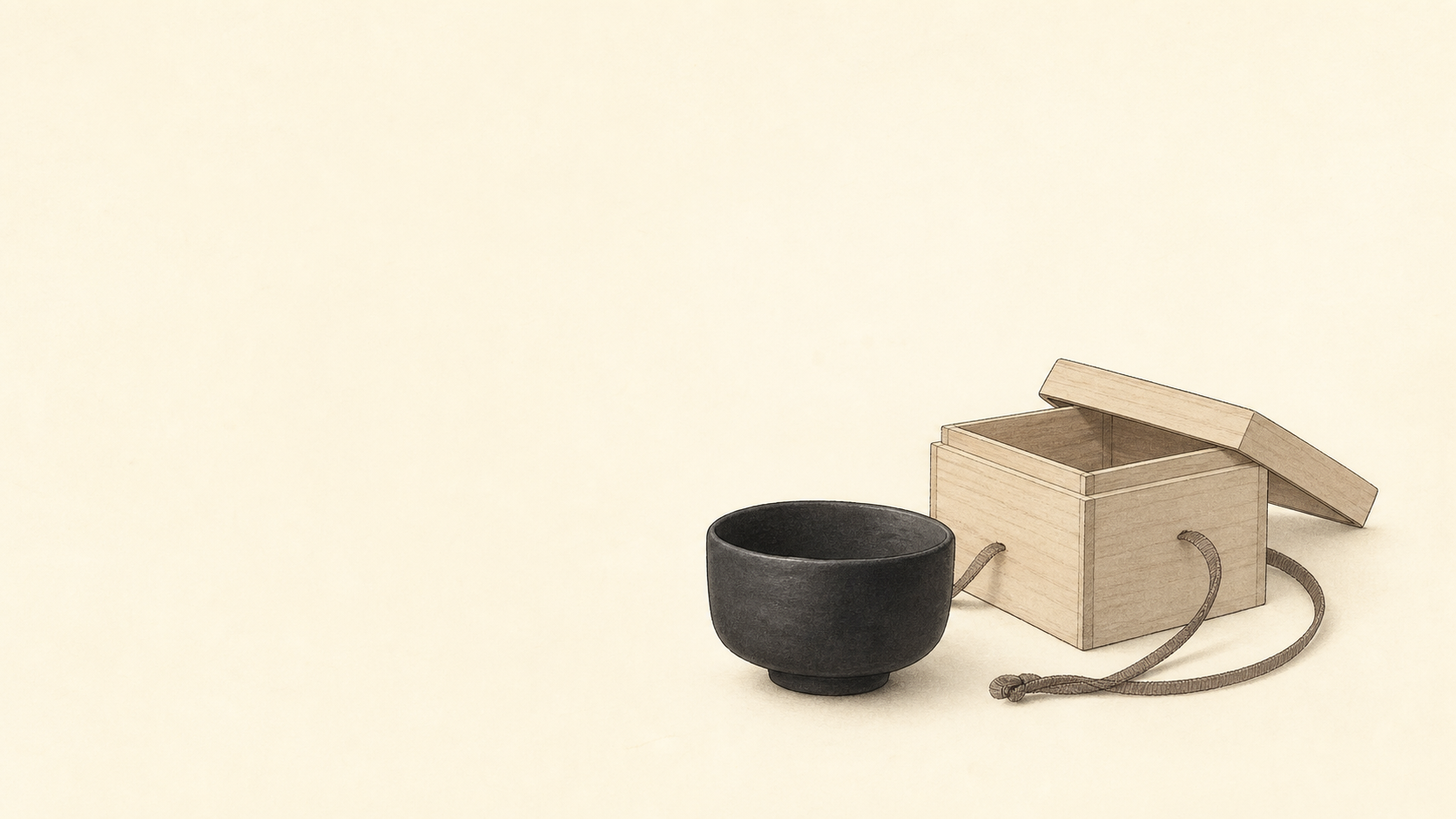
A scroll in a tea room may bear the Zen phrase honrai muichimotsu (本来無一物). It can sound like an invitation to own nothing. The five characters ask a different question: how tightly do we hold on to the meanings we have given our possessions and ourselves?
Where does honrai muichimotsu come from?
Hearing honrai muichimotsu, you might imagine reducing your possessions and living in an empty room.
Owning less does not necessarily make a person free. An empty room can become its own constraint if you insist it must always remain perfectly empty.
The question is what you insist must be true of a thing, or of yourself, beyond how many things you own.
The phrase is traditionally attributed to the Zen monk Huineng. It appears in the Platform Sutra of the Sixth Patriarch, a Zen text. The sixth patriarch is Huineng, who is regarded as the sixth ancestor in the lineage of Chinese Chan, known in Japan as Zen.
The book tells a story in which Shenxiu and Huineng each express a view of the mind in verse. A verse conveying Buddhist teaching is called a gāthā.
Shenxiu compares the mind to a mirror. Polish it every day so dust cannot gather on it. In other words, tend the mind day by day so that confusion and desire do not carry it away.
Huineng asks whether there is any fixed mirror that needs constant polishing in the first place. Mind and self keep changing. Insist that one state is your true self or that you must preserve a certain purity, and that idea becomes another attachment.
Shenxiu polishes the mind, and Huineng questions the mirror
Shenxiu’s verse reminds us to attend to the mind every day. If you become angry, look back at what happened. If you feel pulled by desire, stop for a moment. Tend to the mind as you would wipe dust off a mirror.
Huineng’s verse can be read as taking the question a step further back. Are we treating a pure mind or an unchanging self like a finished object that has always been there? That question still leaves room for practice.
The mind changes with the people and situations it meets. Who you were yesterday is different from who you are today. Settle on an idea of what kind of person you are or what state alone is right, and you may spend your time defending that image.
Care for yourself without clinging to the self you have worked to shape. Read the two verses together and honrai muichimotsu begins to loosen fixed ideas about the self, rather than ask us to give up trying.
There is more to the two verses than an opposition between effort and its rejection. Huineng asks how literally we should take the image of a mind polished like a mirror. Zen practice holds a tension between needing a means to practice and being able to let go of that means.
The phrase asks about more than what we own
The words muichimotsu, literally “not a single thing,” can sound like advice to throw away your belongings. Yet a bowl or a piece of furniture is not a problem because you own it.
You might let the fact of owning an expensive bowl define what you are worth, so losing it would feel like losing a part of yourself. Or you might pride yourself on having very little and fear what will happen if more things come into your home. In either case, there is little freedom in how you relate to the things.
Use something when it is needed, reconsider how you use it as its role changes, and let it go when it no longer serves a purpose. Honrai muichimotsu asks whether that relationship has become too rigid.
Discarding every possession cannot secure this state. Possessions, knowledge, and other people’s regard can all become fixed ideas of who we are. The phrase can be read alongside the care with which tea utensils are passed down. One can own and care for things without letting them govern one’s sense of self.
Caring for an object is different from clinging to it
Chanoyu uses many utensils: bowls, caddies, scoops, kettles, vases, and scrolls. Some have passed through several generations. If honrai muichimotsu called for owning nothing, it would sit uneasily with that practice.
In actual gatherings, a utensil is not always presented the same way. The host chooses according to season and guests and changes what goes with it. A bowl makes a different impression at a summer dawn gathering and at one on a winter night.
Handling utensils with care and passing them on both matter. We narrow our view if we decide a piece has only one value or can be used only one way. A fixed opinion is different from care.
An empty place has room for what comes next
A tea room’s alcove can hold a hanging scroll or flowers. The same things do not stay there all year. They are chosen for the season and guests and put away when the gathering ends.
An empty alcove is doing work even then. When nothing has been set in it, the space is ready for the scroll or flower that will suit the next gathering.
Space on a page or website can work in a similar way. Leave some areas without text or pictures and it becomes easier to see where to look first. A clear area in a tea room can help the next thing placed there come into view.
An object can have more than one role
Read as a question of design, honrai muichimotsu suggests leaving some freedom in the relationships between people and things.
A bowl holds tea. On a shelf it becomes something to look at. Inherited from a relative, it can carry a memory. Its shape may stay the same while its role changes with the person, place, and time. A long-lived utensil has room to take on those changes.
Design considers the bowl’s shape in relation to the hands that hold it, the time in which someone drinks from it, and the place where it is put away. An object can remain useful for a long time if people can find a place for it in a changed way of living.
Try it with one thing you have not used in a while. Why does it sit here? Do I still want to use it? Could it do something else? Move it, give it another use, or pass it to someone who needs it. The thing itself can stay the same while your relationship to it changes.
Conclusion: Rethink how you relate to what you own
Honrai muichimotsu asks you to examine the things you tell yourself have to be a particular way, whether they are objects or ideas about who you are.
Use a bowl with care while being open to another view of it. Keep a memento without deciding your value by the fact that it belongs to you. You can change how you relate to an object without throwing it away.
Perhaps this phrase is a way to loosen the belief that our things and our selves have to be just so.
These five characters appear in Huineng’s verse. To read them as a question about everyday life is to allow that neither things nor the self have a fixed form that will never change.
References
- Aichi Gakuin University, Institute for Zen Studies, “Honrai Muichimotsu”
- Aichi Gakuin University, Institute for Zen Studies, “Getting to Know Zen Phrases: Honrai Muichimotsu”
- National Diet Library, Collaborative Reference Database
- Komazawa University, “A History of Zen: In Search of the Origins of Sōtō Zen,” part 13
 What Is Sadō? How the Japanese Practice of Tea Designs Relationships
 Is the Empty Space in a Tea Room the Same as Negative Space in Graphic Design?
 Ma in Chanoyu: The Intervals in Movement, Space, and Conversation