
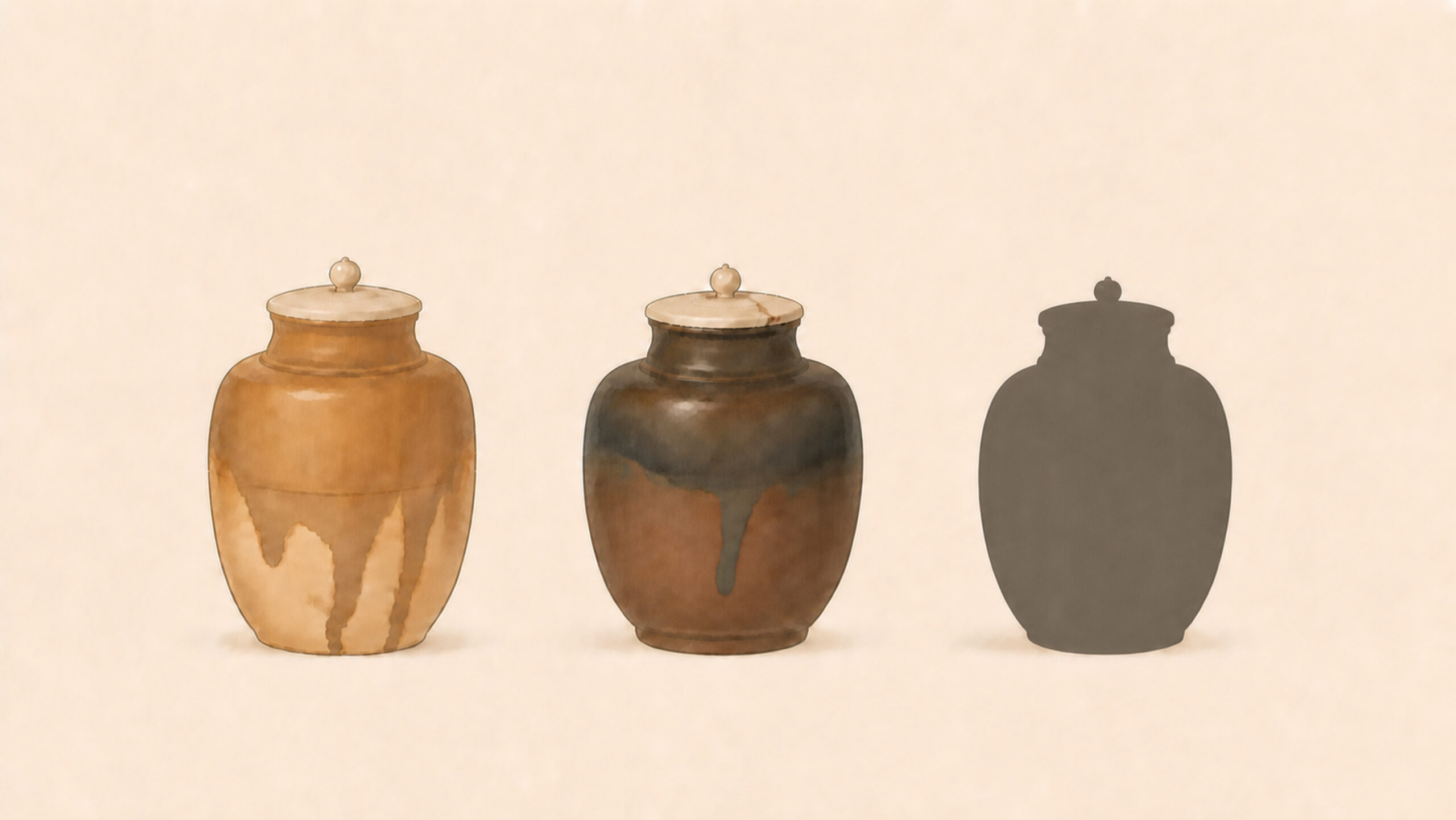
The name Tenka Sankatatsuki means the three celebrated shoulder-form tea caddies of the realm. Hatsuhana, Nitta and Narashiba are three imported Chinese katatsuki caddies that became renowned in the practice of tea from the Muromachi to the Momoyama period.
What Are the Three Celebrated Caddies? The Shoulder Gives Them a Front
Fukuoka City Museum describes the three as outstanding objects celebrated across the realm. A chaire is a small container for matcha used to make thick tea. Many are less than ten centimetres high. Yet a celebrated caddy could be spoken of as worth as much as a castle or a domain. These objects passed among rulers, warlords and merchants in Hakata and Sakai. Why did such small vessels come to have a place in politics? Look in turn at the katatsuki shape, the regard for imports, the objects’ passage between owners and what survives today. The focus here is the three caddies and their provenance. Related articles look at chaire in general, box inscriptions and the fabrics of their pouches.
Katatsuki is a shape in which the shoulder projects out beneath the neck. Compare it with the rounder eggplant and apple forms, nasu and bunrin, and it is easier to see where rim, neck, shoulder and body meet. This gives even a small caddy a strongly articulated upper part.
Kyushu National Museum describes katatsuki as a type of tea caddy with pronounced shoulders, often used at tea gatherings among Chinese imports. Shape is one part of its standing. The flow of its glaze, the clay and the balance of the form matter, along with who owned it, used it in a gathering or named it in a record.
| What to Look At | Hatsuhana | Nitta | Narashiba |
|---|---|---|---|
| Period | Southern Song dynasty | Thirteenth century | Chinese import. Its date is left open here. |
| Form and Glaze | A well-proportioned shoulder form. Light to dark brown glaze. | Close in size to Hatsuhana. Dark glaze on the upper part with runs. | In an old drawing and descriptions, a rounded shoulder, a body fuller towards the bottom, and a deep amber glaze. |
| Provenance | A continuous record of the surviving object | Passed down through damage and repair | Named in negotiations between Hakata merchants and rulers |
| Today | Survives. Important Cultural Property. Tokugawa Memorial Foundation. |
Survives. Important Art Object. The Tokugawa Museum. |
The original cannot currently be located with certainty. Documents of the time and records of tea gatherings survive. |
We can look at the surviving Hatsuhana and Nitta. For Narashiba we have to work with records. The difference matters when bringing the three together.
Hatsuhana: The Strong Shoulder and the Quiet Glaze
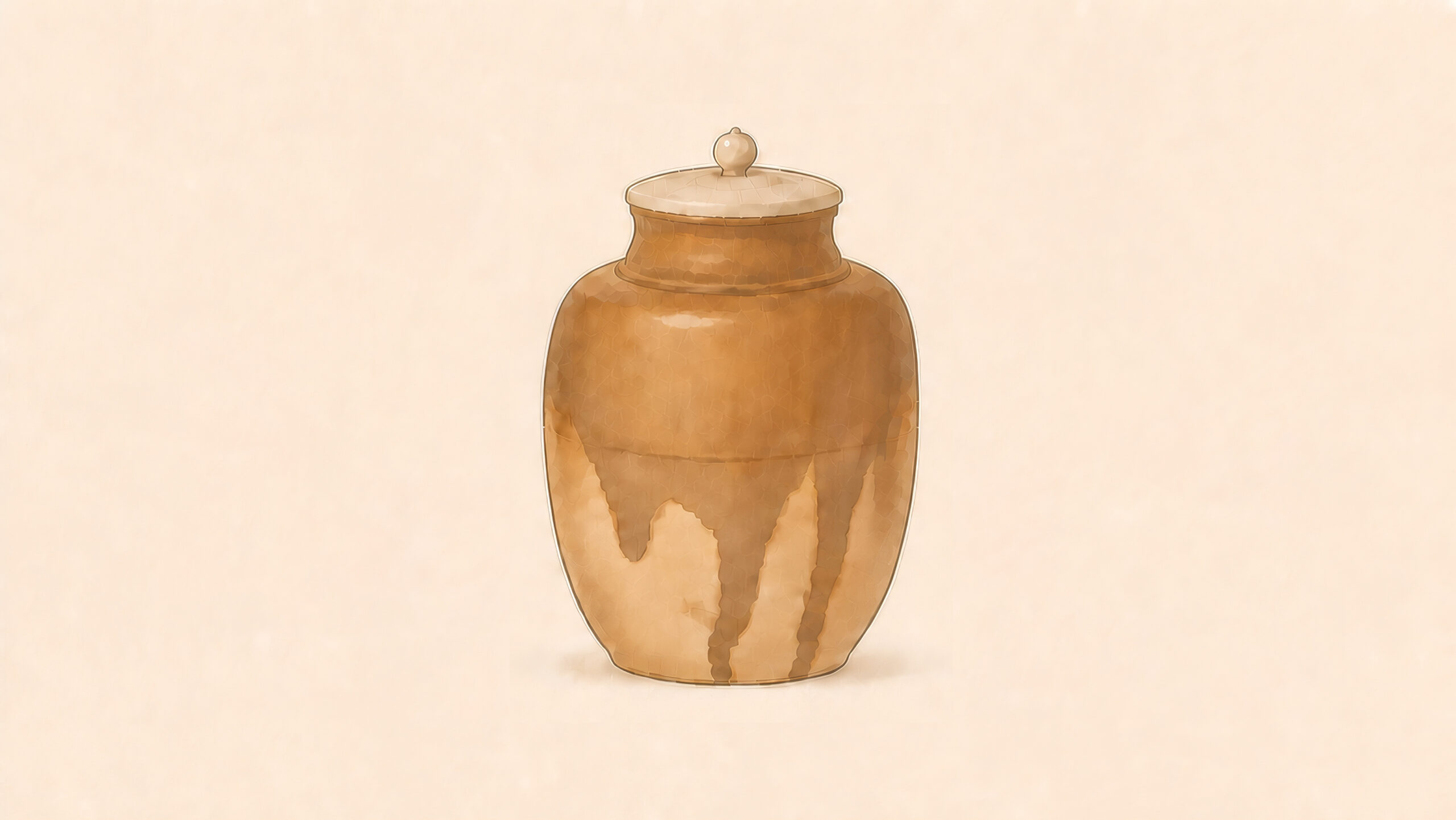
Hatsuhana is designated as a Chinese shoulder-form tea caddy under that name. It is attributed to the Southern Song. It is 8.8 centimetres high and 7.9 centimetres across the body. Designated an Important Cultural Property, it is held by the Tokugawa Memorial Foundation.
Beneath the turned-out rim is a short neck, and the shoulder projects distinctly. The body descends almost straight, narrowing a little at the base. A thin brown glaze goes down to the foot and turns darker where it is thicker. A single incised line circles the body, with another near the neck.
The Agency for Cultural Affairs database describes Hatsuhana as one of the foremost Chinese caddies. It appears in the Shinchō Kōki, Tenshō Meibutsu Ki, Imai Sōkyū’s diary, Tsuda Sōgyū’s tea diary, the Yamanoue Sōji Ki, Sōtan’s diary and other records. Its presence as a celebrated object comes from its form and from the time people spent looking at it, writing about it and telling its story.
To me, Hatsuhana is the most complete of the three as a celebrated object. This is completeness in the sense that its well-proportioned form, surviving vessel, designation, records and current collection all let us point to the same object with confidence. A celebrated vessel needs a form of its own and the continuity that lets people keep calling it by the same name.
Nitta: The Caddy Whose Name and Form Survived Damage
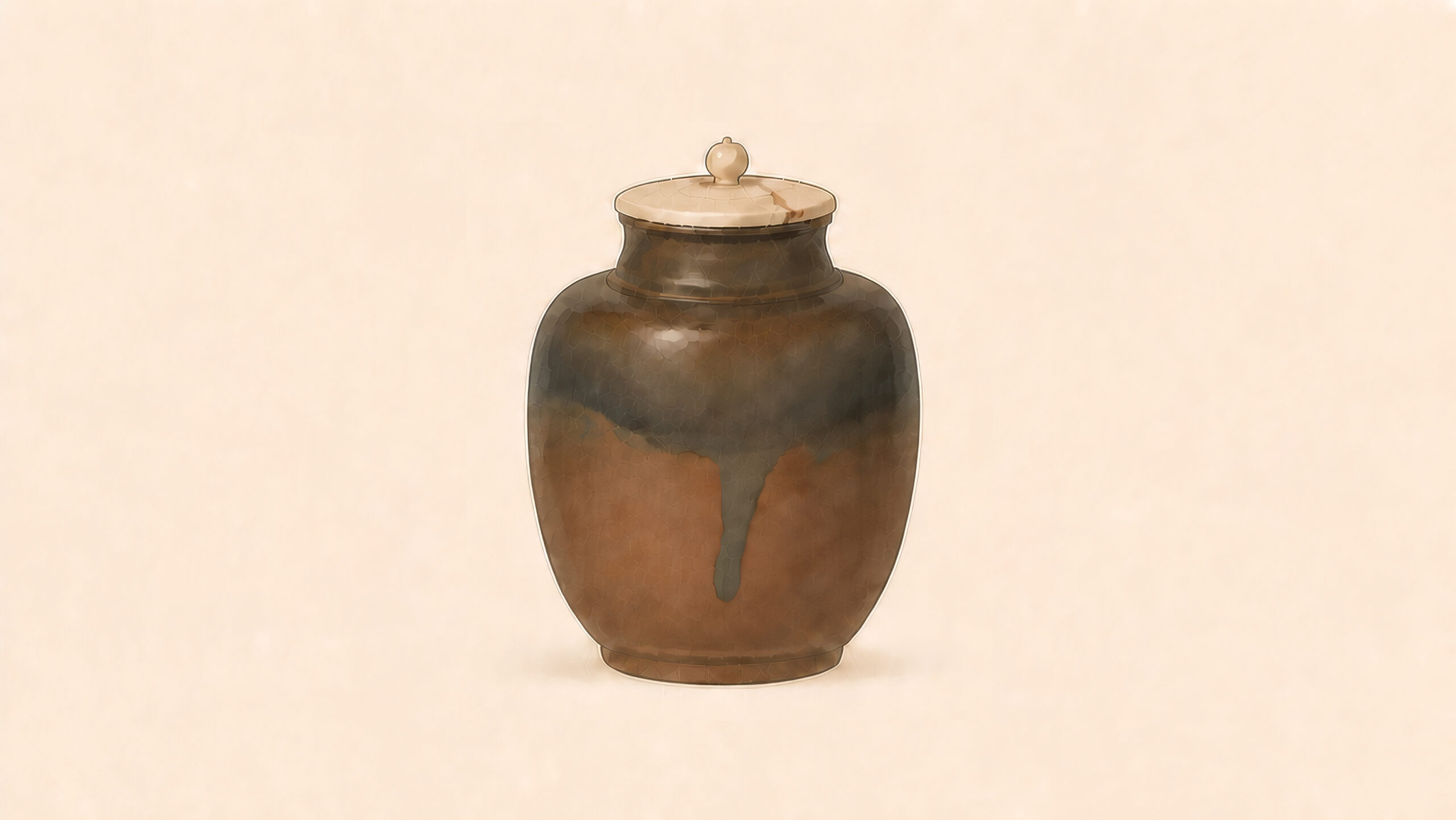
Nitta is a Chinese shoulder-form tea caddy dated to the thirteenth century. It is 8.6 centimetres high and 7.9 centimetres across the body. It is held by The Tokugawa Museum and was recognised as an Important Art Object in 1937.
Cultural Heritage Online notes that Sen no Rikyū praised Nitta as the foremost shoulder-form tea caddy in the realm. Kyushu National Museum also describes it as one of the three celebrated vessels and says Ōtomo Sōrin prized it during the height of his power.
Compared with Hatsuhana, the height and body diameter are extremely close. Yet the two caddies have different profiles. The shape of the shoulder, the swelling of the body and the flow of the glaze give each a different appearance.
Nitta was handed down with an account of damage in the fires of the Summer Siege of Osaka and later repair. Where the owner’s published account leaves the details of the repair open, they remain open here. What we see today bears the time spent preserving the vessel as well as the time of its making.
Nitta suggests that there is more to caring for a cultural object than taking it back to the way it looked when it was made. Damage and repair are also evidence that the caddy passed through history. Treat flawless preservation as the whole of its value and part of that history drops out. Perhaps protecting a celebrated vessel means passing on the identity that survived the changes.
Narashiba: Where the Records Show How Much a Lost Caddy Was Wanted
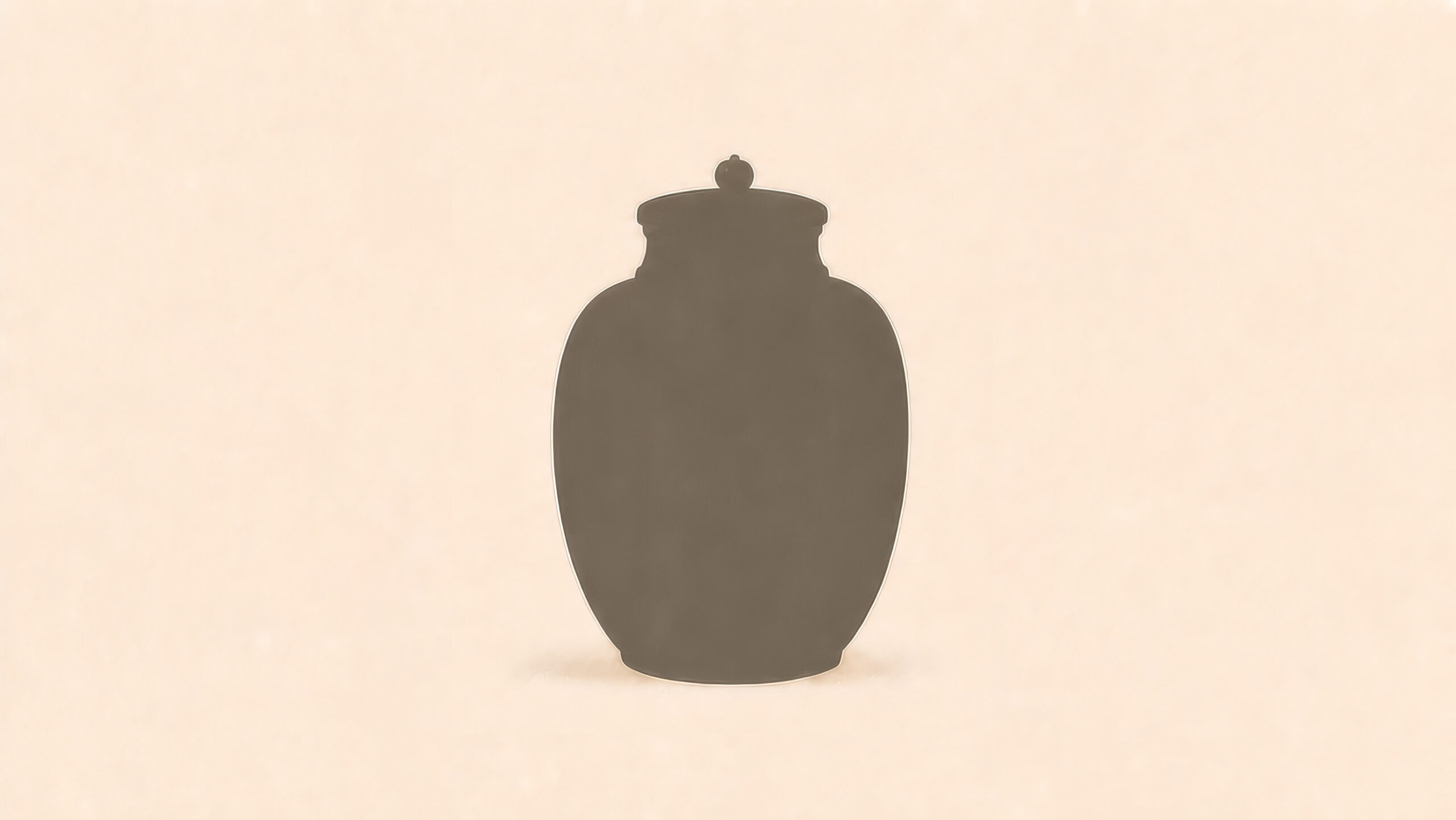
Narashiba is known as a celebrated tea caddy owned by the wealthy Hakata merchant Shimai Sōshitsu.
Fukuoka City Museum preserves a letter in which Ōtomo Sōrin asks Sōshitsu for Narashiba and points to records in Sōtan’s diary. It describes how merchants who built wealth through overseas trade, including Shimai Sōshitsu and Kamiya Sōtan, associated with Oda Nobunaga, Toyotomi Hideyoshi, Sen no Rikyū and Furuta Oribe. The celebrated caddies in the merchants’ possession drew the attention of those around them.
A Hakata merchant without political office held a caddy that ruling figures wanted. Ownership gave a merchant cultural standing in exchanges with people at the centre of power. Price alone cannot explain that value. The desire to see, use or acquire the same vessel strengthened its reputation.
There is no securely identified collection that holds the original Narashiba today. Later reconstructions are distinct from the original. The old drawing in Sōtan’s diary and descriptions from the period let us go only so far. What cannot be confirmed about the glaze or proportions stays open.
Putting Narashiba last helps me see how much of the value of a celebrated object lies beyond the vessel. Its name survives because people wanted it, negotiated for it and wrote about it. Their actions give it a second outline. The absence of the vessel makes the relationships that gave it a name particularly clear.
Without the original Narashiba, one reconstruction cannot settle its outline and glaze. The records, the history of its ownership and later reconstructions are different kinds of information. Keeping track of what is documented and what is inferred helps us see why it mattered beyond its legend.
How Did Three Caddies Become Treasures of the Realm?
First came a long tradition of valuing Chinese imports. Wares that crossed the sea were hard to obtain and brought histories of their own. They helped give a room its standing.
Second, a gathering gave people a place to share an assessment. The vessels were displayed, used for thick tea and examined by guests. Their experiences were written down. One record of a vessel in use could lead to the next assessment.
Third, the passages between owners became a source of value. Each move among lords, rulers, merchants and tea practitioners added another relationship. Who asked for it, who declined to hand it over and where it was shown became part of the story, alongside who owned it.
People, cities, politics and trade came together around small caddies. The collecting habits of powerful people were only one part of that history.
I think a celebrated object earns that designation when relationships around it endure. A similar shape could be made and other things could fetch a high price. What sustains the reputation is the succession of people looking, using, asking, refusing and making a record over generations.
The three caddies show different parts of that succession. Hatsuhana survives as a vessel, a name and a designation. Nitta survives with its damage and repair. Narashiba survives as a name and a set of relationships after the loss of the object. Seeing them together can tell us about three ways a culture keeps objects in view as well as showing three forms worth comparing.
Four Things to Look for in the Three Caddies
- The line from mouth to shoulder: Where do the rim, neck and shoulder change direction, and how far does the shoulder project?
- The overall course of the glaze: Before looking at individual specks, follow the browns from the top down the body.
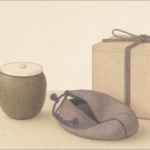
- Accompanying objects: The lid, shifuku pouch, turned storage container and box protect the caddy, give it standing and help document where it has been.
- What survives: Distinguish an extant object, a repaired object and an object known from records. Leave the unknown details open.
The word tenka, “the realm,” grew out of ownership, gift-giving, war and the regard of powerful figures as well as form. The beauty of a vessel and its social value do different work, yet they can reinforce each other. Looking at a celebrated object involves seeing both.
Hatsuhana survives, Nitta survives through repair, and Narashiba was lost to fire according to the account of its loss. What you can see on an object, what lives on in a repair and what you can only infer from records carry different degrees of certainty. That difference is a starting point for looking at the three today.
Closing | A Celebrated Object Is Made of the Vessel and Its Relationships
The three celebrated shoulder-form caddies are Hatsuhana, Nitta and Narashiba.
Hatsuhana and Nitta still exist, with public information about their collections and dimensions. For Narashiba, letters and tea records show its existence and the high regard it enjoyed. It cannot be looked at on the same terms. Bringing the three together means showing how differently they survived.
Why did rulers pay such attention to small ceramic caddies with projecting shoulders? The shape was part of it. So were the value of Chinese imports, the opportunities to be seen at tea, negotiations over ownership and records that accumulated over time.
A celebrated object takes shape through the people who see it, use it, ask for it and pass it down. Three small vessels make that process particularly visible.
The loss of one of the three makes it clearer still. We know Narashiba because people saw it, wanted it and left a record. The eye developed in tea had a way of passing on relationships around an object as well as of looking closely at the object itself.
Principal References
- Agency for Cultural Affairs, Cultural Heritage Database, “Chinese Shoulder-Form Tea Caddy Named Hatsuhana”
- Cultural Heritage Online, “Nitta”
- Fukuoka City Museum, “Chanoyu in Hakata”
- Fukuoka City Museum, “Nineteenth Exhibition of New Acquisitions”
- Kyushu National Museum, “Sengoku Daimyō: Warlords of Kyushu and the Seas of Asia”
 Why Does a Small Chaire Carry So Much History? Tea Caddies, Pouches, and Thick Tea