
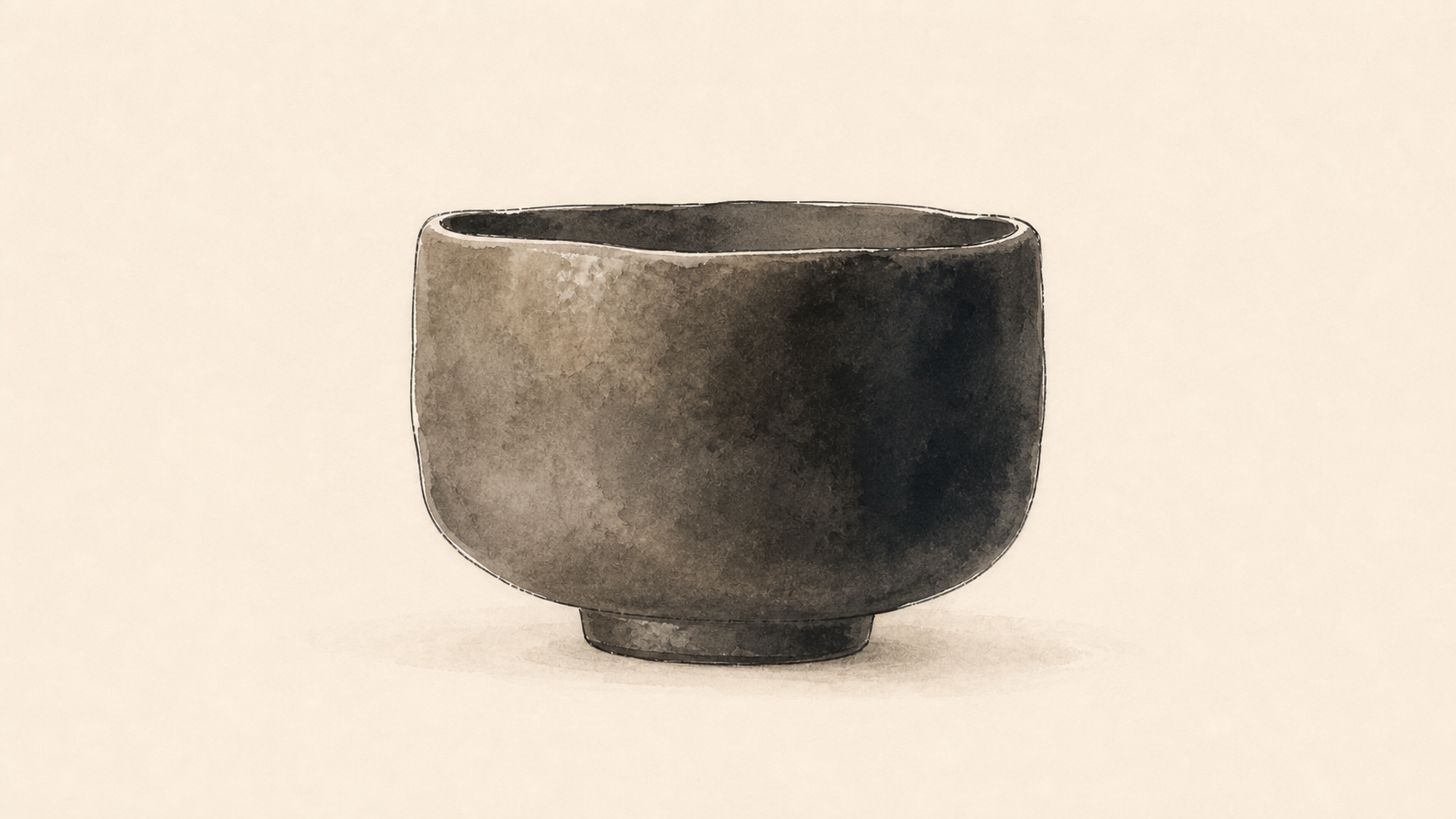
A single black bowl. Encounter a Raku tea bowl for the first time and it may look remarkably plain. There is no elaborate painting, no porcelain-like thinness or evenness. The rim rises and falls slightly, and the body bears the contours left by the hand that shaped it.
What does “Raku tea bowl” cover?
For some 450 years, Raku bowls have been passed down as one of the forms that embody the Way of Tea. Why does so quiet a vessel, with so little apparent polish, draw people in? It helps to take it out of the display case in your mind. Someone whisks tea, offers the bowl, and someone else takes it in both hands and drinks. A Raku bowl does its work in that sequence.
“Raku tea bowl” can be used in a narrow or a broad sense.
In the narrower sense, it refers chiefly to bowls made by generations of the Raku family in Kyoto, beginning with Chōjirō in the Momoyama period. The techniques and styles later spread beyond the family. Today, “raku ware” can also refer more broadly to vessels made using methods such as hand shaping and low-temperature firing.
These usages differ in maker, kiln, technique, and historical context. Here the focus is on the work of Chōjirō and later generations of the Raku family.
A bowl at work in tea
At a gathering, the host chooses a bowl, prepares tea in it, and hands it to the guest. The guest picks it up, drinks, and examines it at close range. Kyoto National Museum describes the bowl as a utensil that can be held and appreciated and that connects the host and guest.
The forms of Raku bowls go with this closeness.
The palms sense the bowl’s volume. The fingertips meet the body, the lips meet the rim, and the interior holds the matcha. The foot supports the bowl when it is set down on the tatami. Looking and using come together in one vessel.
“Black and irregular” leaves much of a Raku bowl unexplained. Consider what the maker kept and what they trimmed away in a form that must hold tea for whisking, fit into the hands, and meet the lips.
When you cup the bowl in both hands, you can feel the curve and trimmed planes of the body. The rises and dips in the rim guide you toward a place to drink. These visible features are closely connected to holding, turning, and bringing the bowl to the mouth.
A form made by hand
Raku bowls are known for being shaped by hand.
Where a rotating wheel guides the clay into a circle, hand shaping starts from a lump of clay. The maker forms the inside and outside and trims them with a tool as the clay dries. Small differences arise in the height of the rim, the fullness of the body, and the line from the lower body to the foot.
Records in Japan’s cultural heritage database describe black Raku bowls by Chōjirō made with hand shaping, trimming, a red clay body, and black Raku glaze. Glazes, trimming, and firing have changed considerably with makers and periods.
A design perspective: Leaving the circle brings the hand into view
A wheel gives a bowl the regular rhythm of a circle. A Raku bowl can move a little away from that circle and find another rhythm.
A place where the rim lifts slightly. A swell that comes toward the palm. A point where the bowl’s weight settles toward the foot. With no perfect symmetry, the eye does more than make a single circuit. It imagines the bowl in the hand.
The departures from a circle let the shape come closer to the hands and mouth of the person whisking, holding, and drinking from the bowl.
A two-glazed lion that predates the bowls
One important surviving work by Chōjirō is the Lion with Two-Color Glazes. The Raku Museum and the cultural heritage database describe a carved inscription on its belly dating it to the spring of the second year of Tenshō, 1574, and identifying Chōjirō as its maker. The lion, made with green and transparent glazes, is an Important Cultural Property.
It makes a very different impression from the later black Raku bowls. The Raku Museum traces the technical roots of Raku ware to Ming-dynasty Chinese three-color glazes and places Chōjirō’s kiln in that line. Raku family tradition credits Ameya, a man of Chinese origin identified as Chōjirō’s father, with transmitting the technique of three-color ceramics.
The span from a colorful clay lion to red and black bowls with almost no decoration shows the range of Chōjirō’s work.
The lion and the bowls can be read together as works shaped by hand, with character given to a volume of clay. Even with different amounts of decoration, the way the modeled form continues from the front around the sides offers a clue to looking at the later bowls.
Chōjirō and Rikyū: How a new bowl came into being
The Raku Museum places the beginnings of Raku tea bowls around 1579, the seventh year of Tenshō, a few years after the lion. Chōjirō’s work moved from colorful ceramic sculpture toward bowls mainly in red and black.
Sen no Rikyū was closely involved in that change. His ideas about tea met Chōjirō’s experience with clay, glaze, and fire in a form that was new at the time. A Raku bowl is particularly interesting as the meeting of a tea practitioner’s and a maker’s work.
From ima-yaki to Raku tea bowls
Raku bowls look like a symbol of tradition today. They were a new kind of vessel when they appeared.
The name “Raku ware” was still unknown in Chōjirō and Rikyū’s time. The earliest bowls were called ima-yaki, “wares of now.” There is a sense of how contemporary an experiment they were in a name now applied to works we see as classics.
They later came to be called Juraku-yaki bowls, and eventually Raku ware or Raku tea bowls. A Raku family account traces the name to a seal bearing the character for Raku bestowed by Toyotomi Hideyoshi.
Black and red, and the variations within them
Black and red Raku are the best-known kinds.
Black Raku uses a black glaze. Red Raku brings out the redness of Juraku clay. The cultural heritage database records examples by Chōjirō with a low-fired black Raku glaze on a red clay body. Recipes and the effects of firing vary with the maker and the period.
Even black Raku can have glossy passages, dull areas, and a brown cast in places. In red Raku, too, the clay, glaze, and fire produce variations. Start with what you can see in the individual bowl.
Conclusion: Seeing what was new before it became a tradition
A hand-shaped black or red bowl is a starting definition for a Raku bowl. Its place in tea gives that description more substance.
It passes from hand to hand during a gathering. Chōjirō’s techniques and Rikyū’s tea came together in it. An experiment originally called “wares of now” became a tradition for later generations.
Start with the whole bowl. Follow the rim, the swell of the body, the line toward the foot, and the way the glaze catches the light. Looking back at the object after defining it is a way to begin seeing Raku.
Look in turn at how much of the bowl fits in the palms, the small changes along the rim, and the surfaces left by trimming and glaze. They reveal a shape chosen to work close to the body.