
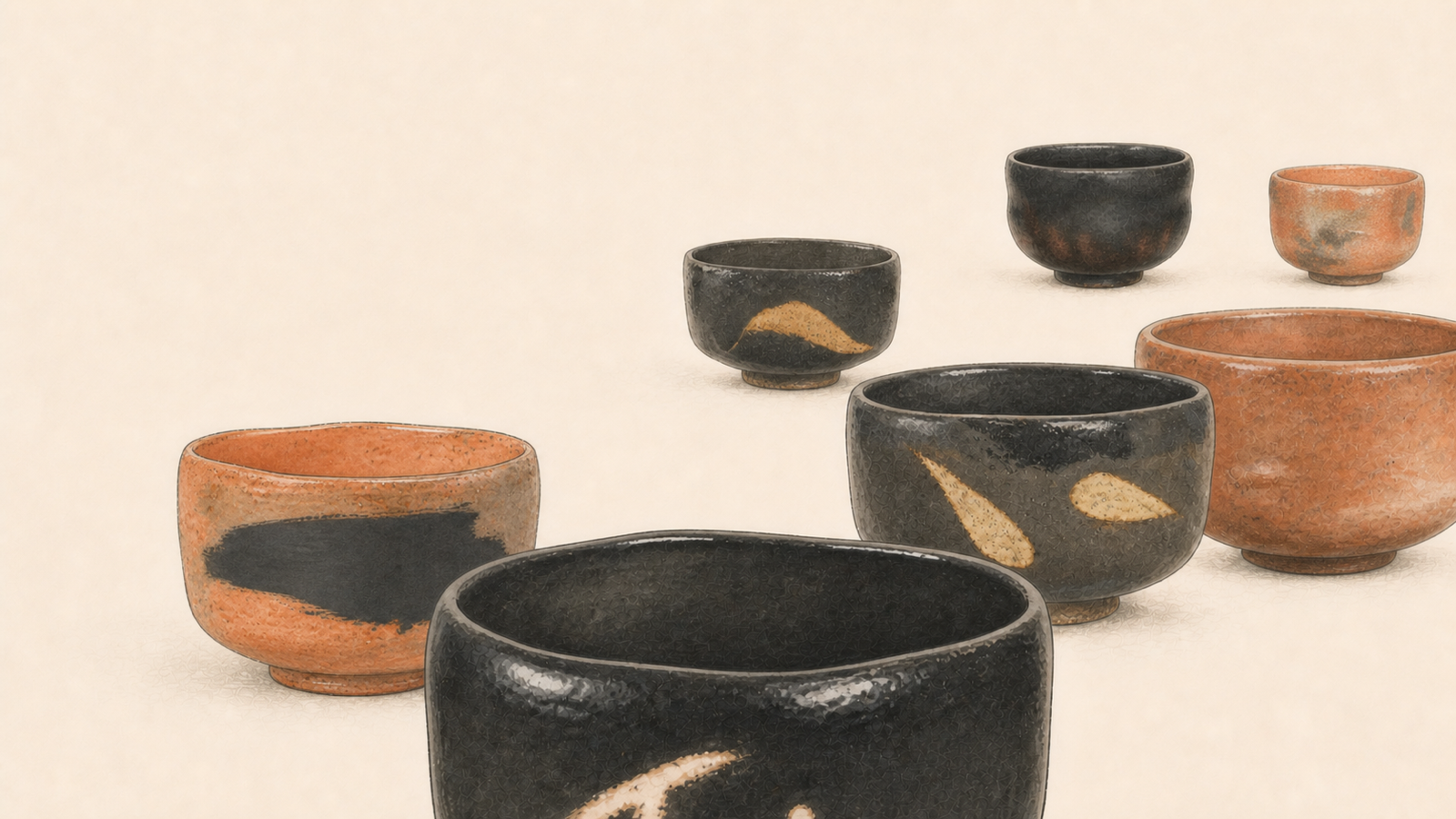
A yellow glaze breaks up the black on one bowl. On another, black pools on the body of a red Raku bowl. In the seven bowls associated with Dōnyū III, known as Nonkō, form and glaze do different work each time. How did Dōnyū change their relationship while continuing the practice that began with Chōjirō?
What are the Nonkō Seven?
The Nonkō Seven are a group of bowls handed down as representative works of Dōnyū, the third-generation Raku potter. Shishi, Masu, Chidori, and Inazuma are black Raku. Hōrin, Wakayama, and Nue are red. Dōnyū was born in 1599, the eldest son of Jōkei II, and died in 1656. Nonkō was his familiar name.
The name might suggest seven versions of the same design. The bowls differ in shape and in the handling of glaze. Masu is nearly square beside rounder bowls. Some are covered in black glaze, while others give yellow glaze or exposed patches a place of their own. The three red bowls have different cuts and layered glazes across the red clay.
The sources consulted do not establish who first grouped the seven under their present name or when. They were recorded as a group in ceramic literature by the Taishō period or earlier, and the name is used by modern museums and exhibitions. The grouping lets us compare different forms and glaze effects without treating them as a series planned by Dōnyū himself.
What did Dōnyū III change in Raku tea bowls?
Raku bowls are raised by hand and trimmed as they take shape. In Chōjirō’s black Raku, restraint in the outline and a black surface that takes in light gave the bowl much of its character. Dōnyū kept the basic practices of hand shaping, trimming, glazing, and firing.
Within that process he made thinner walls, cut planes into the body and the lower curve with a tool, and layered white, yellow, or vermilion with black glaze. He left some areas without black glaze or let a thick layer run down from the rim. The slopes, hollows, and edges between colors form through the making and glazing of the bowl.
Thin walls made another difference. The collections and Omotesenke expressly describe Chidori, Inazuma, and Nue as thin and light. Small changes in the curves of the rim, body, and lower section read directly on a thin wall. A bowl can look full in the hand and feel lighter than expected when lifted.
Another clue to Dōnyū’s place in the lineage comes from Hon’ami Kōetsu. The Raku family records that Jōkei and Dōnyū worked with Kōetsu and fired many of the black Raku bowls he shaped. The bowls do not establish direct imitation. Working close to Kōetsu’s bold forms and their firing gave Dōnyū a context in which the approach inherited from Chōjirō could take more than one form.
Forms that guide glaze: Thin walls, tool cuts, and curtain glaze
The slope or hollow of a bowl gives the glaze somewhere to flow. A vertical cut can give a round body a shallow ridge. A full lower curve with a narrower wall above can let glaze stretch thin over the bulge and collect at the transition or near the base. The angle of the surface under a curtain glaze affects how far and in which direction it runs from the rim.
Turn the bowl and the effect changes. A prominent glaze passage can give way to almost solid black or to exposed clay near the foot. On Masu, corners mark the transitions from one face to the next. On the rounded Inazuma, vermilion and black carry across a continuous curve. A glaze effect that reads as a pattern in a photograph comes and goes along with the outline as the bowl turns in the hand.
In black Raku, yellow or vermilion glaze and deliberately uncovered areas can interrupt a glossy black surface. In red Raku, black, blue tones, and pale mottling can lie over the red from clay and clear glaze. Those variations appear in different places across the seven.
Four black Raku bowls: Shishi, Masu, Chidori, and Inazuma
Shishi: A streak of white across black
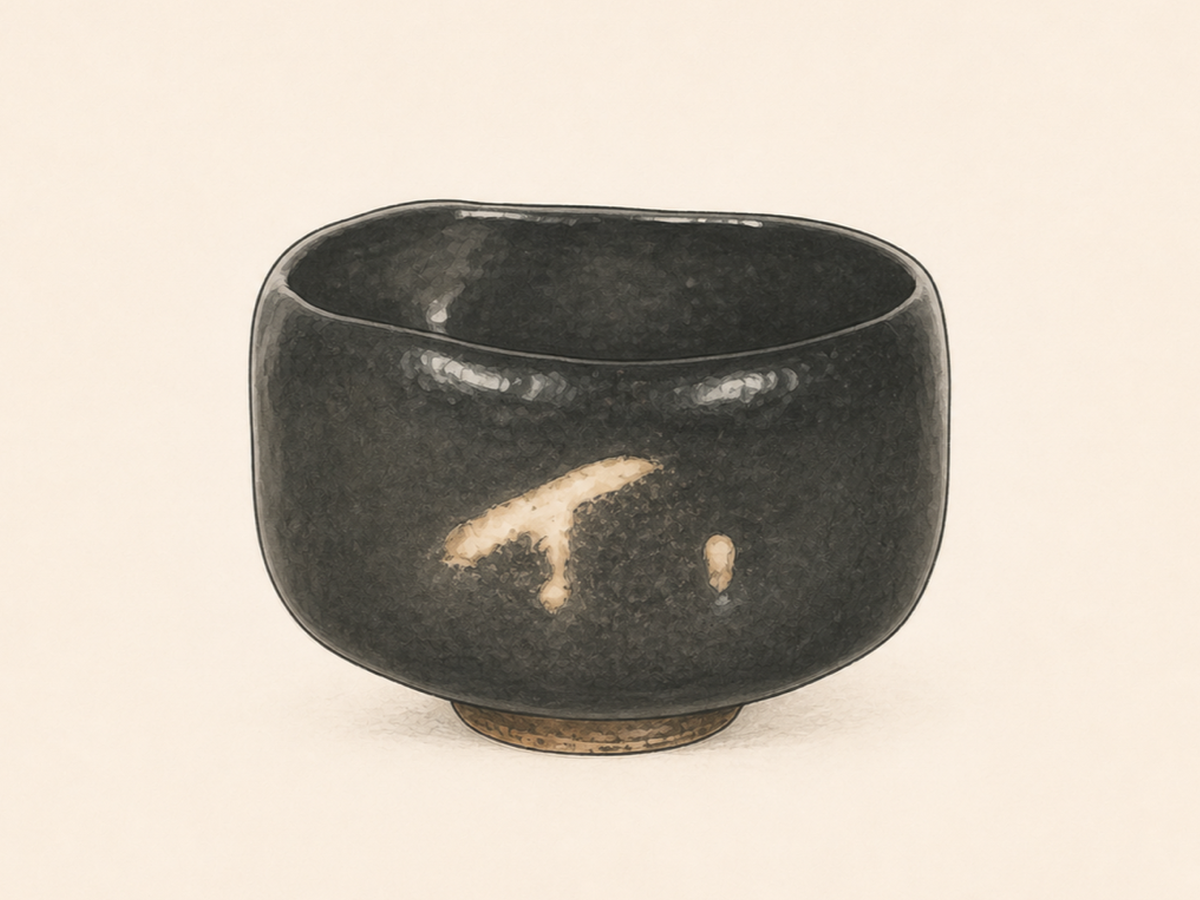
A streak of pale glaze crosses the glossy black of Shishi. Modern records of celebrated bowls and a specialist dictionary based on them describe it as a representative case of Dōnyū’s use of white glaze. It appeared in the Raku Museum’s 2016 exhibition on Dōnyū III and has an inscription by Joshinsai, the seventh head of Omotesenke.
The available photographs and descriptions show a streak of pale glaze entering the glossy black. Its boundary is the principal feature. The public records do not establish every detail of the rim, body, and foot. The white can suggest the bowl’s name, Shishi (“Lion Dog”), without depicting the animal in detail. Set it beside Chidori’s yellow gaps and compare the shape and placement of the light areas.
Masu: Corners interrupt the flow
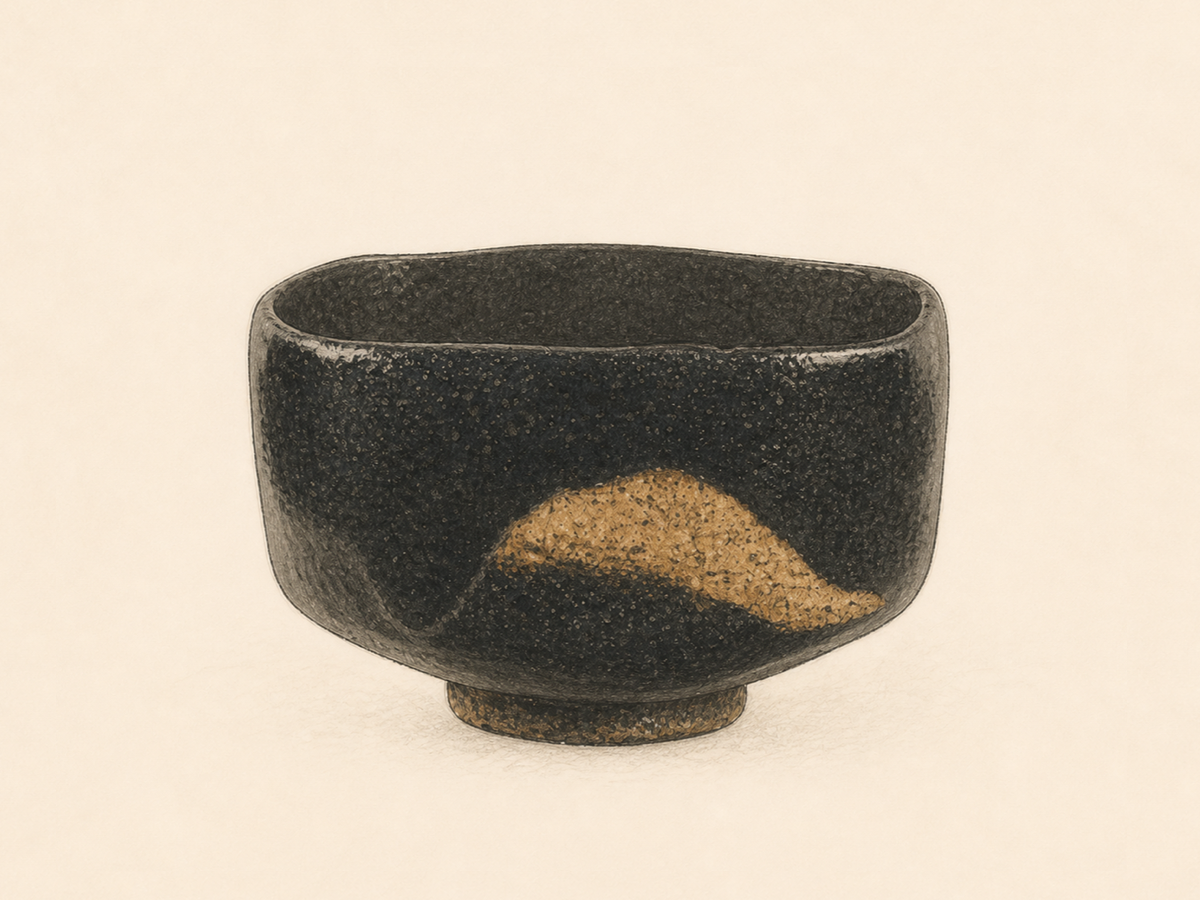
As its name suggests, Masu resembles a square measuring box in plan. The bowl has an inscription by Kakukakusai, the sixth head of Omotesenke, and appeared in the Raku Museum’s 2016 Dōnyū exhibition.
Corners break the continuous course of a round rim and body. As a surface turns at a corner, the direction of the glaze flow can also change. The Suntory Museum of Art compares Dōnyū’s other square bowl Yamazato with Masu and describes its broad body, interior trimmed wide, and thick curtain glaze from the rim. The details belong to Yamazato, but the comparison shows that Dōnyū used curtain glaze on square bodies.
With a round bowl the hand and eye make a continuous circuit. On Masu, each corner changes the rim line and the direction of the face. Glossy black reflects light differently from the front, at the corner, and on the next face. The four-sided form changes how the black reads.
Chidori: Yellow openings on a thin-walled bowl
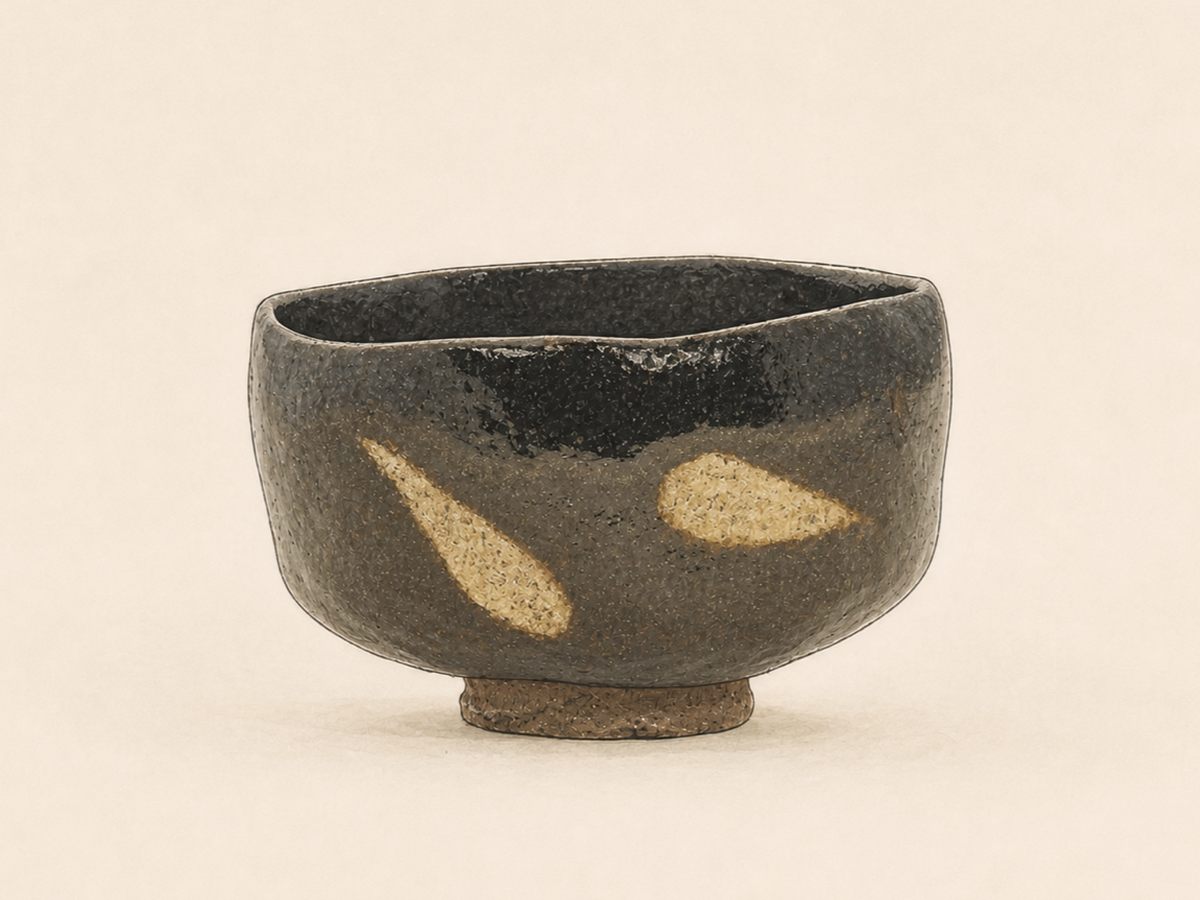
Chidori is in the Fujita Museum. In the Edo period it belonged to the Osaka money-changing house Chigusaya, and in the Meiji period to Hirase Rokō. Fujita Denzaburō bought it at the Hirase family sale in 1906. It is said to have been named by Kakukakusai, the sixth head of Omotesenke.
The museum describes a thin, light bowl with a spacious-looking interior and a glossy black glaze that hangs down from the rim. Two places on the body were left without black and covered in yellow. The triangular patches have been compared to plover tracks, hence Chidori, “plover.” Another account takes the name from the bowl’s gently triangular plan.
Thin walls, curtain glaze, and the yellow gaps work together. A thick black glaze comes down from the thin rim and meets the yellow areas. Turn the bowl and the yellow moves out of the frontal view, leaving a broad field of glossy black again.
The foot bears a Raku seal in which part of the character uses the form of the character meaning “self.” Shishi lets white enter the black. On Chidori, places left without black take yellow glaze. What is left unglazed in black helps shape the final surface.
Inazuma: Black and vermilion across a curved surface
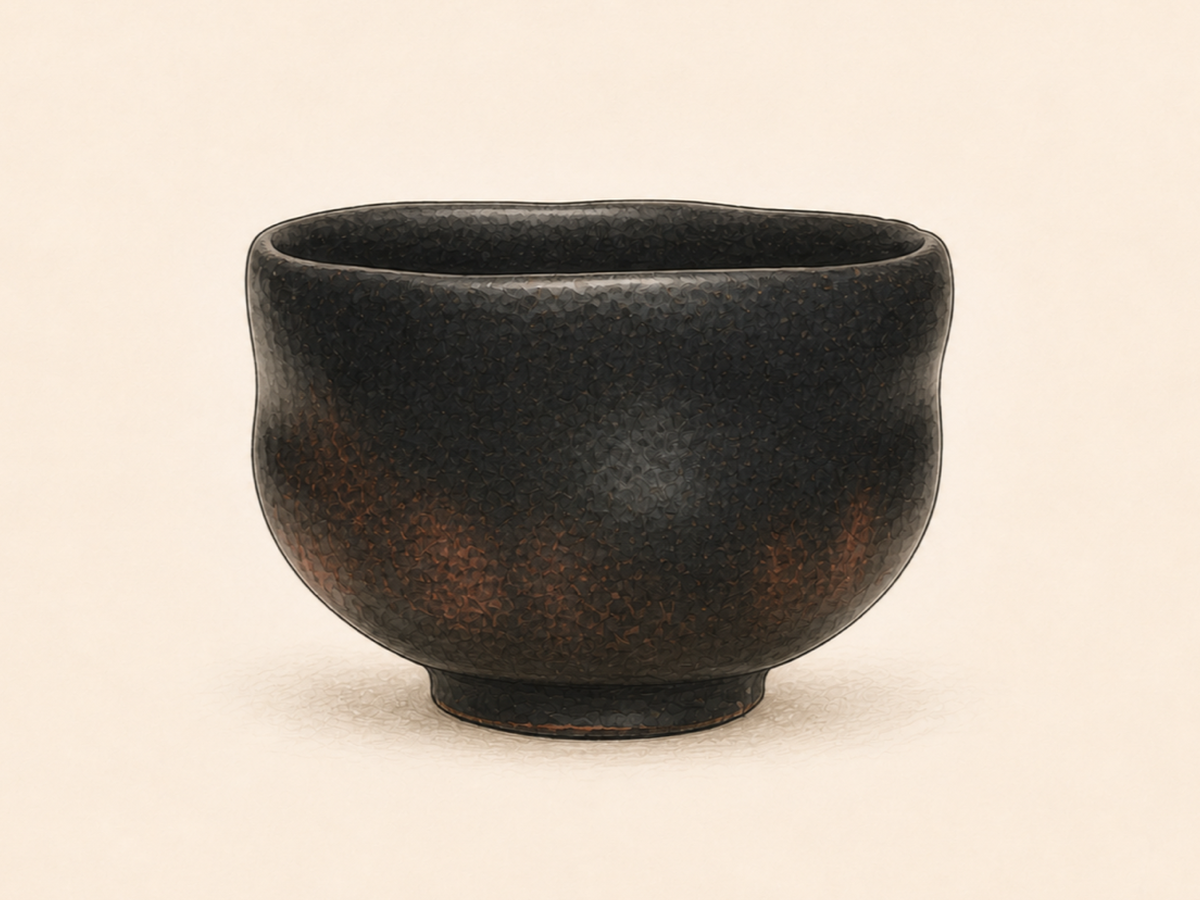
Inazuma has been handed down at Omotesenke. Its Kitayama Kaikan account records a custom dating from around the middle Edo period of using it only at gatherings for the accession of a new head of the school. Its use after it was made is unusually well documented for one of the seven.
The thin body rounds outward from the foot into a full lower curve. It draws inward slightly at the middle, then opens a little toward a rim that turns in. The curve changes angle on the way up rather than making a simple hemisphere.
Thick black glaze flows over that form and vermilion mingles with the glossy black. The effect was compared to a flash of lightning, inazuma. The colors meet along a boundary that shifts with the curvature and firing. On Chidori, the light area comes from a gap in the black. On Inazuma, another glaze runs into it.
Where the full lower curve narrows into the body, the angle of the surface changes under the falling glaze. Vermilion meets the black in varying strengths. The shape can be read as setting out a path for that variation rather than tracing lightning with a painted line.
Three red Raku bowls: Hōrin, Wakayama, and Nue
Hōrin: Vertical and horizontal cuts divide the red body
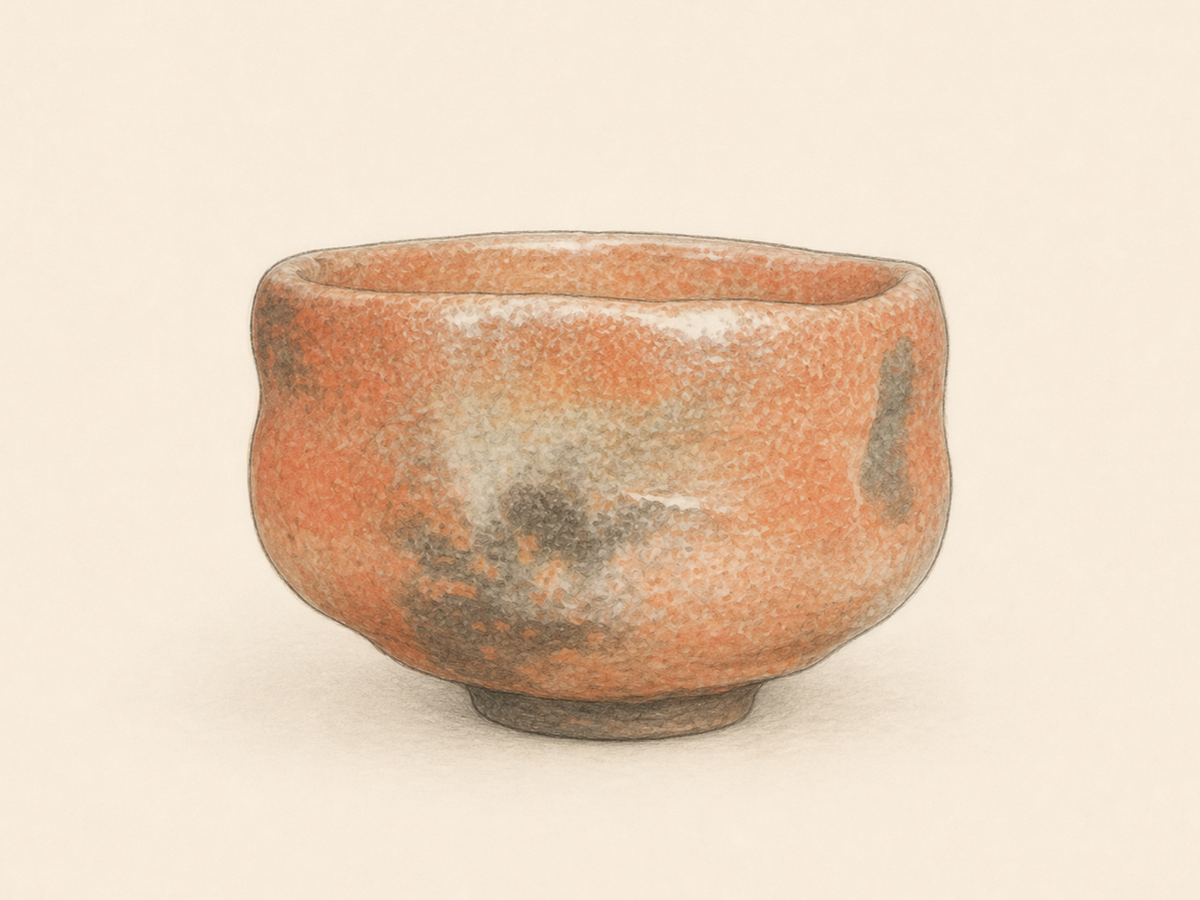
Hōrin has a ripe-persimmon-colored glaze with bluish firing effects and white mottling. Its name is associated with Hōrin Jōshō, a monk at Kinkakuji who owned it. It passed from him to the Kōnoike family and Matsudaira Fumai. Inscriptions by Kōshin Sōsa and Joshinsai Sōsa have also been passed down with it.
A specialist dictionary drawing on Taishō Meikikan and other sources describes a slightly inward rim with a mountain-path profile, a body that narrows, and a full lower curve. Vertical and horizontal cuts mark the body and base. Clay is visible on the foot, with a Raku seal inside. Over the red body is a ripe-persimmon glaze, with localized blue firing effects and white mottling.
The vertical and horizontal cuts cross the body in different directions. The glaze varies in thickness over that relief. Wakayama also has strong cuts, but Hōrin joins an undulating rim, narrowed body, and full lower curve. The cut surfaces give the glaze several places to vary as the bowl turns.
Wakayama: Strong cuts within a composed outline
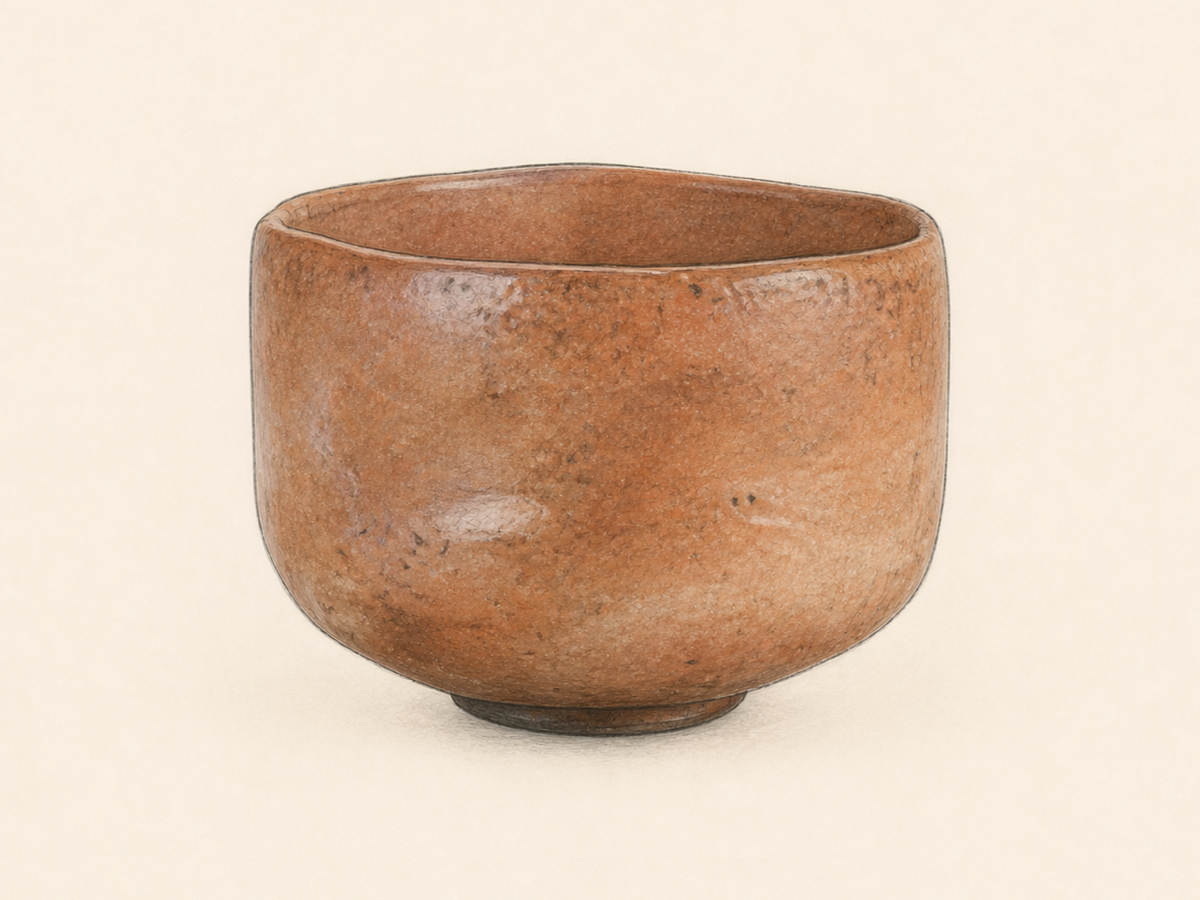
The Nomura Museum holds Wakayama. It passed through the Suganuma family in Wakayama, and Joshinsai, the seventh head of Omotesenke, is said to have recognized the bowl and named it for the place. The museum records that it went to the Kōnoike family and was acquired by Nomura Tokuan at their sale in 1940.
Strong tool marks remain, but the outline is composed. Near the foot is a triangular area where glaze was omitted. Dōnyū’s Raku seal appears inside the small foot. Fine planes created by the cuts take light differently depending on the angle of the bowl.
The exposed clay lies down near the foot, while Chidori brings its yellow gaps to the front of the body. Wakayama’s small foot and nearby triangle of exposed clay contrast with the wider body above. Using the same technique in another position gives a different part of the form emphasis.
Nue: A passage of black on a red bowl
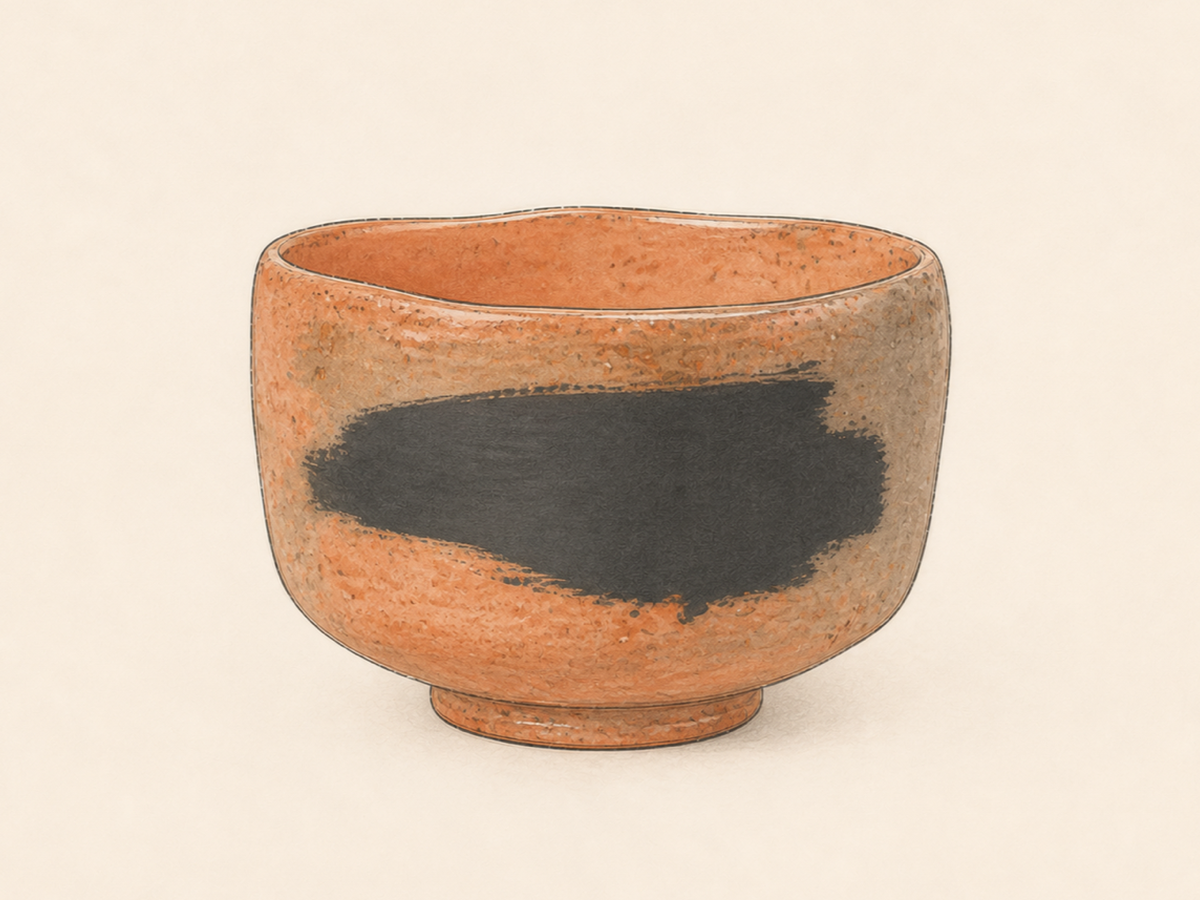
Nue is an Important Cultural Property in the Mitsui Memorial Museum. The seventeenth-century bowl is 8.9 cm high, 12.1 cm across the mouth, and 5.8 cm across the foot. Omotesenke Kitayama Kaikan describes it as particularly large among Dōnyū’s works, with a commanding outline and thin walls throughout.
A patch of irregular black glaze lies on the red body. The name comes from the tale of Minamoto no Yorimasa defeating the creature nue in The Tale of the Heike. The black glaze is said to have suggested the dark cloud in which the creature appears. A local glaze effect on the red body came to recall the story.
Compare Nue with Inazuma. On Inazuma, black covers the bowl and vermilion runs through it. On Nue, red forms a broad ground and the black gathers in one area. Its large thin body leaves ample red around the black, and the patch can pass out of sight when the bowl turns. The area and position give black a role either as the ground or as a point of focus.
Nue’s ownership is connected to the Edo-period Mitsui merchant family. It has inscriptions by Kakukakusai Sōsa and Hisada Sōetsu. The broad body leaves red visible around the dark glaze.
Comparing the seven: What changes in form and glaze?
The four black bowls break up black in different ways. Shishi brings white into contact with it, Chidori leaves yellow openings, and Inazuma mixes in vermilion. Masu divides reflected light with the corners and faces of its square form. A change in glaze, a gap in it, or a change in the shape can each alter the black.
The three red bowls bring the relation between red clay and cut surfaces forward. Hōrin uses vertical and horizontal cuts, a narrowed body, and a full lower curve to vary the glaze. Wakayama fits strong cuts into a composed outline and draws attention to the base with an exposed area beside the foot. Nue sets black on part of a broad, thin red bowl. Red has a different role in each.
The bowls show how changes in the walls affect where glaze goes thin, gathers, and meets another color. Thin walls show more of the changes in contour. Cuts produce different slopes on a curved body, and curtain glaze runs down those surfaces. Where a glaze was left off, the edge of the remaining glaze becomes a line.
Shaping, trimming, and glazing determine the wall thickness, angle of the surfaces, and the places where glaze is applied. The kiln determines how far it runs, how the colors meet, and what other firing effects appear within those conditions.
Conclusion: Shapes that guide the flow of glaze
Hand shaping, trimming, glazing, and firing come from the Raku family practice. Dōnyū varied the thin walls, cut planes, layers of glaze, and uncovered areas from one bowl to the next. Shape affects where glaze can move, while firing affects the way the colors finally mingle.
Where the black ends, the red remains, or a cut raises a ridge, the glaze looks different. On Inazuma, vermilion runs over a full lower curve and a narrowing body. On Nue, black covers part of a large, thin red bowl and leaves a broad red ground around it.
Set the seven bowls side by side and differences in form and glazing change where a glaze flows, pools, or meets another color. The shape gives those changes a place to appear. The fire gives the surface its final appearance.
Main References
- Raku Ware and Raku Kichizaemon, “Raku Successive Generations: Dōnyū III”
- Raku Museum, “Dōnyū III: Collection”
- Raku Museum, Exhibition Checklist for Dōnyū III, Known as Nonkō
- Fujita Museum, “A Bowl by Nonkō, the Raku Master”
- Omotesenke Kitayama Kaikan, “Black Raku Tea Bowl Named Inazuma”
- Mitsui Memorial Museum, “Red Raku Tea Bowl Named Nue”
- Omotesenke Kitayama Kaikan, “Red Raku Tea Bowl Named Nue”
- Nomura Museum, “Red Raku Tea Bowl Named Wakayama”
- Suntory Museum of Art, “Square Black Raku Tea Bowl Named Yamazato”
- National Diet Library Digital Collections, Nihon Tōki Zensho (Compendium of Japanese Ceramics), ed. Ringorō Ōnishi
- Raku Jikinyū and Raku Kichizaemon, The Raku Generations, Revised Edition, Tankōsha, 2023
- Hōan Takahashi, Taishō Meikikan
 How a Black Tea Bowl Became a Quiet Form of Beauty: Chōjirō and Black Raku
 What to Look for in a Raku Tea Bowl: Rims, Feet, and Bowls Associated with Chōjirō