
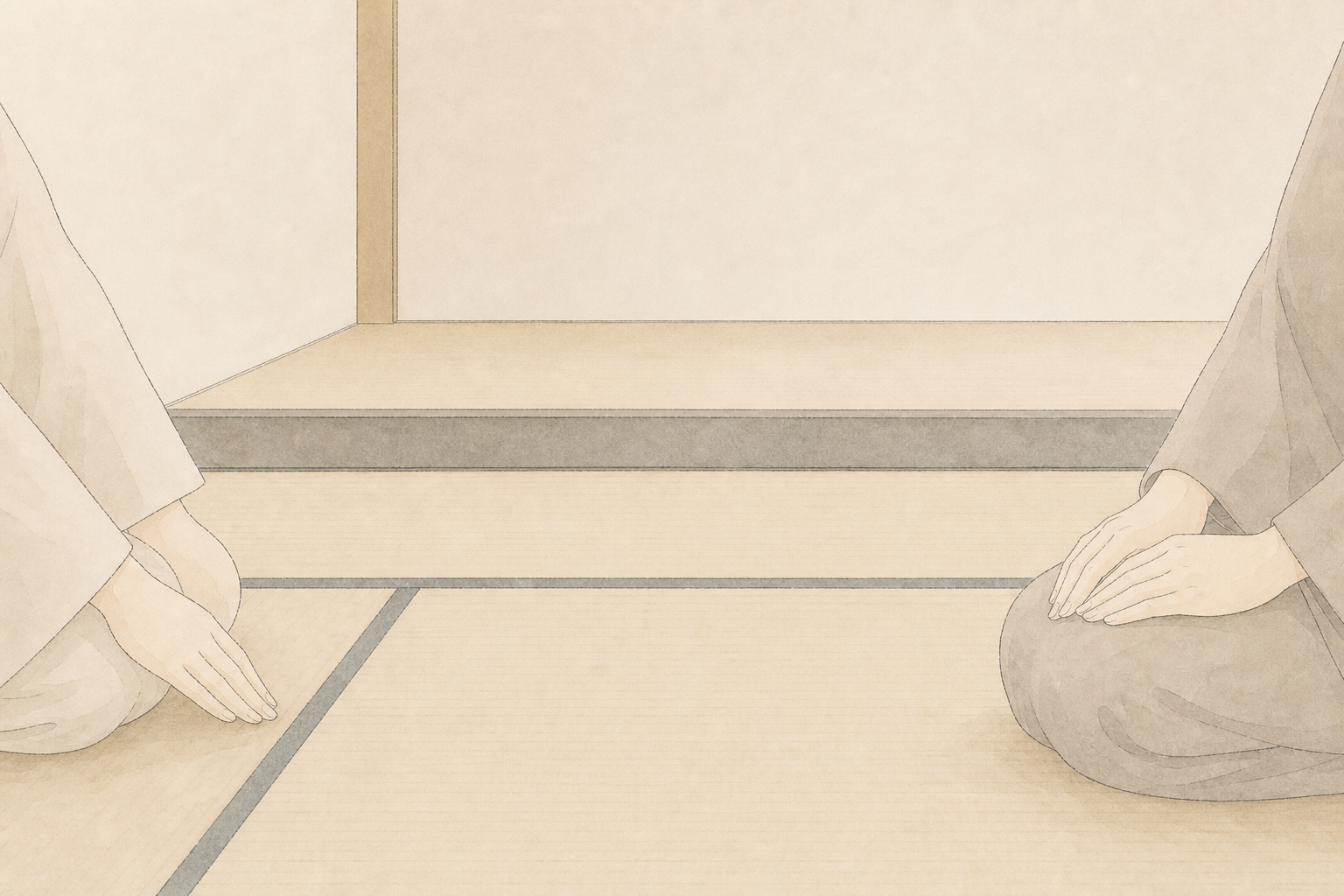
The shōkyaku, or first guest, receives what the host has prepared and helps shape the conversation and the pace for everyone. Start with the work of the guest who takes the lead.
The First Guest Takes the Lead
When I listen to a tea gathering, I notice whose words set something in motion more than who spoke the most. The first guest asks the host questions, moves ahead of the other guests when the occasion calls for it, and helps them keep pace with one another. The role is a little like interpreting between host and guests. Tea takes shape through their shared work.
The first guest responds to the host and gives cues to the other guests. The order of the seats tells only part of what this person does.
The role calls for knowledge and experience so that the gathering can proceed and everyone can take part.
A Question Can Let the Host’s Intentions Come Through
Asked about a scroll, utensil, or sweet, the host can share something of the thinking behind the choice. Without a question, that part of the arrangement might stay private.
The right question is one everyone could benefit from hearing answered at this gathering. Choosing it calls for something like the judgment of an interviewer.
Speaking for the Other Guests Without Speaking Over Them
If the first guest says everything, the other guests become spectators. If they leave the role unattended, the exchanges with the host can scatter.
The first guest can represent those who are present while giving them room to notice things for themselves. Finding that balance is one of the difficulties of the role.
Moving First Gives Others a Cue
When the bowl is served, the first guest’s greeting can help the next person understand the order. The movement gives the group a guide without a verbal explanation.
I think of this as a good form of navigation. One person’s first gesture keeps others from having to guess how to proceed.
Keeping Pace with the Host Takes More Than a Script
A chaji can follow a planned course and still call for a response to the guests or to something that happens that day. Set phrases cannot produce that exchange on their own.
Knowing the form helps you judge where to wait, ask, or leave a thing unsaid. Familiarity with the form makes that freedom possible.
Conversation Does More Than Exchange Information
The name and maker of a utensil matter. If the guests collect answers alone, the conversation can begin to feel like a quiz.
What I value is the exchange in which the host shares why they chose the object today and the guest tells how it struck them. Knowing something can become a way of meeting someone else.
What the First Guest Can Teach Us About Facilitation
The first guest takes in what the host has prepared, asks on behalf of those present, and helps the others hear what comes back. The value of what they say lies in what happens around it.
A single question can draw everyone’s eyes toward an object. The answer can be followed by a silence in which each guest has time to think. What is said may change where people look, who speaks next, or the pace of the room.
A creative director connects the work of different specialists and brings their attention back to a shared aim. The first guest can take a similar place in the room, present without taking it over. I see a way of leaving the people present room to act. A good question can draw the host out, bring the guests’ eyes back to an object, or give the room a new kind of silence. Those changes can be more telling than the cleverness of the question alone.
Listen to the Question and the Reply
When listening, follow what comes before and after the question. Why ask it then? What did the first guest take from the answer? What room did they leave for the person beside them? The role connects the time of several people through a sequence of exchanges.
Sometimes the first guest can receive an answer and pause before moving to another subject. In the interval, the host’s words have time to reach the other guests. Leave the silence for them to take in what was said and the conversation can do more than trade information.
Research on the first guest yields terms, dimensions, histories, and conventions. After checking the facts, ask what the arrangement changes in the speed of a hand or the distance between people. Facts and interpretation have different roles. Used to sharpen observation, the facts can show how a form or movement fits the things, people, seasons, and times around it, and give us a way to notice such relations outside the tea room.
Keeping the Conversation Open
The first guest moves first and gives others a place to begin. They can leave open what other guests have noticed and what the host has not yet said. That openness lets one person at the center support the whole room.
Someone new to tea can look for what happens after the first guest speaks. Who seems at ease? Where do people look? What happens to the pace of conversation? The volume of a voice, the posture, and the length of a pause can all affect how much room there is for others to enter.
A beginner can start by listening to what a question and its answer give the other guests. There is no need to take the role immediately.
Instead of looking for the right words to learn, notice who in the room has not yet been able to take in what happened. That attention is part of learning to be a guest.
It is easy for words like “Japanese” or “minimal” to cover over details. Begin with a mark in the material, a place the hand touches, the interval between things, and the order of the movements.
Closing
The first guest asks, moves first, and connects conversation with the progress of the gathering so others can take part. They let the host’s intentions come through, help direct the guests’ attention, and decide when to be quiet. I see a way of communicating that gives everyone in the room a part.
The first guest picks up the host’s intention in a question, puts into words what the other guests may want to hear, and helps set the pace. The time to ask, the time to pause, and the time to let the next guest in all show how people share the work of hospitality.