
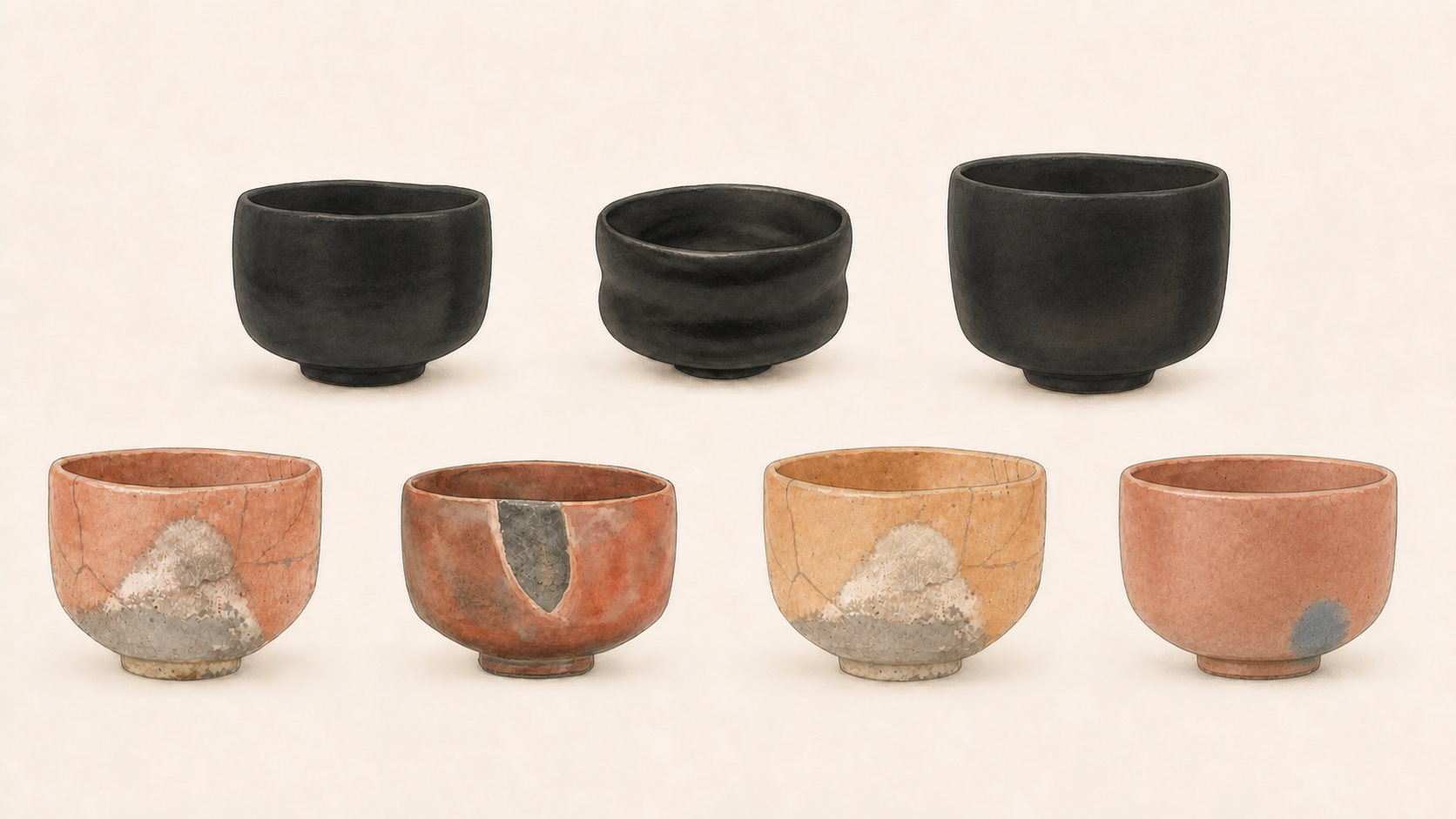
Search for the Rikyū Seven and you will see seven names. Ōguro, Hachihiraki, and Tōyōbō are black Raku bowls. Hayafune, Kimori, Kengyō, and Rinzai are red. Tradition holds that the bowls were made by Chōjirō, the founder of Raku ware, and selected by Sen no Rikyū.
What are the Rikyū Seven? The Raku family calls them the Chōjirō Seven
“Rikyū Seven” or “Rikyū Seven tea bowls” is widely used. The Raku family uses “Chōjirō Seven,” naming the same seven for their maker. The bowls survive in several ways: some originals remain, one bowl was reconstructed after a disaster, and some lost forms are known through later copies. Shape, glaze, name, and provenance give us ways to see the differences among them.
The Rikyū Seven are a group traditionally said to have been selected and named by Sen no Rikyū from bowls by Chōjirō, the first Raku potter.
The three black bowls are Ōguro, Hachihiraki, and Tōyōbō. The four red bowls are Hayafune, Kimori, Kengyō, and Rinzai.
The Omotesenke Fushin’an glossary lists these as the Rikyū Seven, also known as the Chōjirō Seven. It notes differences of opinion about the traditional attribution to Chōjirō. Rikyū’s selection is likewise best understood as a tradition.
The seven bowls have come down to us in several forms.
Surviving originals
Three original bowls by Chōjirō can still be seen.
 Ōguro
 Tōyōbō
 Hayafune
Reconstructed from fragments
The thirteenth-generation Seinyū reconstructed this bowl from fragments of the damaged original.
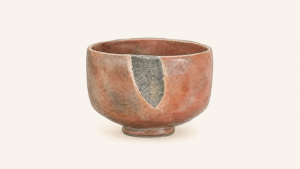 Kimori
Known through copies
These three lost bowls are known through copies by generations of the Raku family and others.
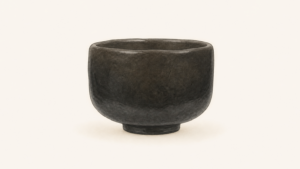 Hachihiraki
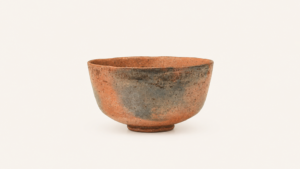 Kengyō
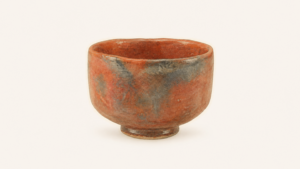 Rinzai
Three black Raku bowls: Different forms within the black
Hand shaping and trimming give Chōjirō’s black Raku bowls quiet rises and dips that differ from the regularity of a wheel-thrown form. Follow how the mouth draws in, how the body meets the lower curve, and how the foot sits. Those details make three distinct outlines visible.
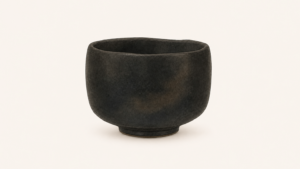
Ōguro: A composed form known as Chōjirō’s hongata
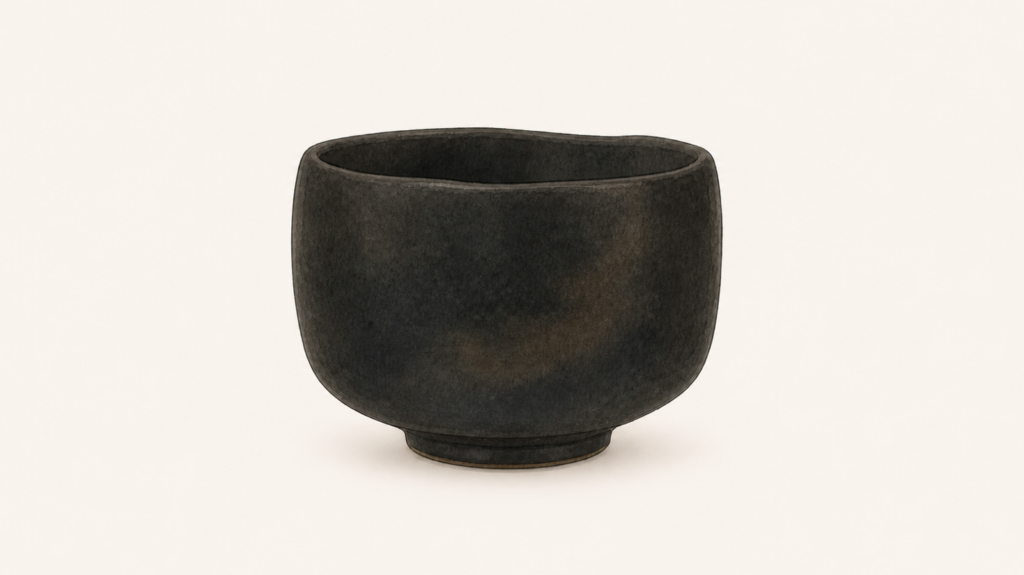
Ōguro is a representative black Raku bowl of the Rikyū Seven. The Agency for Cultural Affairs lists it as an Important Cultural Property in a private collection.
Hand-shaped in sandy red clay, the bowl is coated with low-fired black Raku glaze. The mouth draws in slightly and the lower body is rounded. The Agency for Cultural Affairs notes that such a straightforward form is popularly described as hongata, a standard form. Glossy black surfaces sit beside areas that turned dull and dark gray-brown in the kiln.
The quiet of its outline is worth noticing alongside the depth of the black. The rim curves slightly inward from the swell of the body, gently closing the space held between the hands.
Hachihiraki: Looking at a copy of a lost bowl
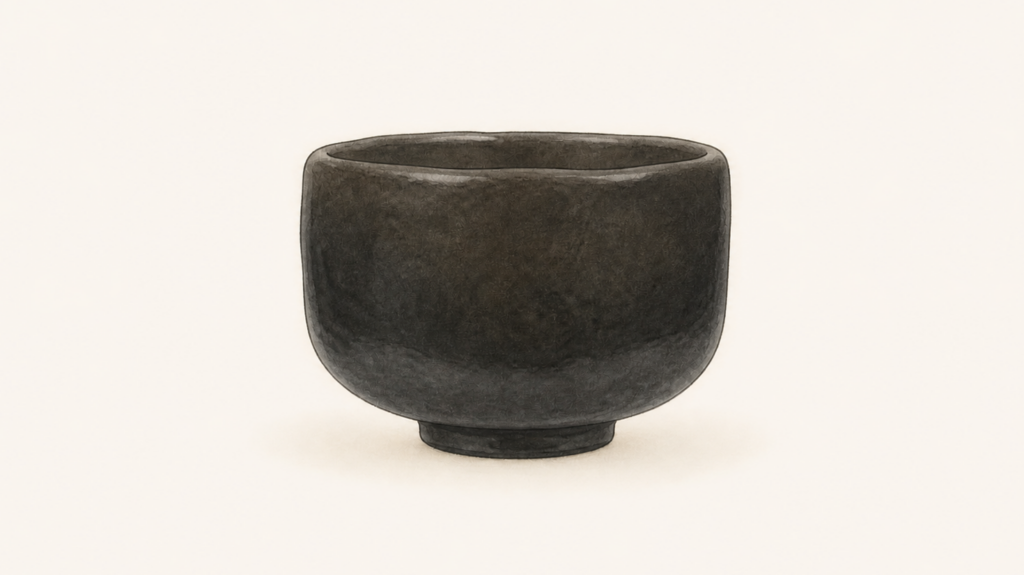
Hachihiraki is one of the three black bowls, but the original is lost. The bowls seen today under that name are largely copies made by later potters.
A copy gives us a clue to a lost form. Its maker and the period when it was made differ from those of the original.
The name can suggest a bowl with a wide opening, but its effect on the imagination does not settle the shape of the original. Copies provide evidence for considering the lost form.
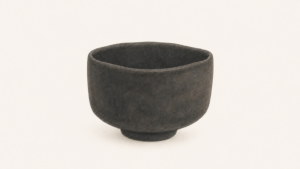
Tōyōbō: A thin-walled bowl with an almost level rim
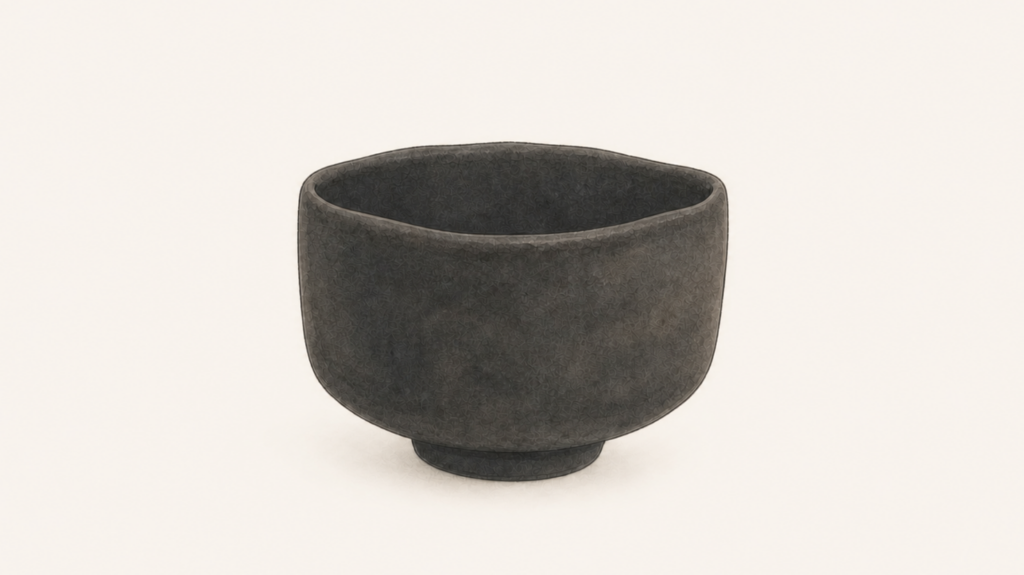
Tōyōbō is also a black Raku bowl designated an Important Cultural Property and held in a private collection.
The Agency for Cultural Affairs gives its height as 8.3 to 8.5 cm and its mouth diameter as 12.1 cm. The profile from the body into the lower curve is likened to a hexagonal tortoiseshell motif cut horizontally in half. The walls are relatively thin and the rim is nearly level. A glossy black glaze covers the bowl, with occasional brownish areas.
Both Ōguro and Tōyōbō are valued for the quiet of their forms. The fullness of Ōguro and the thin, composed outline of Tōyōbō show how differently that quiet can take shape.
Four red Raku bowls: Originals, reconstruction, and copies
Clay color, the thickness of a clear glaze, and the grays produced by firing vary among red Raku bowls. Red-brown, pale areas, and blue-gray can all come together at low saturation, with quiet traces of the hand still visible.
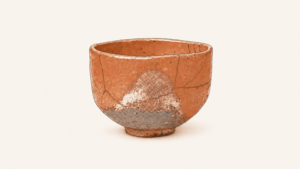
Hayafune: A surviving red Raku original
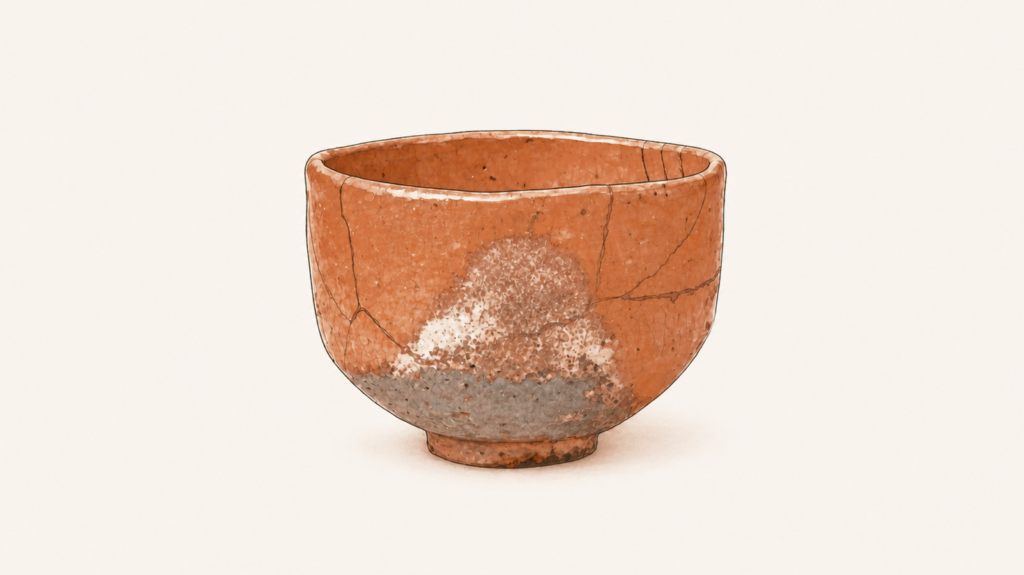
Hayafune is the only one of the four red Raku bowls for which the original survives. It is in the Ebara Hatakeyama Museum of Art.
It is 8.0 cm high, with an 11.3 cm mouth and a 4.7 cm foot. The walls are thin, the rim turns inward slightly, and upright sides soften into a curve at the base. A peak of blue-gray glaze runs down from the body toward the foot. Long crackling between the rim and the lower body and repairs in black lacquer also remain.
The museum records a tradition in which Rikyū said he had obtained the bowl from Korea by fast boat for a tea gathering, hence the name Hayafune, or “fast boat.” The story treats a new bowl made in Japan as a treasure from afar, a revealing shift in the way its value could be understood.
Kimori: A bowl reconstructed from surviving fragments
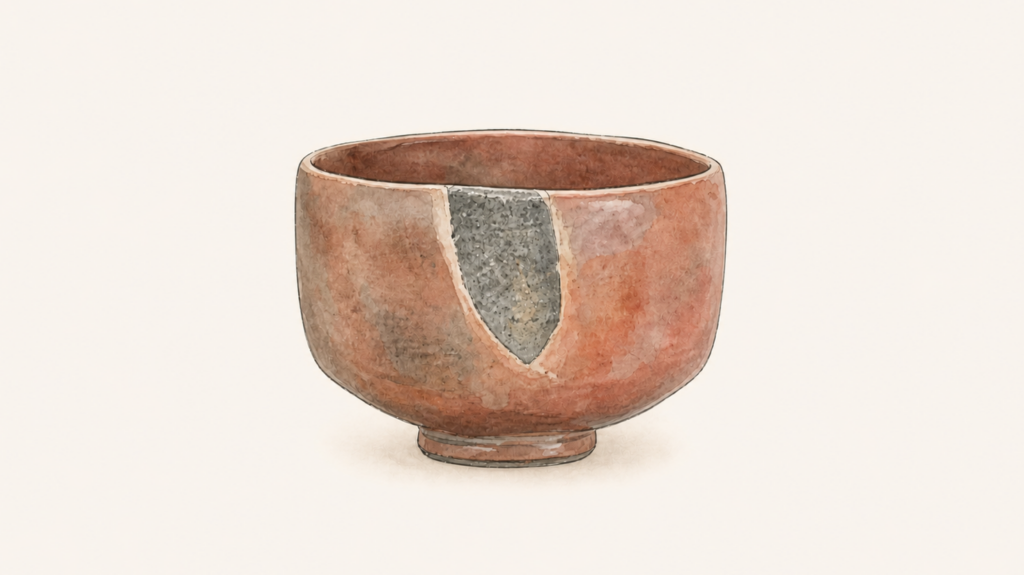
The present Kimori has a history beyond that of the original attributed to Chōjirō.
It is said to have passed from Sen no Sōtan to the Mushakōji Senke and later to have been presented to the Takamatsu Matsudaira family. It broke into fragments in the Great Kantō Earthquake of 1923. In 1934, Raku Seinyū XIII used surviving fragments to reconstruct its form. It survives among the Takamatsu Matsudaira Family Historical Materials.
Kimori is a fruit left on the tree after harvest in the hope of a good crop the next year. Whatever the origin of the name, the bowl itself carries the time of the break and the reconstruction. Fragments of Chōjirō’s bowl and a later hand sustain the vessel together.
Kengyō: Copies of a lost red Raku bowl
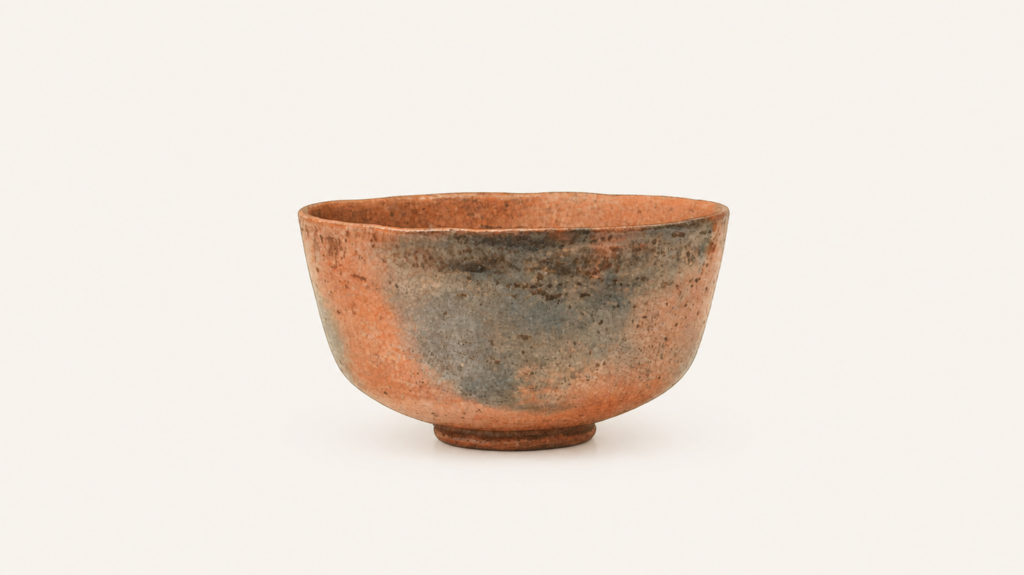
The Kengyō original is lost. Copies by members of the Raku family and other makers give us a way to consider its form.
Historically, kengyō was the highest rank conferred on blind people. Several accounts are given for why the bowl received that name. Its appearance is known through later copies.
The bowl shown is a later copy of Kengyō. Its history includes the transmission of a remembered form through copying.
Rinzai: What a name cannot tell us about form
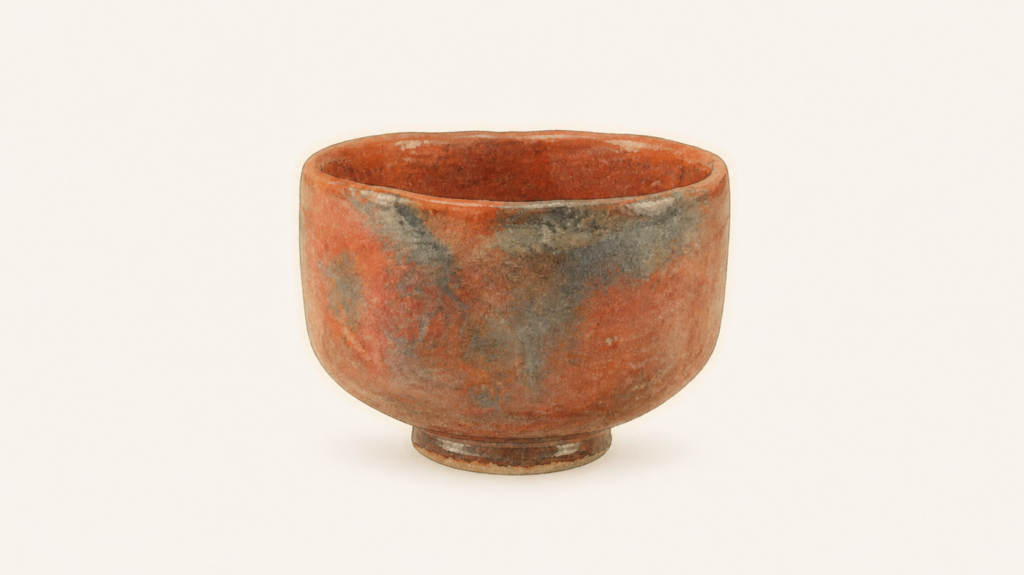
The original red Raku bowl Rinzai is also lost.
Some accounts connect the name to Zen or the shape of mountains. The name alone cannot establish the form of the lost bowl. Later copies by Raku potters and others offer clues.
The loss of three originals shows how the judgment of a bowl could be passed down in box inscriptions, records, copies, and tradition as well as in the object itself.
How to look at the seven bowls: Four points of comparison
Three black and four red give you a way to remember the group. Four points of comparison help bring their differences into view.
First, look at the rim. Does it turn inward, stay close to a level line, or open out? That small angle at the mouth affects the whole impression.
Second, follow the body into the lower curve. A rounded transition like Ōguro’s feels different in the hands from the more clearly marked change in Tōyōbō.
Third, look at areas of glaze. In black Raku, see how sheen gives way to dull areas. In red Raku, follow the red-brown, pale areas, and passing flows of blue-gray. Look at the movement across the larger surfaces.
Fourth, check the condition in which the bowl survives: original, reconstruction, or copy. Each tells us something about how a vessel survived, was lost, or was given a form again.
The bowls show how much variation can emerge within close constraints. The mouth may close or open. The glaze may envelop the body in black or let the red clay show.
How the forms of the bowls were passed down
The group gives us a way to think about the seven celebrated bowls and what happened to them.
First, the bowls show why Rikyū and Chōjirō’s relationship is richer than a simple division between designer and artisan. The works cannot tell us precisely what Rikyū specified or what Chōjirō decided himself. What survives is the work that came out of the relationship.
Second, names change the encounter with a bowl. Ōguro, Hayafune, and Kimori bring memories and stories to clay and glaze. Some accounts of a name may have taken their shape later. The story has a place alongside what can be established historically.
Third, copying became a means of preservation. Raku potters in later generations made bowls under the same name after an original was lost. A copy is also an interpretation of how a maker understood the preceding work.
Three originals survive. Kimori was reconstructed from fragments, and three more survive in form through copies. These histories give each bowl a different kind of evidence.
Compare what survives in an original, a reconstruction, or a later copy and see where each leaves a question open. Similarities among the rims and bodies of several copies can be considered without settling the shape of a lost original. Transmission calls for imagination and for evidence.
Conclusion: Seven different forms and different ways of surviving
The Rikyū Seven comprise three black Raku bowls, Ōguro, Hachihiraki, and Tōyōbō, and four red ones, Hayafune, Kimori, Kengyō, and Rinzai. The Raku family calls them the Chōjirō Seven.
The originals that survive are Ōguro, Tōyōbō, and Hayafune. Kimori was damaged in the Great Kantō Earthquake and reconstructed from fragments by Seinyū XIII. Hachihiraki, Kengyō, and Rinzai are known through later copies that carry a memory of their forms.
Look at where a work survived, was reconstructed, or passed down through a copy. The seven bowls become a way into how people in tea have handed down things and the memories of them.
A small shift between areas of black, glaze running across red clay, the angle of a rim, and the volume received by the hands: each gives us something to look at. In some cases, the shape remains through its name and later copies. Each of the seven is another way into the history.
Main References
- Omotesenke Fushin’an Tea Glossary, “Rikyū Seven”
- Raku Museum, “Chōjirō, the Founder: Collection”
- Agency for Cultural Affairs, “Black Raku Tea Bowl, Ōguro”
- Agency for Cultural Affairs, “Black Raku Tea Bowl, Tōyōbō”
- Ebara Hatakeyama Museum of Art, “Red Raku Tea Bowl Named Hayafune”
- Nezu Museum, “Cutting Famous Paintings and Passing on Celebrated Utensils”