
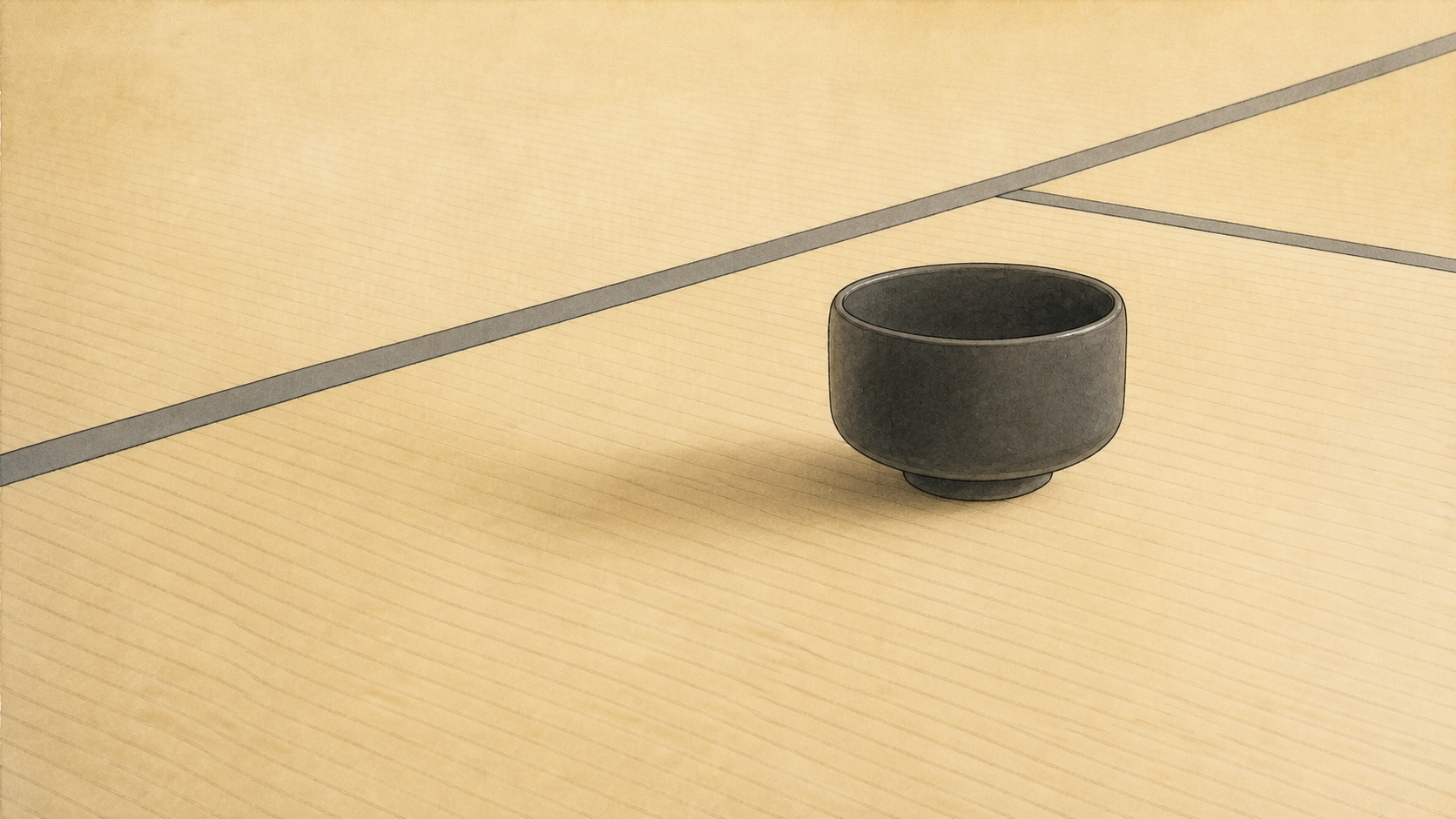
Sen no Rikyū is easily associated with black bowls, simple things, and small rooms. His work also rearranged relationships among people, objects, bodies, and power. Those relationships show what his choices did beyond establishing a recognizable style.
Rikyū’s work goes beyond a list of stylistic traits
A black bowl, a small room, and spare utensils are familiar parts of Rikyū’s image. Simply collecting those forms misses something. When a form changes, the relationship between a person and an object can change with it. Look behind the shape. What was valued, who was brought face to face, and what did the shape ask the body to do?
Rikyū inherited practices already in use. That inheritance, his work with craftspeople, and his proximity to rulers helped sharpen how he made choices.
To see the creativity at work, consider what he passed over and how he rearranged established values as well as what he made.
Raku bowls changed how the vessel met the body
The Kyoto National Museum connects Chōjirō’s black Raku bowls with Rikyū’s inventiveness. Forms that do not foreground the turn of a wheel, a black surface, and a presence felt close to the hand offer a different view from one centered on treasured wares brought from China.
A new form changes how a bowl is viewed. It can also change the relationship between the holding hand and the color of the tea, and between host and guest.
A rustic tea room changes how power and the body meet
A small entrance and limited space change the guest’s posture and movement. The Kyoto National Museum exhibition contrasted two ideas with Rikyū’s wabi tea room and Hideyoshi’s golden tea room.
Simplicity is one visible feature. Who comes in, how their body enters, and how they face the objects show what the room rearranges.
Rikyū changed how people decided what belonged in a gathering
What suits a particular guest, occasion, and time? That choice matters more than simply placing expensive against inexpensive, or lavish against plain.
Reproducing a particular look misses the creative decision. Watch the relationships, remove what is unnecessary, and see whether a familiar thing can appear from another angle. That is where Rikyū’s work remains alive.
See Rikyū as a person in history
Chanoyu did not begin with Rikyū. His work emerged where the lineages of Jukō and Jōō met the daimyō and townspeople of the period, craftspeople such as Chōjirō, and a culture that prized imported wares.
Treat him as an isolated genius and it becomes difficult to see the joint work and the response to an existing culture. Ask what he inherited, what he turned around, and whose skill made it possible.
His relationship to power and his death also exceed a simple, beautiful image. Seeing him as someone practicing within tensions and contradictions gives his choices their full force.
Rikyū’s creativity lay in rearranging what people valued
He worked with makers to produce new bowls, and helped people see familiar materials and objects differently alongside already prized wares from China. He added ways to recognize value without denying that costly things had their worth.
A small room and a black bowl work in relation to posture, the color of tea, the distance to a guest, and the way power comes into view. Rikyū’s work brings form and those relationships together.
What carries forward today is a willingness to question familiar standards, understand their history, work with makers, and consider the recipient’s experience in deciding what deserves attention.
Look beyond an appearance associated with Rikyū
Black, earthen walls, dim light, and a small room can evoke a Rikyū-like atmosphere. These are the forms that remained after the choices were made.
The inventive part is the question of why a form was needed. Who will be there, what will they see, and how will the gathering relate to recognized values? Copying the style without those questions only recovers its surface.
Respect the historical forms and observe the relationships that exist today. The way of making a choice is what can be passed on.
Looking at creative work through the makers who shared it
A single idea cannot make a bowl or a tea room by itself. Form emerges through exchanges among people who know the materials, the people who build, and the people who use what is made.
Credit only one name and the network that made the work possible recedes. Look at where Rikyū’s direction met the skills of the craftspeople.
Giving a whole project direction means working with people who know different things and bringing their contributions into one experience.
Keep the tension between power and taste in view
Chanoyu was deeply involved in politics, gifts, ownership, and authority as well as quiet beauty. Rikyū worked within that tension.
Treat simplicity as a pure beauty free from power and much of the history is lost. The choices came amid competing values: display and restraint, renowned objects and objects whose value was still taking shape.
The relationships are worth seeing with the contradictions still in them. That is a prerequisite to drawing on Rikyū in contemporary design.
Rikyū designed relationships
I try not to stop at the phrase “the master who perfected wabi tea.” A large idea of a person can conceal what was chosen, what was changed, and the tensions with those around him. The sequence of choices interests me more than the style.
He brought existing utensils into new settings, changed dimensions, asked makers for new objects, and changed how the guest’s body moved. The work resembles bringing several kinds of expertise together to shape an experience. Calling him a designer in the modern sense would flatten that distinction, but I recognize the attention to how all the parts relate.
Using his name as an authority does little to explain him. Consider the sources, the period, and later idealizations separately, and look for observable changes in actual objects and rooms. Chanoyu comes closest to contemporary design for me when I see Rikyū as someone who reordered what people valued.
Look at Rikyū’s choices across the whole gathering
Putting his inventiveness to use today means considering a present-day set of values. Decide what to keep and what could change in order to make a new experience. That demanding way of making choices is what I want to bring into current creative work.
Conclusion
Rikyū’s design changed the relationships of utensils with bodies, hosts with guests, power with simplicity, and inherited practice with the life of his time. A black bowl or small room gives us a place to start asking how he decided what belonged.
His work brought history and standing to bear on relationships among things, makers, guests, rulers, and bodies. Those changed relationships gave people another way to decide what to value.
Watch how the distance between people and things changes and the transformation of chanoyu becomes easier to see. Look at a surviving form and ask which relationships it brought closer and which conventions it set aside. That question is a way into what has been passed down.
 Honrai Muichimotsu: What It Means to Be Free of Attachment
 Who Was Sen no Rikyū? The Life of the Man Who Changed Chanoyu