
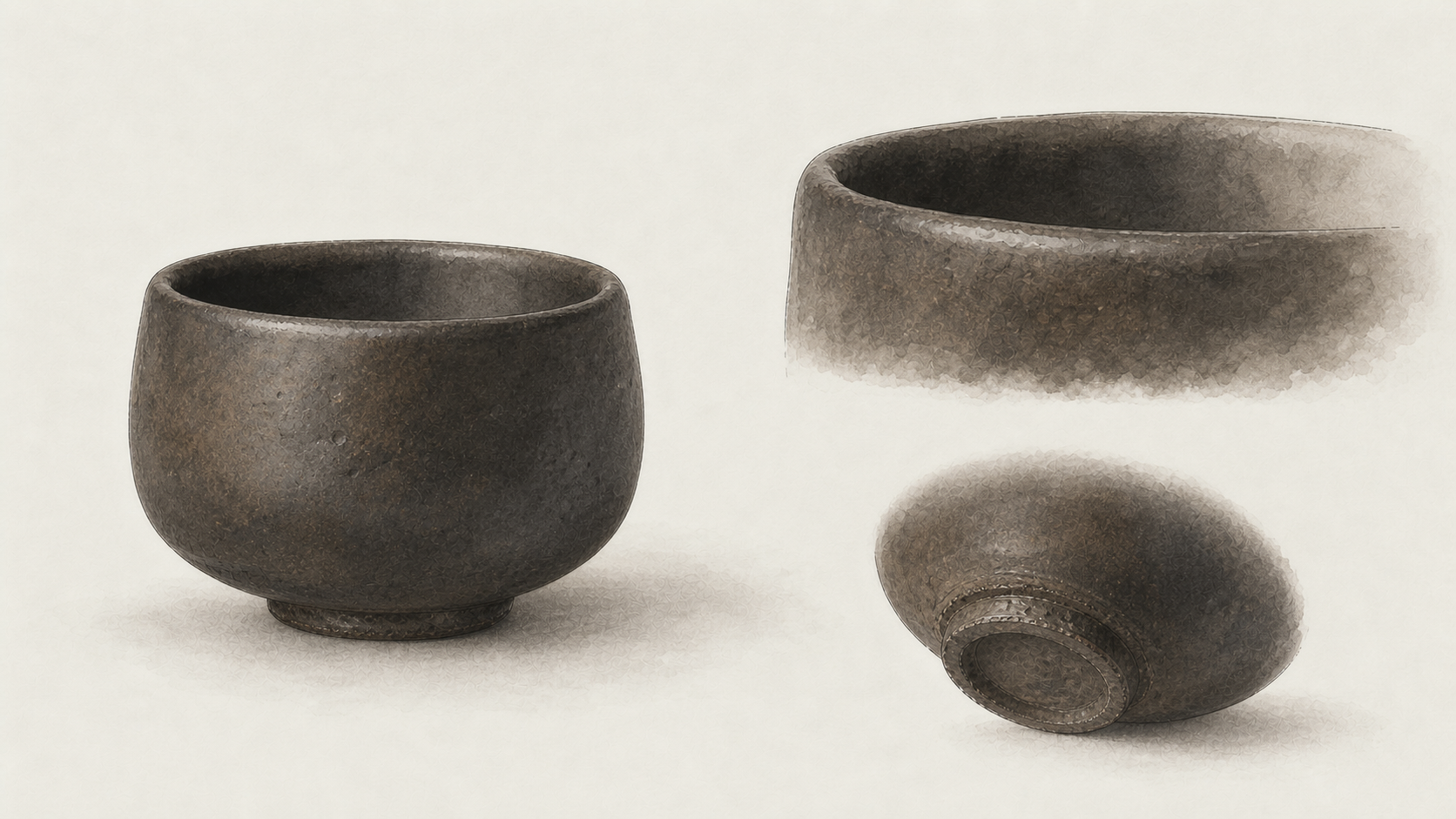
It is easy to tense up in front of a tea bowl, feeling that there must be a right way to look. The maker, date, name, and cultural property designation can all bring us closer to an object. Looking at it goes beyond getting the facts right.
Start with the whole bowl
There is more than one place to start and more than one way to respond. Take in the whole bowl, then move closer to whatever catches your eye. Read about the work and come back to it. Here are six points of entry into Raku and five celebrated bowls associated with Chōjirō. The names can help us see what sets one bowl apart from another.
Look at the whole bowl before reading the label.
Does it sit low and settled, or seem to rise? Does it appear evenly balanced, or does its weight seem to shift to one side? Move, if possible, before calling any one face the front.
Let the first impression settle before calling the bowl “distorted” or an example of wabi. Words can flatten small differences into the same general impression.
Take a circuit around the highest and lowest points of the rim, the swell of the body, and the position of the foot. Imagine where the weight will settle and which face will come toward you when you lift it. That gives you a more concrete sense of how the shape holds together than symmetry alone.
Rim and body: Where eyes, lips, and hands meet
Trace the rim with your eyes all the way around.
Does its height stay even? Where does it turn inward or open out? Does the thickness change? The heritage database describes Mukiguri as having a slightly inward-curving rim with a rounded edge, and Daikoku as having a slightly constricted opening.
The rim draws the outline and meets the lips. Even with a bowl behind glass, imagining where you would drink from it brings that line closer to the body.
Body and lower body: Volume that fits the hands
Look at the swell of the body and how it draws in toward the foot.
Round, cylindrical, half-cylindrical, and shallow are useful descriptions. Also imagine where the weight will fall, whether the body opens outward or draws inward, and how your fingers would sit if you cupped the bowl.
Mukiguri has four faces along the body and rounds out toward the foot. Follow the change from a plane to the lower curve to see how it comes together as more than a simple square.
Interior and foot: Looking inside and underneath
The interior, or mikomi, is where the whisk moves, where matcha gathers, and what comes close to the guest’s eyes after drinking.
Notice the depth of the bottom, the rise of the walls, the tea well, and the glaze. Imagine the bowl with tea in it as well as empty.
The inside of Kaedegure at The Metropolitan Museum of Art shows wear from extended use. Alongside the form originally given to it is a record of time spent making tea in it.
The foot: Many choices in a small space
The foot supports the bowl. It can be hard to see on display, but its size, trimming, exposed clay, and marks left by kiln supports all tell us something about making it.
Mukiguri has a small circular foot. The inside was trimmed into a swirl, and the record notes five marks around the edge. The Raku Museum says Murasame is the only surviving cylindrical Chōjirō bowl with the type of foot likened to the base of a Go-stone container.
The foot alone cannot identify the maker. Look instead at how it carries the weight of the whole vessel. It connects the face you see to the underside you rarely see.
A design perspective: The hidden structure supports the visible shape
When a bowl is viewed straight on, the foot is barely visible. Its size and position still affect the rise of the body and how stably it sits on a tatami mat.
A Raku foot puts practical and visual work into a part that is normally hidden. This attention to the underside often appears in Japanese utensils.
Glaze: Looking within the black and red
Look for sheen, cloudiness, thickness, browns, and changes from use in black Raku. In red Raku, notice the red of the clay, pale areas, scorch marks, and where the glaze has flowed.
Keshiki, the “landscape” of a surface, includes small differences in color and sheen as well as conspicuous kiln effects. A change in time or viewpoint can give those differences character.
How a bowl feels in the hand
A bowl has a feel in the hand that goes beyond a numerical weight. It includes the balance, the fit in the palm, and the distance from hand to rim.
In front of a museum case, imagine holding a bowl from its dimensions and outline. If there is an opportunity to handle one, compare the weight you expected from looking with the volume and balance that you feel in your hands.
Mukiguri and Daikoku: Two black bowls, square and round
Chōjirō’s black Raku tea bowl Mukiguri is an Important Cultural Property.
It has a four-sided body, a rounded lower section, a small circular foot, thick black glaze, and a mark from iron tongs. The angular upper part gives way to curves at the lower body and foot. Look at how the square and the circle come together.
Daikoku: Looking closely at Chōjirō’s black
The cultural heritage database also lists Chōjirō’s black Raku tea bowl Daikoku as an Important Cultural Property.
It is hand-shaped from sandy red clay and covered in low-fired black Raku glaze. The mouth draws in slightly and the lower body is rounded. Different conditions during firing gave it both glossy and dark gray-brown passages.
At first glance the contour is composed and there is little apparent movement. Compare the glossy and gray-brown surfaces. The changes made by fire emerge within the quiet form.
Omokage, Murasame, and Kaedegure: Names and time
The Raku Museum presents the black Raku tea bowl Omokage as a representative work by Chōjirō. Its records mention inscriptions by Yamada Sōhen and Ishikawa Jian, an accompanying letter by Kakukakusai, ownership by Machida Shūha, and its earlier place in the Raku family collection.
According to the museum, Yamada Sōhen wrote the name Omokage, and Ishikawa Jian recorded its resemblance to another tea bowl as the source of the name.
A maker does not always name a bowl when it is made. Later owners look at it beside other bowls, and a box inscription or an accompanying letter can preserve a name. Omokage carries the memory of people who saw it.
Murasame: A cylindrical bowl with a Go-stone container foot
The Raku Museum identifies the black cylindrical Raku bowl Murasame as a work by Chōjirō. It has an inscription by Joshinsai and is counted among the seven bowls in the later Chōjirō selection.
The museum describes it as the only surviving cylindrical bowl by Chōjirō with a foot resembling the base of a Go-stone container. Alongside the cylinder you see from the front, consider how the foot receives the weight of the whole bowl.
Kaedegure: Seeing the time spent in use
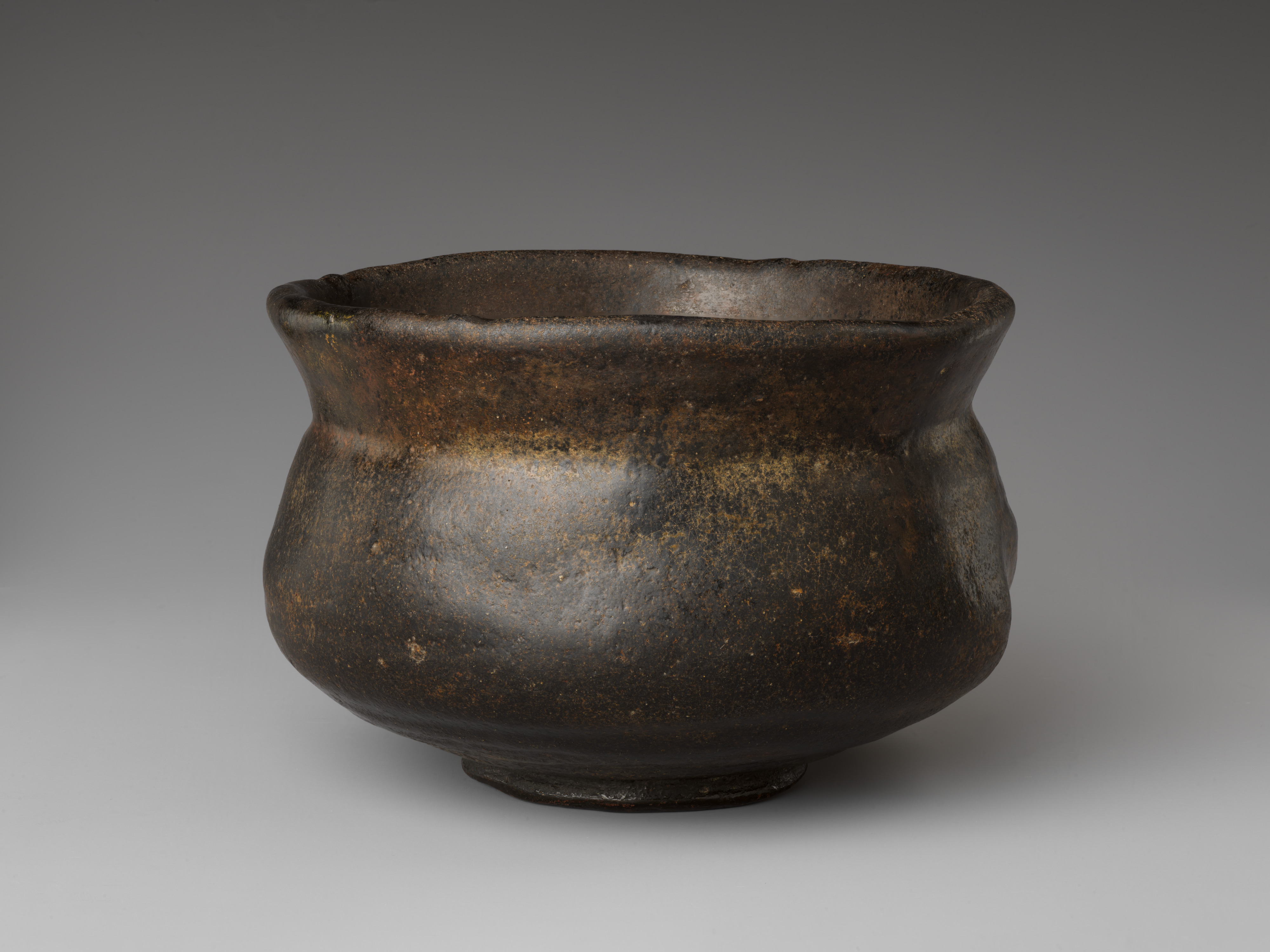
The Metropolitan Museum of Art dates Kaedegure to the seventeenth century and describes it as a black Raku bowl in the style of Chōjirō.
The museum describes it as earthenware with black Raku glaze and records a gift date of 2024. It notes a sheen on the outer surface and interior wear that shows extended use.
Outside, the sheen remains. Inside, there is wear from the time people spent preparing and drinking tea. The bowl shows what happened to it after it left the kiln.
Conclusion: Look again after learning the name
A celebrated bowl gives us more to look at than its name or designation.
Move between the rim, body, interior, foot, glaze, and feel in the hand and the bowl takes on a more particular form. Names, inscriptions, provenance, and collections show what happened in the years after it was made.
After reading the label, look away from it and go back to the whole bowl. One line or patch of light that you missed the first time is enough to change the encounter.
Move from the whole to the rim, interior, foot, and glaze, then back to the whole. A name and a history can deepen what you see. The difference you saw for yourself becomes a point of comparison for the next bowl.
 Why Raku Tea Bowls Leave Room for the Hand
 Why Raku Tea Bowls Are Shaped by Hand: First Raku, Second Hagi, Third Karatsu
 How Raku Continues by Changing: A Tradition with Room for Different Forms
 How a Black Tea Bowl Became a Quiet Form of Beauty: Chōjirō and Black Raku