
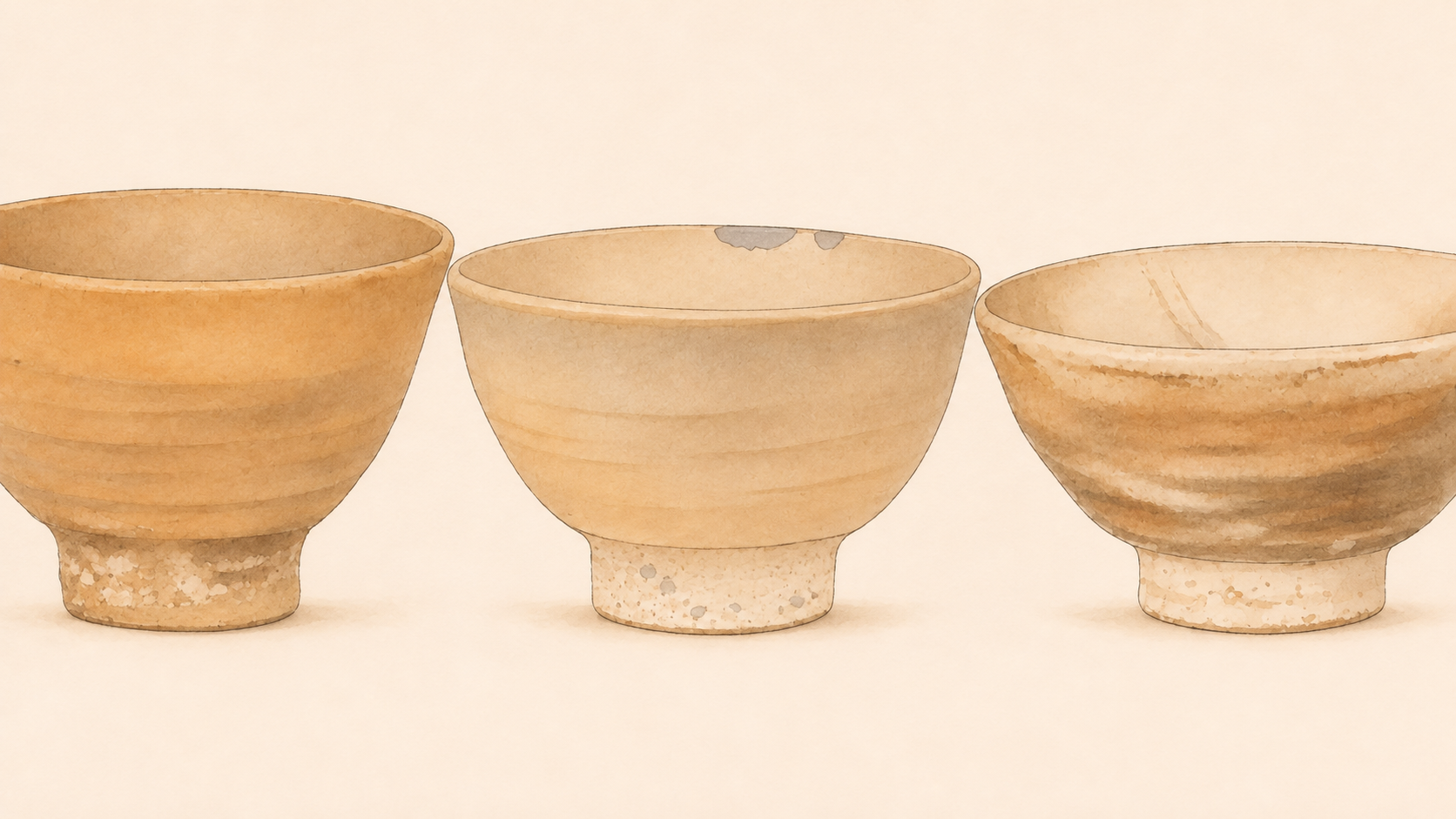
Ido bowls have a loquat-colored surface and no painted decoration. Since the Momoyama period they have been held in especially high esteem among Korean tea bowls. What should we look at to see why? Begin with the differences among large Ido, small Ido, and blue Ido.
What is an Ido tea bowl?
Next, look together at features often associated with Ido: wheel marks, bamboo-joint feet, and the granular glaze called kairagi. Then turn to Kizaemon, Hosokawa, and Kaga, collectively known as the Three Great Ido Bowls. It helps to know where to look before learning the names and stories.
Ido is a kind of Kōrai chawan, a bowl made on the Korean peninsula and taken up in Japanese tea. Similar ceramic fragments have been found at kiln sites on the peninsula. There is still no single established account of the original use or the origin of the name Ido.
One theory derives the name from the depth of the interior, like a well. Another connects it to Ido Wakasa no Kami. Whatever the name originally meant, the form, clay, glaze, and traces of use are still there to see.
The typical outline is straightforward. A wide mouth opens into a deep interior, and the body narrows toward the foot. Glaze coats the inside and outside, with a yellow-brown shade likened to a loquat. Horizontal lines from the wheel circle the body, and a tall foot is trimmed below.
The absence of bright painted designs and regular symmetry can make the bowls look alike at first. Compare the opening, volume, height of the foot, and thickness of the glaze in turn. The simplicity allows small differences to do a great deal of work.
Imagine making tea in the bowl. The deep interior gives the whisk space, and the wide mouth shows a broad patch of green thick tea. The loquat color gives matcha a quiet background. Lift the bowl and the small circle of the foot carries the broad form above it. Shape and color have more to do once the bowl contains tea.
Large, small, and blue Ido: What the categories reveal
Tea practitioners in Japan distinguished large Ido, small Ido, blue Ido, kokannyū, and ido-waki by shape, size, and glaze. The terms were developed by people looking closely at similar bowls, rather than names assigned to the products by potters on the Korean peninsula.
Large Ido: Depth and volume
Large Ido, or ōido, is also called meibutsu-de, the type associated with celebrated objects. Many examples have mouths over about fifteen centimeters across and a deep, imposing form. Kizaemon, a National Treasure, Hosokawa, an Important Cultural Property, and Kaga all belong to this group. Alongside size, look at the generous outline from mouth to lower body, the raised foot, and the volume given to the form by the loquat glaze.
Small Ido: Compact proportions
Small Ido, or koido, is written in Japanese with characters that can mean “small” or “old.” These bowls are smaller and lower than large Ido, and sit easily in the hands. Gyokuto at the Ishikawa Prefectural Museum of Art measures 14.0 cm across the mouth and 6.6 cm high. Balanced proportions and a subdued surface matter here more than the imposing scale of a large Ido.
Blue Ido: A low form and a bluish glaze
Blue Ido, or aoido, generally groups bowls that are flatter than large Ido and have a bluish cast to the glaze. Shibata, an Important Cultural Property, measures 7.1 cm high and 14.5 cm across the mouth. Kanazawa’s designated Kumoi is appreciated for its even form, throwing lines, bamboo-joint foot, glaze crackle, and kairagi. The low center of gravity and compact outline are worth seeing alongside the color.
Kokannyū and ido-waki: A closer look at the boundaries
Kokannyū refers to small bowls with fine glaze crackling and ido-waki to bowls with qualities close to Ido. Some objects straddle categories. The terms help describe what looks large or blue and which glaze effects stand out.
| Type | Typical form | What to look at first | Examples |
|---|---|---|---|
| Large Ido | Large, deep, and imposing bowl form | Opening, body volume, and tall foot | Kizaemon, Hosokawa, Kaga |
| Small Ido | Small and compact | Feel in the hands, low center of gravity, and subdued glaze | Gyokuto, Rōsō |
| Blue Ido | Relatively flat, with a bluish cast | Low proportions, bluish glaze, and crackle | Shibata, Kumoi |
| Kokannyū and ido-waki | Smaller bowls or forms closely related to Ido | Finely cracked glaze, and similarities to and differences from Ido | Consider each work individually |
The categories make it easier to see more than one type of Ido. The imposing size of large Ido, the intimacy of small Ido, and the low tension of blue Ido show how different proportions give shared features different effects.
Features of an Ido bowl: From the whole to the foot
In tea, the term yakusoku describes recurring features that give a kind of utensil its character. For Ido these include loquat-colored glaze, glaze crackle, throwing marks, a bamboo-joint foot, kairagi, a small nub of clay within the foot, and firing marks inside.
Start with the whole outline. How far does the rim open? Where does the body swell and how does it come down to the foot? Does the small foot take the weight of the broad upper section? Starting with the outline keeps the glaze in relation to the vessel’s shape.
1. Loquat-colored glaze
Firing iron-bearing clay and glaze can yield a soft brown with yellow or red tones. Bluish, gray, and reddish areas can appear beside thin passages. The surface serves as a background to the green of matcha.
2. Glaze crackle and throwing lines
Crackle is a network of fine cracks on the surface of the glaze. Color from use can enter it over time. Throwing lines are the horizontal marks left by fingers or tools as the clay turns. The movement of making the bowl remains as a surface rhythm.
3. The bamboo-joint foot and the tokin in the center
A bamboo-joint foot has a step that looks like a node on a bamboo stem. Trimming can leave a small pointed nub of clay inside the foot called a tokin. It offers a clue to the cutting around the base, even if the bowl stays upright.
4. Kairagi
Kairagi is a granular surface produced as glaze pulls together, chiefly around the foot. Kyoto National Museum explains that the Japanese characters liken the pattern to plum blossoms. Look at it in relation to the height of the foot, the trimmed lower body, and any exposed clay. Together they bring some visual weight toward the base.
5. The interior and marks from firing
The bowl’s interior, or mikomi, can show a depression where tea collects, spiral throwing lines, and contact marks from stacking in the kiln. With tea inside, small changes in depth and color can become more apparent.
The features vary in strength from bowl to bowl. Okina, a large Ido at the MOA Museum of Art, lacks distinct kairagi around its foot. Its deep, large form, throwing lines, and loquat glaze still mark it as a celebrated large Ido. Shared features give us terms for comparison.
Kizaemon, Hosokawa, and Kaga: Comparing the three celebrated Ido bowls
Kizaemon, Hosokawa, and Kaga are known as the Three Great Ido Bowls. All are large Ido and all passed through the collection of Matsudaira Fumai. Use the shared features to see which stand out and which are subdued in each.
Kizaemon, National Treasure: Depth and an imposing base
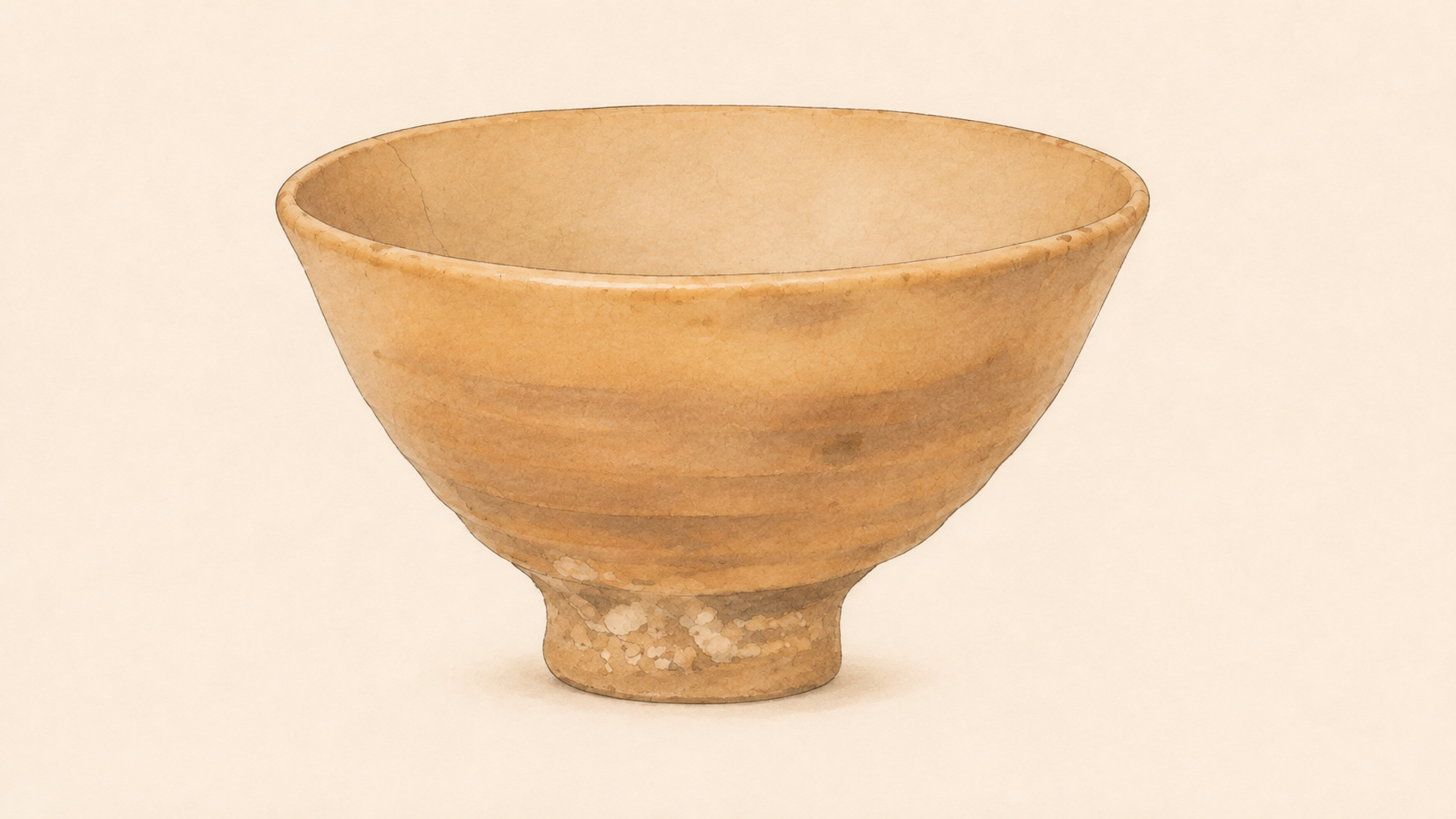
Kizaemon is 9.8 cm high, 15.4 cm across the mouth, and 5.3 cm across the foot. The walls rise and open slightly, the interior is deep, and the lower section is thin. Look for the loquat glaze, kairagi around the foot, and lacquer repairs on parts of the body.
In photographs from the front, the rough surface around the foot can catch the eye. The breadth and depth make a large space held up by a relatively small foot. The kairagi gives the base emphasis within a generally composed and imposing form.
Hosokawa, Important Cultural Property: Clear articulation of the typical features
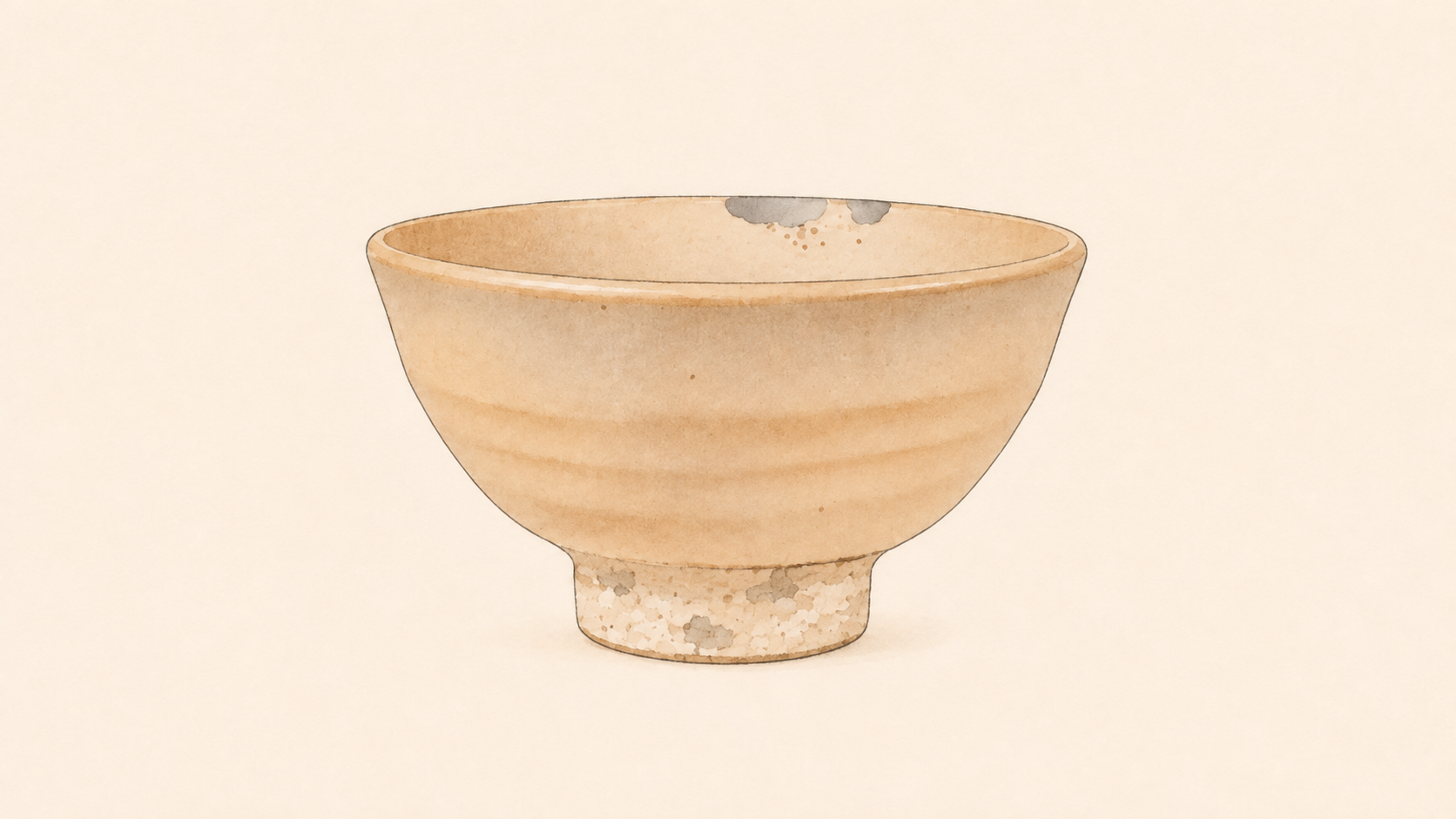
Hosokawa is 9.4 cm high, 15.8 cm across the mouth, and 5.7 cm across the foot. It has a gently rising body with throwing lines, a tall, sharply trimmed bamboo-joint foot, and bright, slightly reddish loquat glaze. Clear kairagi runs from below the lower body into the foot.
The Ebara Hatakeyama Museum of Art describes it as a representative large Ido with well-defined features. Kizaemon commands attention through depth and the tension at its foot. Hosokawa shows how the elements of the type fit together.
Kaga: Strong throwing lines and glaze marks like a water stain
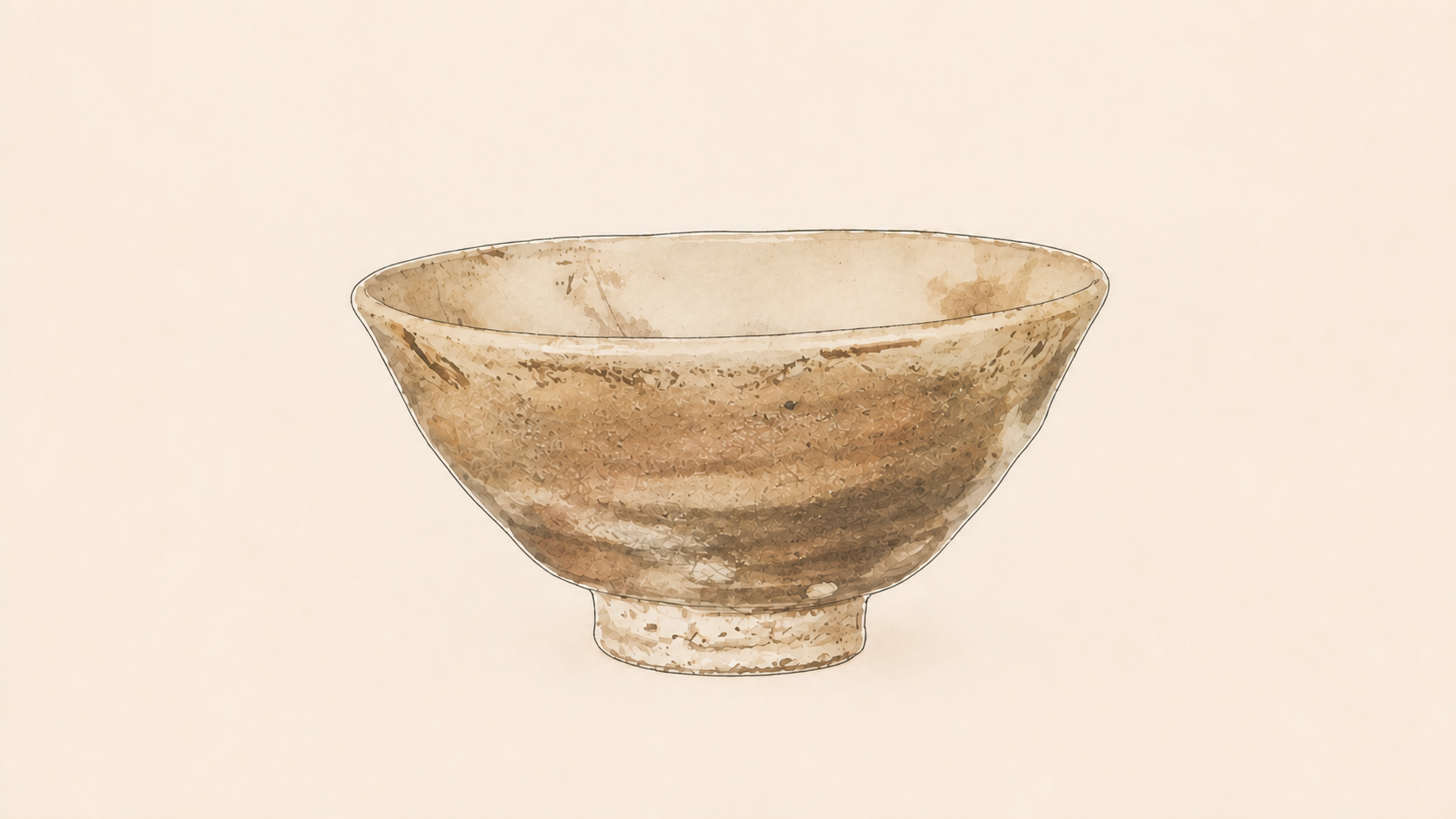
Kaga, also called Shishi, is a large Ido. Historical records list a height of 7.7 to 8.1 cm, a mouth diameter of 14.4 to 15.1 cm, and a foot diameter of 5.2 cm. It is lower in proportion than Kizaemon and Hosokawa, with a slightly open bowl form and strong throwing lines.
The foot rises sharply, but the kairagi is more subdued than on the other two. Instead, gray stains and white glaze mingle on a bluish ground. One account likens the discoloration in the crackle to water stains from a leak. A celebrated Ido bowl can have qualities that do not depend on pronounced kairagi.
| Name | Approximate dimensions | Defining features of the form | Glaze and foot |
|---|---|---|---|
| Kizaemon | Height 9.8 cm, mouth 15.4 cm, foot 5.3 cm | Deep interior and imposing volume | Strong kairagi around the foot, lacquer repairs |
| Hosokawa | Height 9.4 cm, mouth 15.8 cm, foot 5.7 cm | Gently rising, graceful form | Bright loquat color, kairagi running into the foot |
| Kaga | Height 7.7–8.1 cm, mouth 14.4–15.1 cm, foot 5.2 cm | Lower proportions and strong throwing lines | Blue, white, and gray glaze effects, water-stain-like marks |
Hosokawa makes the typical features clear, Kizaemon stands out as a whole, and Kaga has particular glaze effects and lower proportions. The same terms describe all three, with different points of emphasis. Those differences help us remember them by name.
Why Tsutsui-zutsu has a history of its own
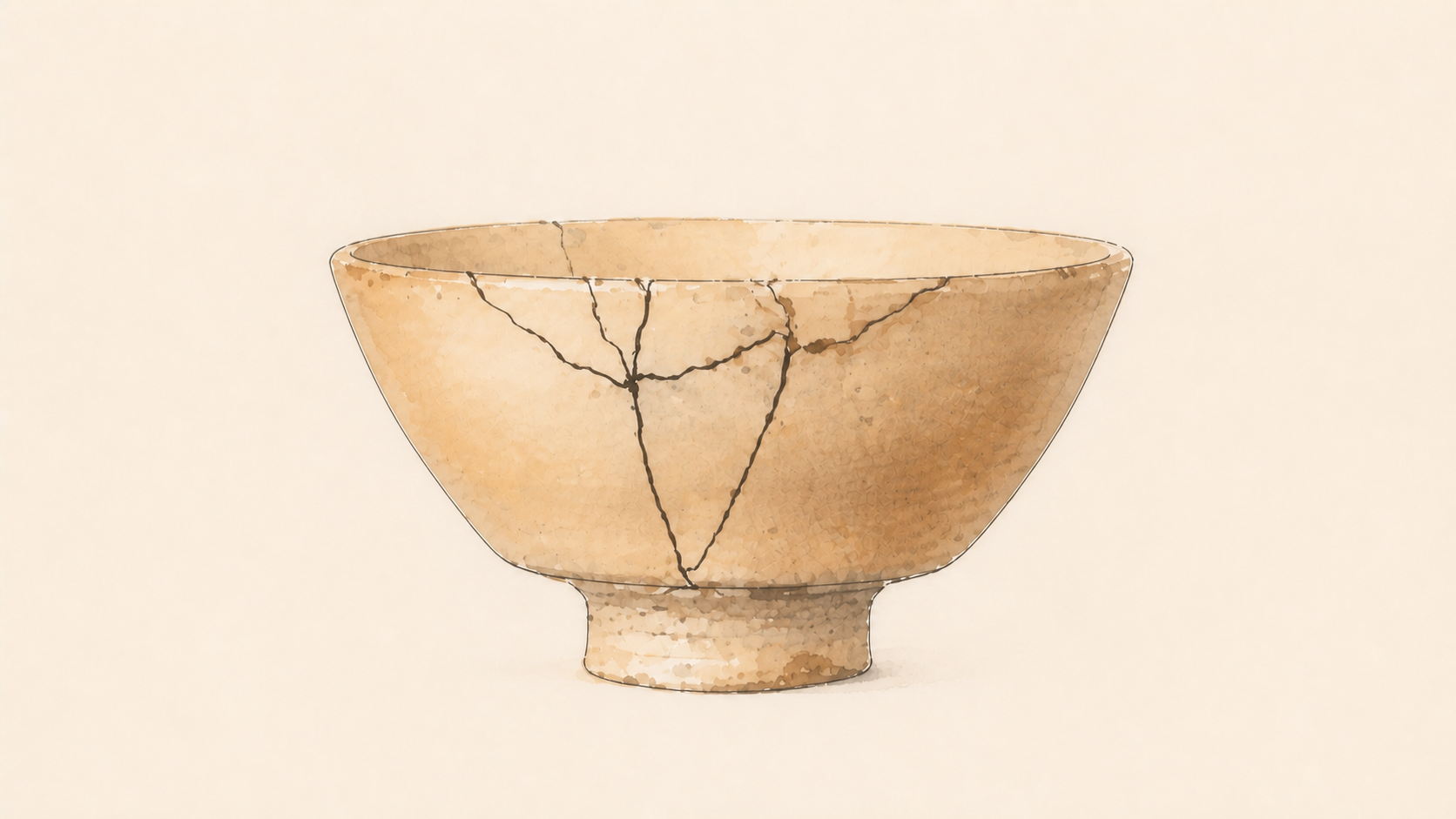
Tsutsui-zutsu is a renowned large Ido, often mentioned alongside Kizaemon. It sits outside the group known as the Three Great Ido Bowls. Its history gives another way to see what made Ido bowls worth keeping.
The bowl is 7.9 cm high, 14.5 cm across the mouth, and 4.7 cm across the foot. It is on the low side for large Ido. Tradition says it passed from Tsutsui Junkei to Toyotomi Hideyoshi. When it broke in five at a tea gathering, Hosokawa Yūsai is said to have calmed Hideyoshi’s anger with a poem alluding to The Tales of Ise. Lines of repair remain visible.
The choice to keep a broken bowl, repair it, name it, and transmit what happened became part of its history. The Three Great bowls show the form and provenance of famous large Ido. Tsutsui-zutsu shows how the time a bowl spent in use could be kept with it.
The group and the separate example bring different grounds for appreciation into view: form and glaze, ownership, occasions when the bowl was used, and damage and repair. The bowl and the relationships people built around it are both part of what survives.
How everyday vessels became highly prized tea bowls
Japanese tea practitioners are often said to have repurposed everyday wares from the Korean peninsula. That gives a sense of the broad change, but the full picture of original use and trade is uncertain. Later, bowls were also made to suit Japanese orders. There is more than one history behind what are now treated as celebrated tea bowls.
Tea gave vessels made in one setting a different use. The wide opening, deep interior, feel in the hand, and color beside matcha had a new role in whisking tea, drinking it, and examining the bowl.
Tea practitioners selected bowls for their outlines, feet, glazes, and feel in the hand. Terms such as large, small, and blue Ido grew from that close attention to differences among plain bowls.
The maker, the person who selected the bowl, the guests who used it, the person who repaired it, and later owners all had a part in its value. The bowl’s significance developed through use and transmission as well as through the original making.
Rarity, the status of owners, and stories of provenance also influence how a celebrated bowl is ranked. Start with dimensions and outline, then look at the glaze and foot before reading about its past. That order gives you a way back to the object after hearing its name.
Conclusion: Learning the shared features and seeing where bowls differ
Start with the opening and depth of the bowl. Then look at the loquat glaze, throwing lines, crackle, bamboo-joint foot, tokin, kairagi, and firing marks inside. Look at how the features around the foot balance the volume above them.
The categories help us see the scale of large Ido, the compactness of small Ido, and the low proportions and bluish cast of blue Ido. Kizaemon, Hosokawa, and Kaga share traits and differ in depth, proportion, and glaze. Tsutsui-zutsu, outside that group, preserves a history of repair and transmission.
Learning the shared features lets you see where a bowl departs from them. Kaga’s subdued kairagi and its absence on the large Ido Okina show the range within the group. Move between the typical form and the individual work and the particular shape of each plain, loquat-colored bowl comes into view.
References
- Cultural Heritage Database, “Ido Tea Bowl Named Kizaemon”
- Ebara Hatakeyama Museum of Art, “Ido Tea Bowl Named Hosokawa”
- Kyoto National Museum Museum Dictionary, “Korean Tea Bowls”
- Fujita Museum, “Small Ido Tea Bowl Named Rōsō”
- Ishikawa Prefectural Museum of Art, “Small Ido Tea Bowl Named Gyokuto”
- City of Kanazawa, “Blue Ido Tea Bowl Named Kumoi”
- MOA Museum of Art, “Ido Tea Bowl Named Okina”
- Ishikawa Prefecture, “Ceramic Tea Bowl Named Tsutsui-zutsu”
- “Kaga Ido, Also Known as Shishi,” an account drawing on Taishō Meikikan and other records
 Ido Tea Bowls: How an Everyday Vessel Became a Celebrated Bowl