
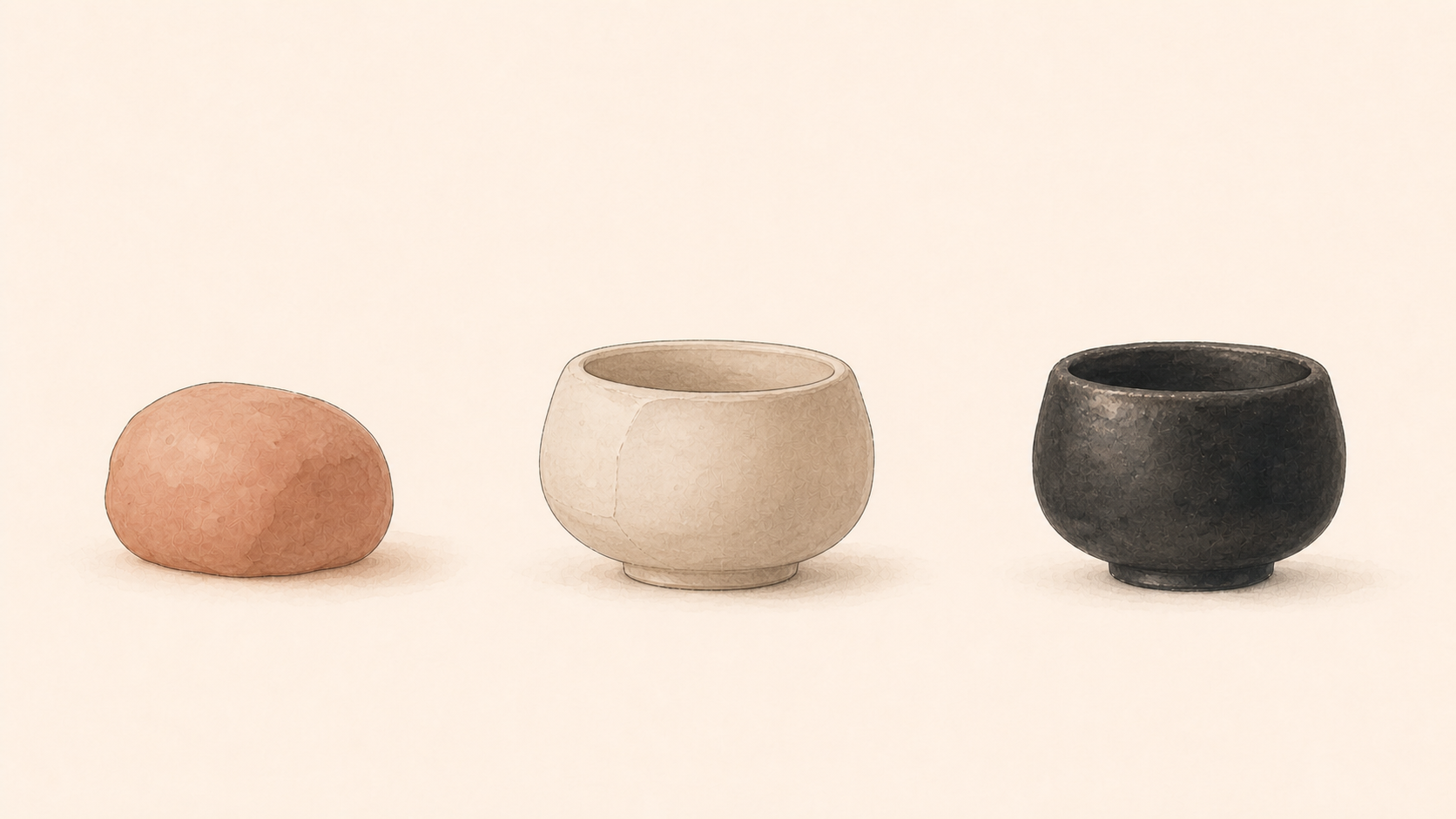
Why are Raku tea bowls shaped by hand? The stages have familiar names: hand shaping, trimming, glazing, and firing. Those names alone do not add up to a single recipe for a Raku bowl.
Hand shaping: Pressure gives the clay its form
Chōjirō and later generations used the process to different ends, and their methods differ from those called raku more widely today. Tea also has a memorable saying: “First Raku, second Hagi, third Karatsu.” Raku takes form in the hand, Hagi changes with use, and Karatsu shows a variety of clay and glaze surfaces. The saying and the processes behind the bowls give us ways to compare them.
The basic method for shaping a Raku bowl is to work the clay by hand.
Rotation guides a wheel-thrown bowl toward a circle. In hand shaping, pressure from the palms and fingers forms the inside and outside of a lump of clay together. The rim, interior, body, and lower body take shape as parts of a vessel that has to work as a tea bowl.
The cultural heritage database describes Chōjirō’s Mukiguri as a thick-walled, four-sided bowl hand-shaped from soft earthenware. Its interior has gentle irregularities and a depression resembling a small tea well, and its foot was trimmed. One face of the body retains a mark made by the iron tongs when the bowl was lifted from the kiln.
Hand shaping brings the interior for whisking, the rim for drinking, the body that sits in both hands, and the foot that supports it on the tatami into relation with the thickness of the clay.
Trimming: Taking away clay to shape form and weight
The maker trims the shaped clay with a tool as it dries.
Where the clay is retained or removed affects the fullness of the body, the way the lower body draws in, the balance, and the shape of the foot.
Some bowls by Chōjirō keep the trimming from calling attention to itself. The Raku Museum describes the ninth-generation Ryōnyū emphasizing vertical, horizontal, and diagonal trimming as part of both form and decoration. The fifteenth-generation Jikinyū developed sculptural forms with yakinuki firing and bold trimming.
Hand shaping and trimming are common terms. What an individual maker leaves thick, the depth of the lines, and where the weight settles can give the bowl a different character.
Glaze and fire: How the surfaces acquire character
Japan’s cultural heritage database records black Raku bowls by Chōjirō with low-fired black glaze on red clay bodies. Mukiguri has a thick black glaze inside and out that fired with a brown cast. Daikoku has both glossy areas and dark gray-brown areas on the same bowl.
The Raku Museum describes black Raku as using a black glaze and red Raku as bringing out the red of Juraku clay. It also describes later generations developing new glaze effects, including Dōnyū’s combination of glazes and Ichinyū’s vermilion glaze.
The color of the clay, the kind and thickness of glaze, and the changes in the fire all contribute to the result. Recipes vary with the maker and period.
Firing: The surface takes its final character in the kiln
The cultural heritage entry for Shunkan describes Chōjirō’s bowls as hand-shaped and fired in an inner kiln. The entry for Mukiguri records a mark left by the iron tongs used to lift the bowl from the kiln.
In the kiln the glaze melts and bonds with the clay, producing sheen, dull passages, and brown mottling. Generations of makers have worked with kilns and glazes to find their own expressions of black and red.
Firing can give two pieces of the same shape different surfaces. The maker determines the form, and the heat introduces variations that cannot be fully predicted.
A design perspective: The process remains in the finished bowl
Hand shaping remains visible in the rise and fall of the rim. Trimming affects the weight around the body and foot. Glazing and firing change how light meets the surface.
How something is made affects how it is held, seen, and used. The steps of making a Raku bowl are things we can look for in the finished piece.
Looking beyond the fact that a bowl was made by hand
Being handmade can sound like a guarantee of value. To appreciate a Raku bowl, look at what the marks do rather than how many there are.
Does the shape work for whisking, holding, and drinking? How do the trimming and the wall thickness affect the balance? Does the glaze cover the form or make its contours clearer? The relationships among steps matter more than their number.
A plane pressed into the body, clay trimmed away near the base, and the space for a finger beside the foot all record choices made during shaping. Follow where clay was added or removed to see how the process remains in the form.
What does “First Raku, second Hagi, third Karatsu” mean?
The familiar phrase puts Raku first, followed by Hagi and Karatsu. It names three kinds of bowl that have been prized in tea.
It has a rhythm that makes the three names easy to remember. It works well as a way to talk about different qualities that tea practitioners have appreciated in bowls.
Three different kinds of appeal
Set the order aside for a moment and the differences among Raku, Hagi, and Karatsu come into view.
Raku is a hand-shaped tea bowl that emerged in Japan in the encounter between Rikyū’s tea and Chōjirō’s work.
The city of Hagi traces Hagi ware to the kilns serving the Mōri family and the participation of potters skilled in techniques from the Korean peninsula. Hagi is known for its subdued glaze, its feel in the hand, and the way it changes with use, traditionally called the “seven changes of Hagi.”
Saga Prefecture describes Karatsu’s beauty as an everyday vessel, with an expressive clay body, iron painting, and a variety of glazes. Its origins are a matter for further study, and its kilns and trade developed in a different setting from Raku’s.
Form, clay, glaze, firing, and the time a bowl spends in use offer several grounds for appreciation. The bowls are harder to see clearly if all three are measured by a single standard.
A way to compare three kinds of bowl
“First Raku, second Hagi, third Karatsu” offers a place to start comparing.
Why did a phrase putting Raku first take hold? How does a Hagi glaze that changes with use bring the bowl into relation with the person using it? How did Karatsu’s versatility and its place in everyday life make their way into tea?
Ido, Tenmoku, Shino, and Oribe bowls also helped shape the history of tea. The three in the saying offer only a starting point.
Look at what each does with the tea and the body. Raku offers thickness and hand-shaped planes, Hagi a surface where clay and glaze change with use, and Karatsu a variety of effects in clay and glaze. These bowls draw attention to different things.
With a bowl in hand, feel its weight and where it balances, then look at the rim, foot, and glaze. Asking when a quality emerges in use makes the saying a way into looking.
Conclusion: Knowing how a bowl was made helps us see the differences
Knowing how a Raku bowl is hand-shaped, trimmed, glazed, and fired gives us ways to understand differences in form and glaze. The familiar saying can send us looking at Raku, Hagi, and Karatsu in turn.
Look at the thickness of the clay, the shifts in glaze, and the trimming of the foot before turning to the name of the maker or the old rankings. Differences in how bowls were made give the eye somewhere to begin.
Pressure and trimming allow the maker to connect the clay to what the bowl has to do. Those choices come back to the person using it. Knowing the process makes them visible in the finished form.
References
- Cultural Heritage Online, Search Results for Chōjirō
- Cultural Heritage Online, “Black Raku Tea Bowl, Shunkan”
- Raku Museum, “Roots of Raku Ware”
- Raku Museum, “Raku Successive Generations”
- City of Hagi, “Overview of Hagi: Geography and Industry”
- Saga Prefecture, “Karatsu Ware”
- National Diet Library Search, Exhibition Catalogue for “First Raku, Second Hagi, Third Karatsu”
 Why Raku Tea Bowls Leave Room for the Hand
 What to Look for in a Raku Tea Bowl: Rims, Feet, and Bowls Associated with Chōjirō
 How a Black Tea Bowl Became a Quiet Form of Beauty: Chōjirō and Black Raku
 How Raku Continues by Changing: A Tradition with Room for Different Forms