
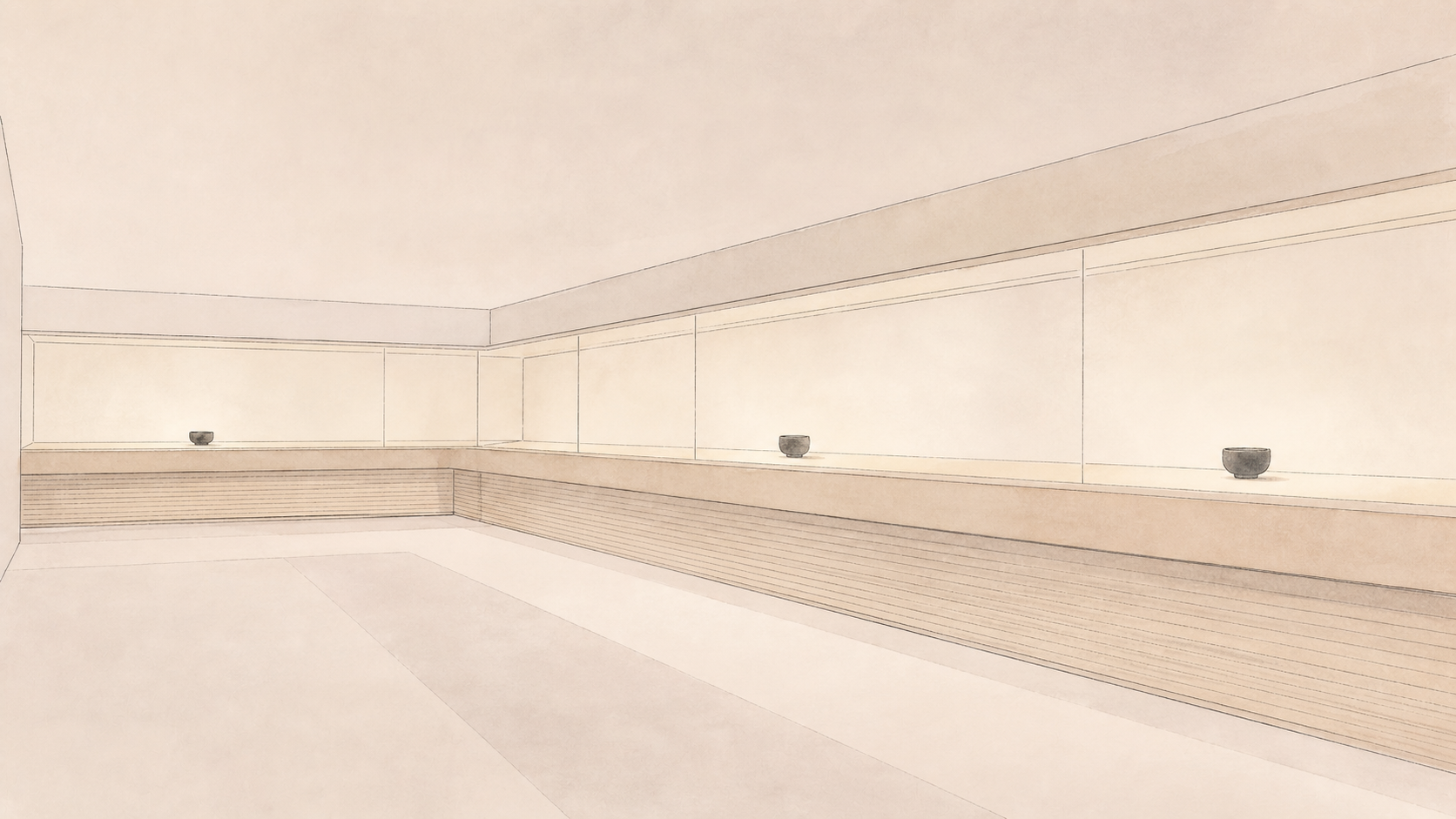
West of the Kyoto Imperial Palace, on Aburanokōji Street just south of Ichijō, the Raku Museum stands beside the Raku family and its kiln. The museum’s official guide records that it opened in 1978 under Kakunyū, Raku Kichizaemon XIV.
A museum devoted to one lineage
The collection centers on works passed down through generations of the Raku family, tea crafts, and historical documents. Pieces and records kept as references for the next maker tell a story of change across some 450 years. It is a place to bring what you know about names, techniques, and people back to the bowls themselves. How can you see those changes in a gallery? Start with one bowl, read the label, then look again.
The Raku Museum gives visitors a chance to focus on a single lineage.
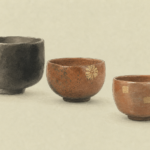
See how the quiet forms of Chōjirō give way to Dōnyū’s moving glazes, Ichinyū’s vermilion glaze, Ryōnyū’s marked trimming, and more recent approaches to form. When works by different generations are on view together, it is possible to compare what changed and what each maker reconsidered under the same Raku name.
The museum describes the tradition as a transmission to a single successor in each generation. Some successors were adopted, and members of the family also worked with people outside the lineage, such as Hon’ami Kōetsu. The line continued in part by meeting people beyond it.
Look for differences between neighboring bowls as you trace the generations.
What is on display changes
Exhibitions rotate. The exhibition theme and the condition of individual works can affect what appears in the gallery.
The museum holds Omokage and Murasame, both discussed in our guide to looking at Raku bowls and Chōjirō’s work. Either may be off display on your visit.
Check the exhibition page and checklist if there is a bowl you want to see. The collection and the current exhibition are different things.
Take a first look before reading the labels
Take a first look around the room before reading all the labels.
Remember a bowl that catches your eye. Let its outline, volume, and the light on the glaze register before considering whether it is black or red or whether the maker is famous.
Then read the maker’s name, date, bowl name, box inscription, and provenance. How does it differ from Chōjirō or later makers? What does the official description single out? Take that information back to the bowl that caught your eye.
You may see a change in rim height, glaze thickness, or the curve of the lower body that you missed the first time. The label can give you another way to look.
Rim, body, interior, foot, and glaze
The points of entry from our guide to looking at Raku bowls and Chōjirō’s work can also be used in the gallery.
Start with where the weight seems to settle. Trace the rim and follow the body into the lower curve. If the angle allows, look at the depth and glaze of the interior. If you can see the foot, check its size, trimming, clay, and marks left by kiln supports. Then step back and look at the whole again.
A display case leaves some areas out of view. A catalogue or exhibition photograph can let you look at the underside as well.
The Raku Museum has also held online events in which the camera moves close to the foot, back, interior, and seal, with explanations from a maker’s perspective. Areas hard to see in a regular display can matter to understanding the work.
A museum where you can touch the work
The Raku Museum has offered a special program that lets participants take objects in their hands and examine them.
A photograph or set of dimensions cannot convey a bowl’s weight, balance, fit in the palm, distance to the rim, or the feel of the foot. A bowl may feel different from what you imagined.
Programs vary. Check the museum’s official notice if you want to take part.
A handling session can reveal the weight, wall thickness, interior depth, and the place where the fingers meet the foot. The program and how to take part vary by event. Check the dates, what is included, and whether advance booking is required.
If you can hold a bowl, take time to move between looking at it at rest and feeling it in your hands. Compare the part that looks heavy with where the weight actually falls. That gives you another point of reference when looking through a display case.
What to check before a visit
Exhibitions change with the program and the condition of the works. Check the museum’s exhibition page and checklist before visiting if you hope to see a specific object.
For current opening hours, closing days, admission, and booking requirements, consult the Raku Museum’s official site before traveling.
If you need help moving through the building or using its facilities, check the official facilities guide and consult the museum in advance.
Check the exhibition title, dates, closing days, admission, and list of works when available. Even if a particular bowl is off display, there may be several works by one generation or black bowls by different makers that you can compare.
Where notes are permitted, try describing the form before naming the color: “the rim turns inward,” “the lower body draws in,” or “the foot is small.” A consistent order of observation makes it easier to compare your notes with the catalogue when photography is restricted.
A design perspective: Putting differences within sight
The history of Raku bowls, Chōjirō’s black Raku, the makers’ methods, and the celebrated works all provide background. It can help to set that knowledge aside briefly in front of the object.
You can look up which bowl is famous or which generation was innovative later. First stop at a bowl that catches your eye. Follow the rim, watch the light on the glaze, and imagine how it would feel to hold.
Then read about it and return. The information has done useful work if the same bowl now shows you a line or color you missed.
In a museum focused on one lineage, small differences come through: a few millimeters at the rim, the sheen of a glaze, the swell of the lower body. Similar objects make their differences visible when shown together.
Seeing generations together lets you follow change within one kind of bowl. Compare the rim, body, foot, and glaze of two neighboring bowls one at a time. This succession shows makers revisiting earlier choices.
Conclusion: Begin again with one bowl
Names, dates, and techniques are a start. Taking time in front of a bowl and imagining it passing into your hands gives that knowledge a concrete form.
After seeing the objects, you may have more questions and want to see another bowl. The visit gives you somewhere else to begin.
At the museum, move between the whole bowl and its details. Then compare the same places on the next bowl. When you can describe a difference, the long span of generations becomes visible in the forms themselves.
After visiting, write down one difference you saw in a contour or felt in your hands. It will give you a place to begin at the next exhibition.
 Why Raku Tea Bowls Leave Room for the Hand
 Why Raku Tea Bowls Are Shaped by Hand: First Raku, Second Hagi, Third Karatsu
 What to Look for in a Raku Tea Bowl: Rims, Feet, and Bowls Associated with Chōjirō
 How Raku Continues by Changing: A Tradition with Room for Different Forms