
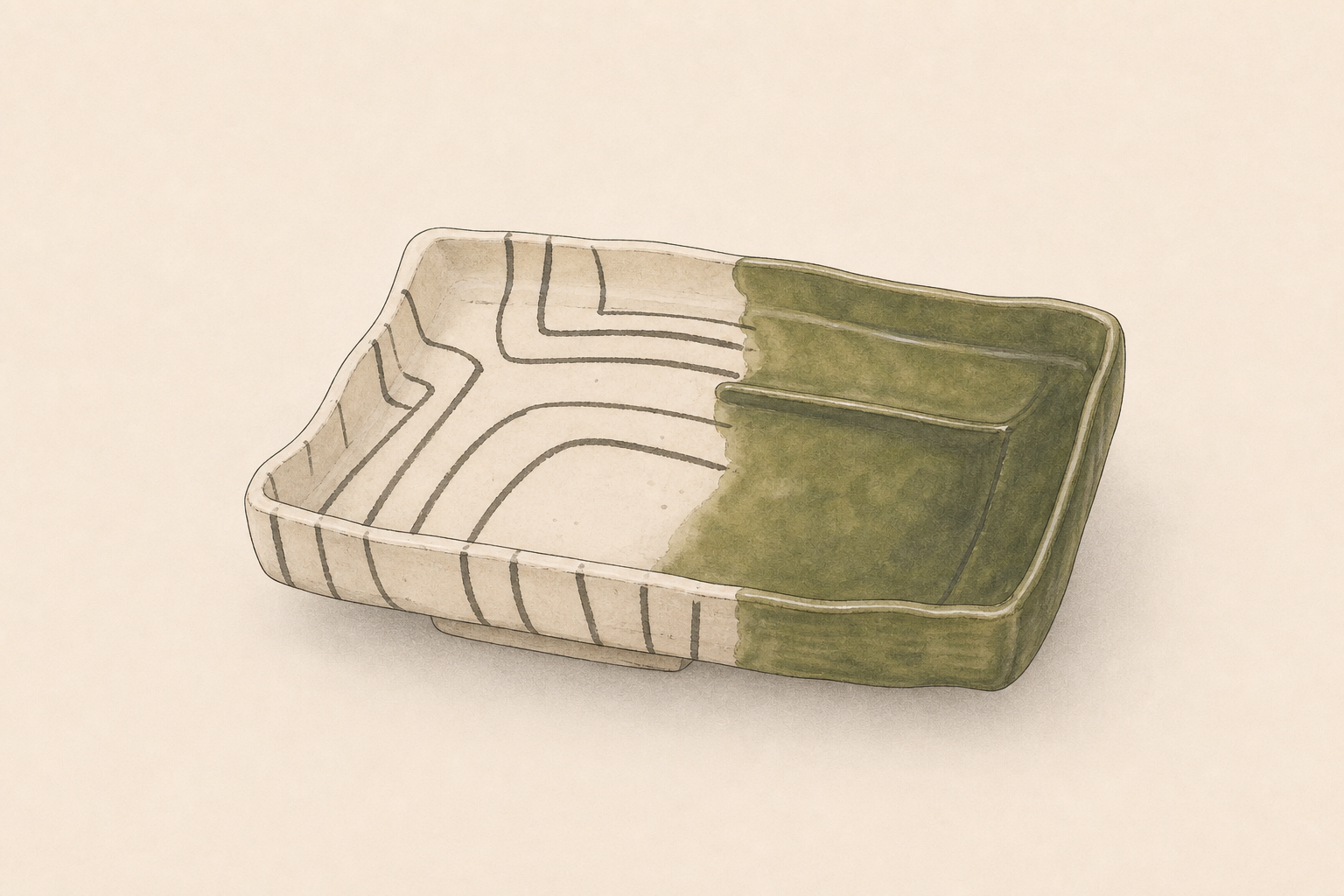
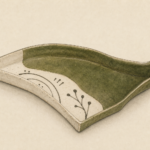
Green glaze, sharp shifts from black to white, distorted outlines, and bold designs all belong to Oribe ware. How do vessels that give up an even, regular form arrive at such a strong sense of balance? The first clue is that Oribe ware comes in many forms.
The many kinds of Oribe ware
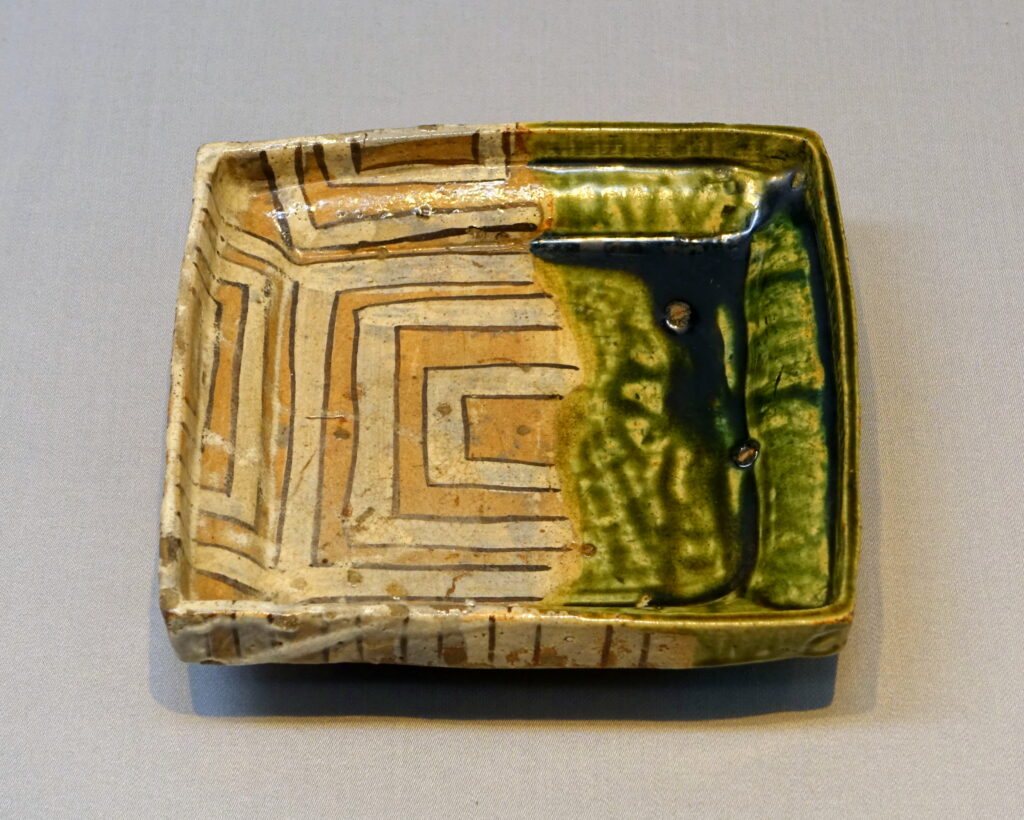
Oribe ware is a glazed ceramic that developed in Mino in the early seventeenth century. It is famous for green glaze, but there are many varieties distinguished by color and technique, including Ao Oribe, Sō Oribe, Kuro Oribe, Oribe-guro, Aka Oribe, and E Oribe.
The ware takes its name from Furuta Oribe. The name by itself cannot tell us that he directly instructed the makers of every vessel we now call Oribe ware. The style is better understood in the context of both the taste associated with Oribe and developments in technique and production at the Mino kilns.
As you move around a vessel, follow the edge of the green glaze, the changes in height along the rim, and the point where the eye settles once the vessel holds food or tea. The irregular shape gives the eye a direction and a sense of movement that an even outline would not.
Green glaze changes the way the form reads
The deep green associated with Oribe comes from a glaze containing copper. The glaze can cover the entire vessel or meet a white area or an iron-painted design.
A broad green area gives a part of the vessel visual weight. A small patch makes a place for the eye to stop. Color divides the form and shifts its apparent center of gravity.
Why make a tea bowl in the shape of a shoe?
Black Oribe and Oribe-guro include shoe-shaped bowls, or kutsugata, that look like a round bowl pressed out of shape. The rim rises and falls, and the body bulges and curves inward.
There is no single fixed angle from which to see this shape. Turn the bowl and a different outline appears. The places where you support it change too. The form reveals itself as you hold the bowl, turn it, and drink.
The rim has a long axis and a short one. It offers more than one possible front and invites you to choose where to hold the bowl and where to drink. As the tea spreads along the oval interior, both the surface of the matcha and the rim take on a direction. Changing the form changes the actions it calls for.
The elongated tea surface makes the approach to the bowl feel more directional than in a round bowl. The distortion affects both how the tea looks and the angle at which you bring the bowl to your lips. The difference begins inside the bowl and carries through to the way you use it.
Bold patterns and the force of blank space
Lattices, plants, flowers, and geometric patterns can look as though they are about to spill over the outline of an Oribe vessel. Plain glaze and stretches of blank white remain beside them.
The strength of the lines is only part of what makes the patterns bold. Much of the effect comes from the difference between painted and unpainted areas. Slight shifts in the repetition give the surface a rhythm.
A cluster of geometric shapes, plants, or abstract lines may sit beside an unpainted area or a plain pool of glaze. The relative widths of the painted and unpainted areas show how the design works across the whole vessel.
Where the iron-painted lines stop short of the green glaze, the unpainted area is part of the composition too. A curved surface can hide part of a pattern set off center and let it come into view as you turn the piece. The gap changes the moment at which the next part appears.
Departing from a familiar form
Graphic and product designers still move elements off center, leave out a piece of a letter, or set dissimilar materials against each other. Making everything irregular is rarely enough to give it character.
Oribe ware still has to work as a bowl or a serving vessel. Clay and glaze must survive the firing. Keeping those requirements leaves room to alter the outline or the pattern. The stable parts give the variation force.
A vessel has to stand, be held, and, in the case of a tea bowl, meet the lips. Distort everything and the sense of direction disappears. Decorate everything and the accents are lost. Oribe ware shifts some parts of the outline, pattern, or glaze while keeping others quiet.
Even a very freely shaped bowl depends on a stable foot, room for the whisk inside, and a rim that meets the mouth at a workable angle. Those are places to look for the choices that keep a departure from regular form from getting in the way of use.
How the composition changes as you turn the vessel
A photograph of Oribe ware can draw the eye to the boldest face. A bowl is three-dimensional. Turn it slightly and the visible area of green glaze, the edge between black and white, and the position of the design change.
A symmetrical vessel tends to remain visually steady as you move around it. An irregular Oribe vessel can feel steady from one side and precarious from another. The person using it has a chance to find a view of their own.
In a serving vessel, the colors and shapes of the food change the composition again. Food or tea can bring the vessel to a new balance. That flexibility lets Oribe ware make a strong visual impression and still serve as an everyday utensil.
The green itself can vary across one vessel. The thickness of the glaze and the firing can produce deep greens, lighter greens, and passages with a brown cast. Pale clay, black iron painting, and a darkened edge can meet, making the boundaries between colors something to look at in their own right.
In mass production, uneven color may be rejected as a defect. In Oribe ware, the kiln can leave variations even where the maker controls the technique. The choice of where to apply the glaze and what shape to put into the kiln leaves room for changes that cannot be fully predicted.
As you turn the vessel, green glaze, iron painting, and areas of bare clay come into sight in succession. A single photograph from the front cannot show how soon one area gives way to the next or how quiet the back can be. The composition unfolds over the time it takes to turn the piece.
Conclusion: A balance between order and irregularity
An Oribe vessel may shift the shape, color, pattern, or use of blank space in one place and find a new balance across the whole.
A familiar order gives the potter a way to judge where a departure might bring out a different quality. An irregularity can acquire a character of its own.
The maker shapes what can be decided in advance and leaves room for changes brought about by the clay and the heat. The variations on the finished piece can carry traces of both.
Look for the point where an outline, a design, a glaze, or a blank area gives way to the next. In the way those transitions move the eye as you hold the vessel, you can see how precisely a familiar shape has been unsettled.
 Who Was Furuta Oribe? The Tea Practitioner Who Followed Rikyū and Found a Style of His Own
 How Furuta Oribe Changed the Tea Room
 Hyōgemono: The Playful Side of Furuta Oribe’s Tea
 Who Was Kobori Enshū? The Tea Practitioner Who Brought a New Refinement to Tea
