
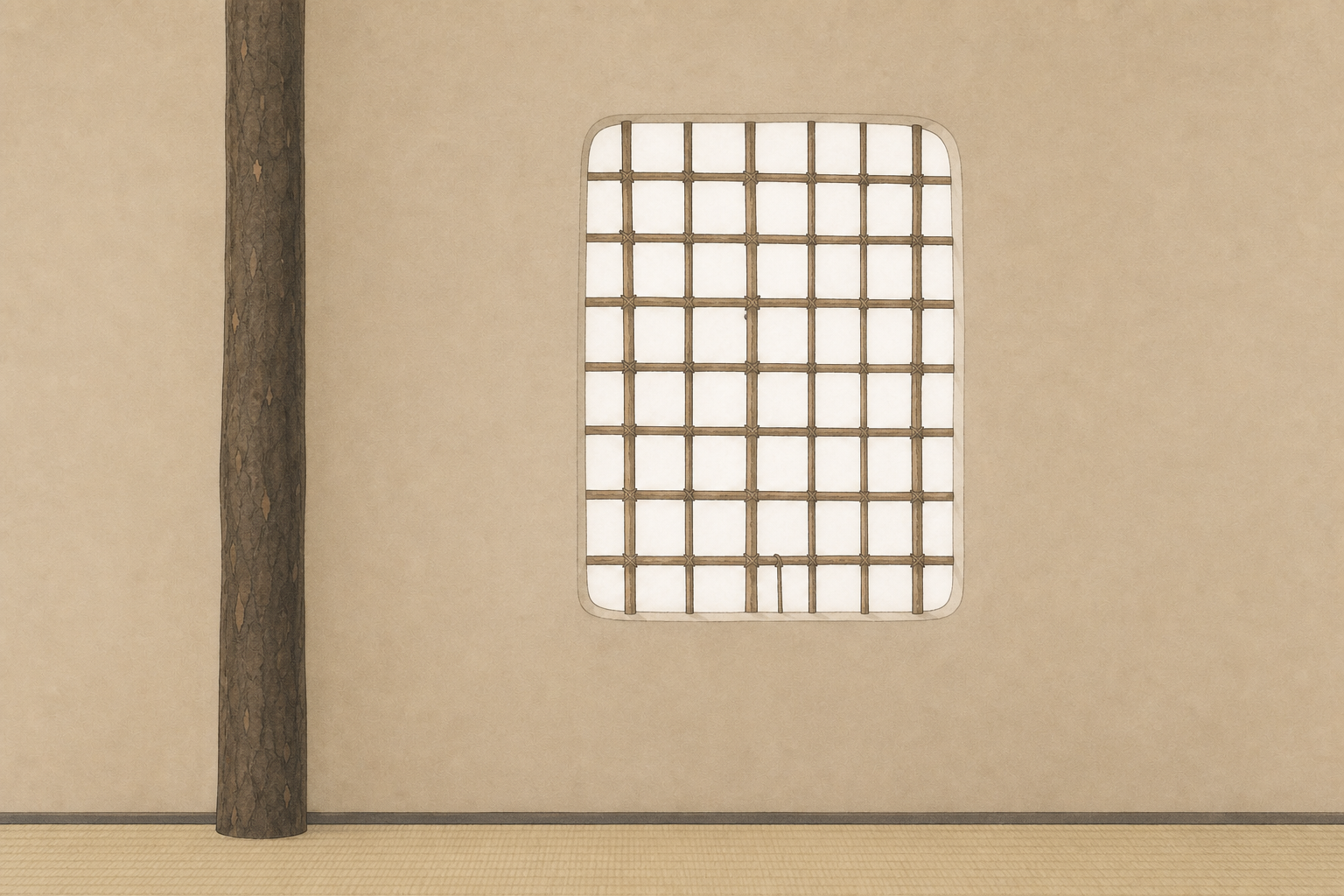
Furuta Oribe worked within the tradition of Rikyū’s small tea room and brought changes to its light, its seating, and the way utensils were brought together. How did he use those details to give the guests something to discover? The starting point is the small room he inherited from Rikyū.
What Oribe took from Rikyū’s small tea room
Oribe’s tea rooms build on the small size and simplicity of the hut-style rooms Rikyū developed. Their dimensions and light could nevertheless vary.
Ennan, an Important Cultural Property, preserves a layout associated with Oribe’s taste. It has a three-mat room with a shorter daime mat and an adjoining sōbanseki, a seat for an accompanying guest. The design makes the positions and relationships of those guests part of the room alongside those of the host and principal guest.
Oribe kept the proximity of Rikyū’s small room while changing the number of guests, where an accompanying guest could sit, and the directions from which utensils came into view. The earlier room provided a way to bring people close together. Oribe used it to accommodate different ways of seeing the same gathering.
The intimacy of Rikyū’s small room gave Oribe a starting point. He could bring other relationships into a single gathering by changing the guests’ seating and sightlines, while keeping the closeness that a larger reception room would have lost.
A separate seat brings another point of view
The sōbanseki gives an accompanying guest a place to take part from a position separate from the principal guest. People in the same room see it from different points of view.
Seating follows roles and relationships. The arrangement can reflect social rank and also give conversation and sightlines more than one direction. Each guest experiences the room from their own seat.
The surprise produced by light and utensils
Oribe’s tea brought together irregular bowls, boldly shaped water jars, and decorative vessels for the meal. The outline of a single strong shape stands out against a quiet earthen wall.
A restrained setting can make one unexpected object enough to draw the guest’s eye. The selection of utensils changes how the whole room feels.
Look at the order in which objects come into view from the entrance, the position of the accompanying guest, and the angle at which light reaches a vessel. A quiet room can give the eye and the conversation places to go.
The tea room as a sequence of discoveries
A guest follows the roji garden path, changes posture at the entrance, looks into the alcove, and encounters the utensils. What there is to see emerges as they move.
This sequence gives Oribe’s playfulness a place. A surprising shape would lose its effect if everything about it were explained at the entrance. The moment and distance at which the guest can see it matter.
In a room laid out in this spirit, a turn, a post, or the end of a wall can make an object or another person come into view. The guest pieces together those relationships while moving. A partly obstructed view can create anticipation.
When a post or a short wall hides part of the view, a guest may shift their head or their body. Finding an object or another guest becomes something they do for themselves. The room gives them a sequence in which to look.
Quiet makes room for play
It is easy to imagine that nothing happens in a quiet place and that a playful place must be noisy. Quiet is precisely what allows small differences to register.
The quiet of Rikyū’s room provided a background against which Oribe could make a shift in form or a change in conversation easier to notice. Restraint leaves room for surprise.
An irregular bowl or an unexpected window can stand out without making the room feel busy. Against a restrained background, one departure from the surrounding order is enough to give the eye a focus.
Several playful details can be spaced so they appear one by one. You might see a window as you enter, a utensil when you sit, and its pattern when you turn it. Each surprise has time to register.
A quiet interval before and after a change lets the guest take it in at their own pace.
Arranging the utensils changes the space
The walls and ceiling are only part of what makes a tea room. The scroll in the alcove, the flower vessel, the bowl brought to the guest, and the dishes for the kaiseki meal all contribute. Different combinations can make the same room feel bright or taut.
A number of bold utensils of the sort associated with Oribe can compete for attention. Their effect depends on where one is shown and what is kept quiet around it. A single change can carry more force in the course of an otherwise restrained gathering.
The objects that appear over time are part of the design of a room, alongside its fixed architecture. Oribe’s tea treated the room as a place that could be arranged afresh for each gathering.
Rooms associated with Oribe’s taste accommodated the numbers and roles of people at gatherings among the warrior elite. The small room made room for an accompanying guest and for the handling of utensils. Its dimensions answered to what would take place there.
A window does more than set the overall brightness. More light can make the green and the patterns of Oribe ware or the colors of the meal vessels easier to see. The forms of the objects and the light and surfaces around them can be considered together.
Toriawase, the selection and arrangement of utensils, is part of the space. A shoe-shaped bowl, a water jar of a different material, and the place where light falls can be arranged in the order in which a guest might notice them. Each object has room to show a character of its own.
An unusual room loses much of its effect if its layout has nothing to do with how guests move or where utensils appear. The windows, seats, and orientation of the utensils can work together in the order in which the guests discover them.
Conclusion: A room that leaves something to discover
A tea room can calm the mind and still make room for the unexpected. A guest walks, sits, looks up, and turns toward the person beside them. Each movement can reveal something they did not expect to see.
Oribe changed the sequence in which guests discover the room as well as its appearance. A small departure from the expected layout gives people a reason to look again.
In an exhibition or shop today, changing the objects alone may leave some of their appeal unseen. Distance, brightness, and the order in which objects appear can be adjusted to what there is to see. Oribe’s tea room offers a way to think about the objects and their setting together.
Oribe kept the intimacy of Rikyū’s rooms and changed the seating, the views, and the way a guest comes across the utensils. Those changes gave the guest more to discover within a small space.
 Who Was Furuta Oribe? The Tea Practitioner Who Followed Rikyū and Found a Style of His Own
 Why Oribe Ware's Distorted Shapes Are Beautiful
 Hyōgemono: The Playful Side of Furuta Oribe’s Tea
 Who Was Kobori Enshū? The Tea Practitioner Who Brought a New Refinement to Tea