
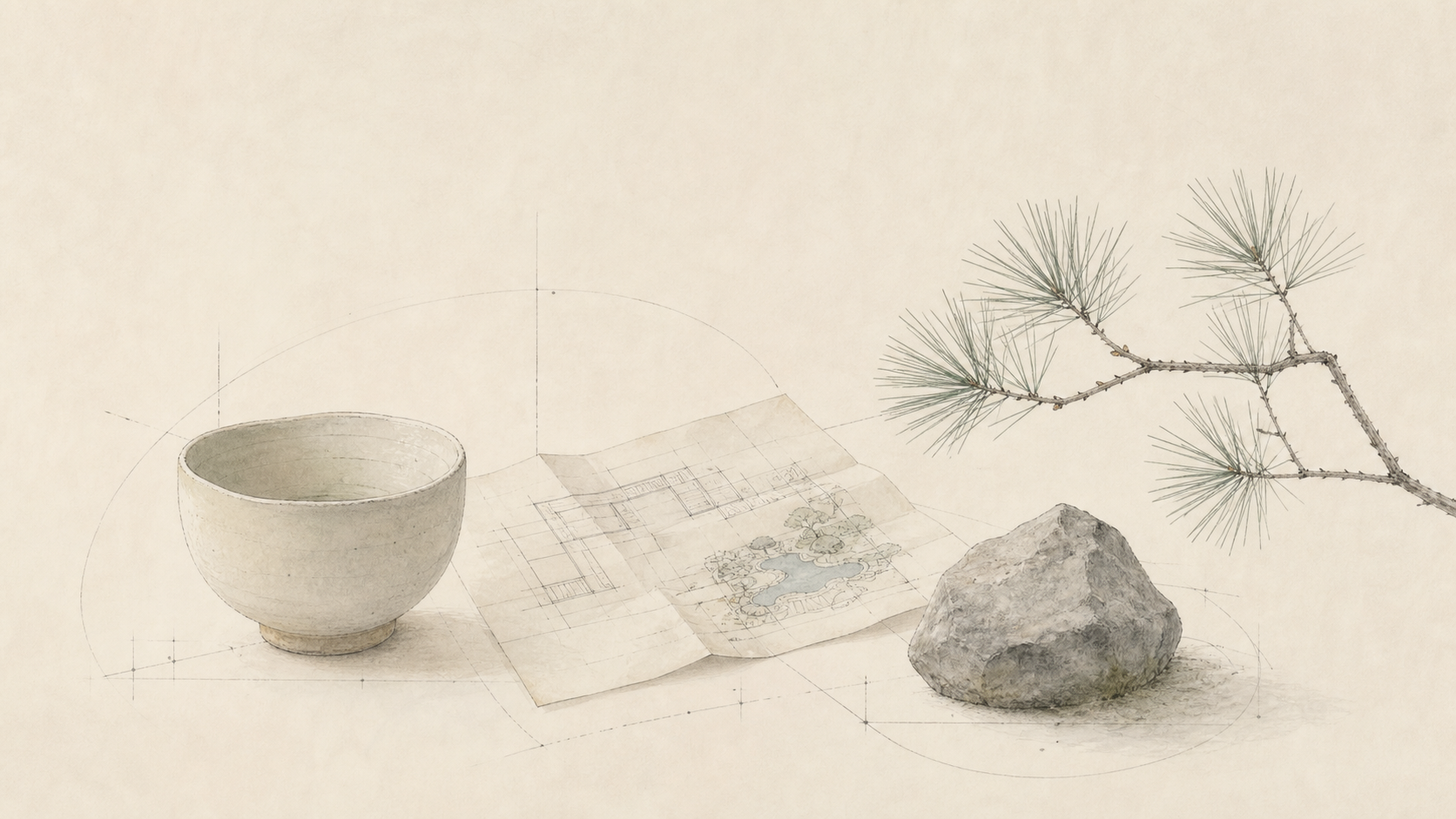
Kobori Enshū was a daimyō and tea practitioner, a magistrate in charge of construction, and a figure in architecture and garden design. After Rikyū and Oribe, he brought a brighter refinement to chanoyu. His life begins with another name, Kobori Masakazu, and the appointment that gave him the title Enshū.
Kobori Masakazu and the name Enshū

Kobori Enshū was born in Ōmi in 1579. His given name was Masakazu. He later became known as Enshū after receiving the court title Tōtōmi no Kami.
A daimyō, he worked on buildings and gardens as a construction magistrate for the Edo shogunate, and at the same time served as a tea instructor to the Tokugawa shogunal family. His work extended well beyond the role of a tea practitioner alone.
One way to see Enshū’s range is to ask how he brought utensils, words, buildings, and gardens together. His refinement came from working with the different standing and character of each element to give the whole a sense of dignity.
Learning in the wake of Rikyū and Oribe
According to the Enshū school, Enshū met Rikyū when he was young and began to study under Furuta Oribe at fifteen. He was in a position to carry Rikyū’s wabi and Oribe’s bold inventions into another generation.
Enshū also brought something of his own to tea: courtly elegance, waka poetry, and calligraphy. He joined them to chanoyu to develop a bright, composed aesthetic.
The work of a construction magistrate
A sakuji bugyō oversaw major building projects such as castles and palaces. Enshū brought the work of builders together with the supply of materials, the budget, ceremonial requirements, and the needs of the people who would use the space.
He set out standards and an overall plan that allowed specialists to do their work. In modern terms, it was a role that combined aspects of architecture, public administration, and production.
A construction magistrate had to consider the site and how people would move across it as well as the design of the building itself. Enshū’s eye for order developed through the practical work of coordinating artisans, materials, ceremonies, and budgets on public projects.
It took more than drawing what he liked. The builders’ skills, the available materials, and the requirements of a ceremony had to come together in a single experience. That ability to work within several constraints helped give Enshū’s style its refinement.
Choosing utensils and shaping their stories
Enshū selected utensils now called chūkō meibutsu, celebrated objects of the later generation. He gave tea caddies names drawn from classical poems and chose their shifuku cloth pouches, boxes, and wrappings.
He treated the object, its name, provenance, and accessories as a whole. Words and layers of history became part of how an object was seen.
A name from a poem changes the time a guest spends looking at the caddy without altering its surface. Shape, box, cloth, and words could be arranged in an order for the guest to encounter over the course of a gathering.
A name can connect the shape of an object to a waka poem or a remembered place. The box and pouch also give the guest a sequence in which to approach the object. The form stays in the memory together with its name and history.
Notice which part of a utensil stands out after you hear its name. That is one way a story can change how a form is seen.
Working across disciplines
Enshū’s work extended through tea, architecture, gardens, calligraphy, waka, and the crafts. What matters is how he brought those pursuits together with a consistent sense of form.
A garden stone and the beveled surface of a tea caddy differ in size and material. Both invite us to consider the clarity of a line, the balance of a placement, and the room left around it.
The scale changes as you move from a gateway to a garden, a room, a utensil, and finally a name. Across those scales, one can see an interest in bringing elements of different standing together and guiding the eye from one to the next.
From a distant garden view to the lid of a tea caddy, Enshū gave some elements a foreground role and let others support them. His projects can be read together by looking at how he brought different materials and qualities into accord.
What leads and what supports remains a question at every scale.
Who was Enshū designing for?
In the early Edo period, when Enshū was active, tea reached from warriors and townspeople into the circles of the shogunal family, court aristocrats, and daimyō. People with different backgrounds needed forms they could share as well as the example set by an individual with a strong taste.
Enshū hosted gatherings, selected utensils, chose names and boxes, and worked on buildings and gardens. His work gave people from different backgrounds ways to recognize an object’s value. Giving it a name, tracing its history, and recording how it was handled helped pass on an appreciation of it.
Refinement can offer more people a way into a practice while preserving its depth. Enshū brought his aesthetic into the arrangements that let people take part in it.
The Enshū school records that he hosted more than four hundred gatherings in his lifetime and received daimyō, court aristocrats, shogunal retainers, and townspeople. A utensil could speak differently to each. Names and combinations of utensils could connect those different worlds.
A name drawn from waka offered a point of entry to someone at home in court poetry. The standing of a utensil and the way it was fitted out could convey a sense of order to a member of the warrior class. Enshū also found uses in tea for imported materials and vessels. His style could take in those differences and still hold together.
Enshū’s arrangements made room for guests from different backgrounds, the dignity of a formal setting, and the intimacy of tea. Allowing for the people in the room is part of what gave kirei sabi its form.
Conclusion: The beauty of bringing things into balance
Rikyū pared things back, and Oribe departed from familiar forms. Enshū made a new selection from many elements and brought them into harmony. The result still gave each element a distinct role.
Different materials, periods, and social positions could meet in one setting and retain their character. Enshū’s refinement gave those differences a way to work together.
The description “cultural organizer” fits a man who created settings for people and objects to meet and developed names and forms through which their value could be passed on.
Enshū brought gardens, buildings, utensils, and words into relation while letting each do a different kind of work. The connection between that practical work and his eye for beauty gives his projects their character.
 Who Was Furuta Oribe? The Tea Practitioner Who Followed Rikyū and Found a Style of His Own
 Why Oribe Ware's Distorted Shapes Are Beautiful
 How Furuta Oribe Changed the Tea Room
 Hyōgemono: The Playful Side of Furuta Oribe’s Tea
