
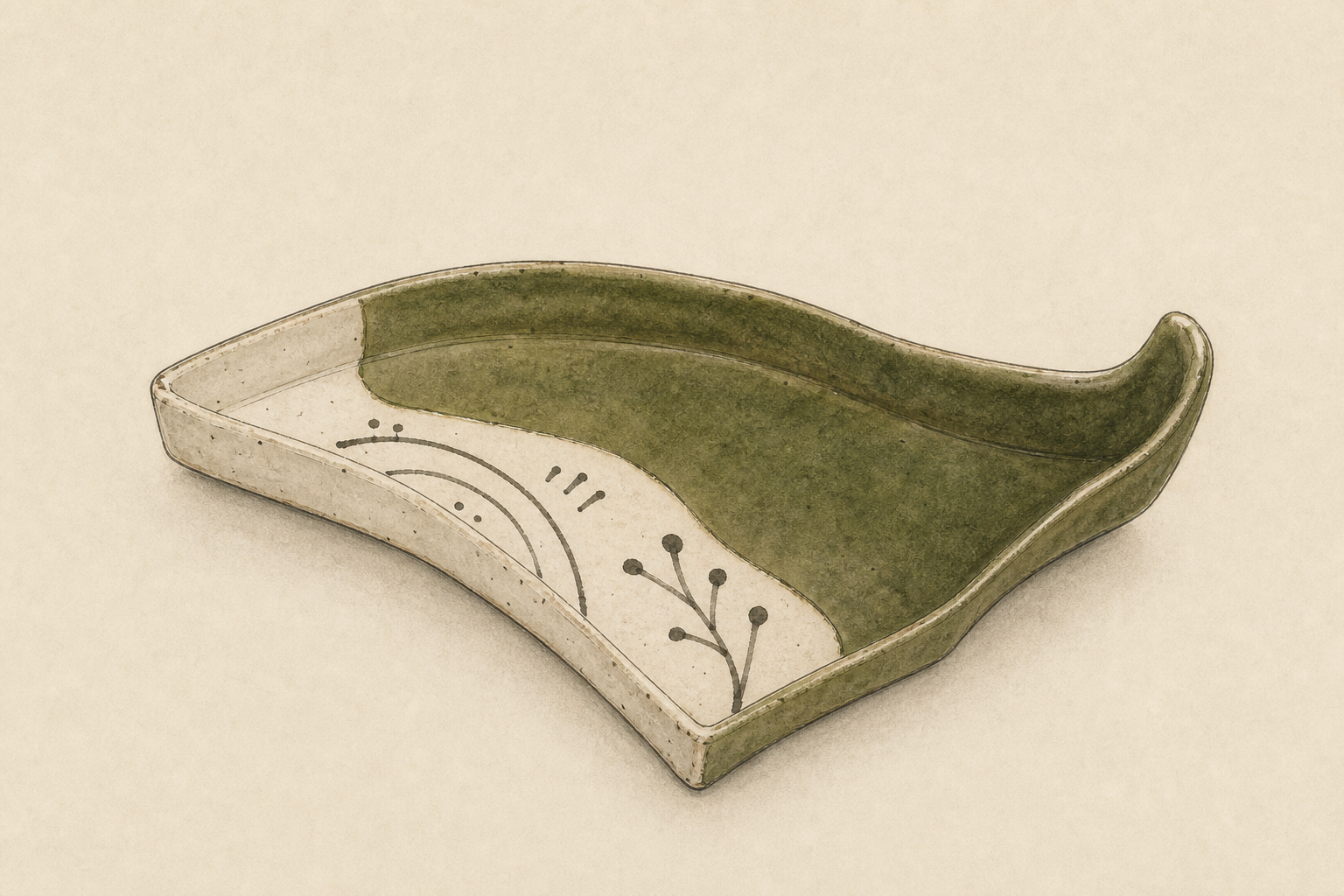
A hyōgemono is something eccentric or playful. In Oribe’s tea, laughter and play can give people a new way to look at a familiar form. What does it mean to behave or make something in that spirit?
What does hyōgeru mean?
Hyōgemono is a word often used to describe Furuta Oribe’s aesthetic. The verb hyōgeru can mean to jest, to behave playfully, or to act in an unusual way.
The ordinary word “funny” captures only part of it. A deliberate departure from a well-ordered form can leave you momentarily unsure of what you are seeing and make it hard to look away.
Think of a person who knows the balance of a well-made bowl and the established gestures of tea, yet chooses to shift the center of gravity and upset an expectation. The word includes the wit or amusement we find in precisely how they depart from the familiar.
The verb describes a movement away from an established form. A shift in a contour, a pattern, or a gesture can take the viewer by surprise and bring physical movement and laughter back into a stiff encounter.
Looking at which way the object departs from the expected shape helps distinguish a choice from eccentricity alone.
Laughter gives us a way into a work
An uneven bowl or a dish of an unexpected shape can surprise you before you have time to think. Sometimes the first response is a laugh.
Laughter eases the pressure to understand a work correctly and gives you a chance to look at the shape for yourself. With Oribe’s playfulness, a spectator becomes someone who can respond.
A shoe-shaped bowl or a bold pattern invites more than one reading. As you work out which side is the front or what the design depicts, you move, and a conversation can begin. A laugh can make a highly esteemed object feel close enough to look at with your own eyes.
In the moment of laughter, the object comes a little nearer. Rather than simply deferring to a celebrated utensil, you can turn it and ask the next guest what it looks like to them. The shape invites participation.
A familiar form makes departures visible
A departure depends on people knowing the form it departs from: the round rim, the balanced pattern, and the established arrangement of utensils. Oribe knew those conventions.
A slight shift can be enough. Press the rim. Interrupt a pattern. Set black against white. The playful effect comes from the difference between the parts that keep their order and the part that breaks away.
A round opening, stable balance, and the layout of a conventional pattern make an oval, a tilt, or a gap stand out. Familiarity with the rules gives Oribe room to choose an effect.
With a round bowl, symmetry, and the center of a pattern as points of reference, we can judge how far a vessel departs from them. Oribe uses a familiar form as a language shared with the viewer and changes a part of it.
Play needs room
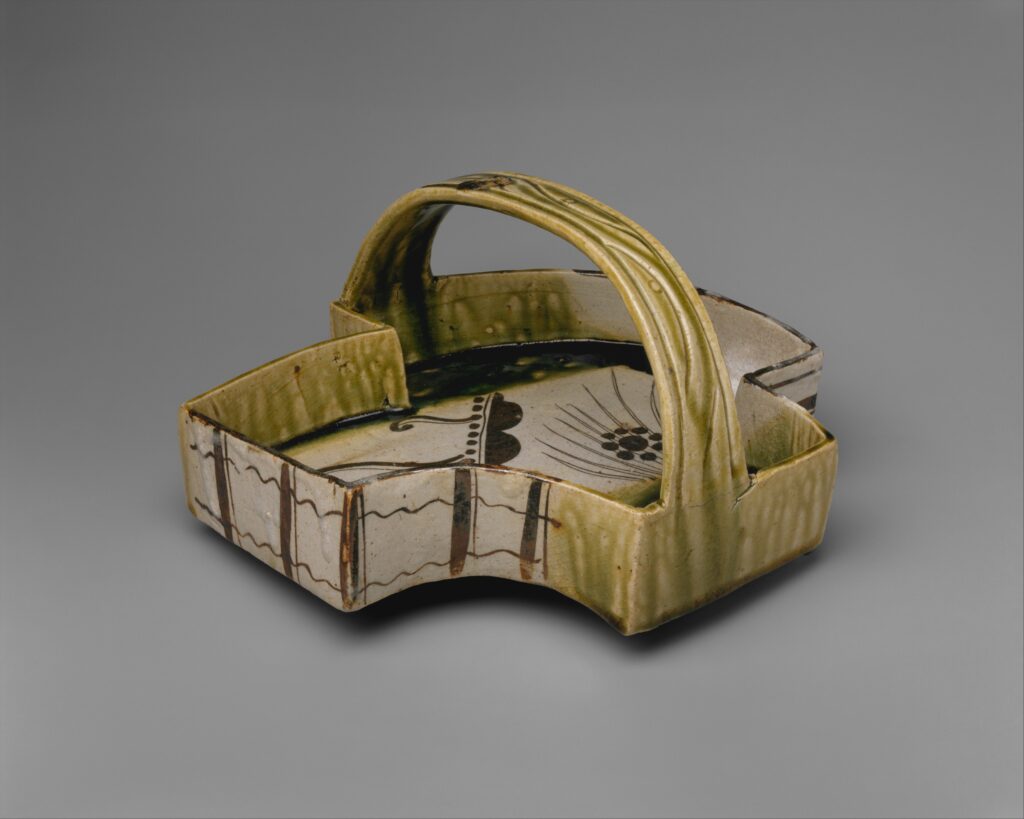
An object with a single settled explanation gives its viewer little to do. What does it look like? Which side is the front? Why is that line there? Oribe vessels leave such questions open.
They leave room for the viewer’s imagination. That opening sets up a small exchange between the maker and the person who uses the piece.
Room for play can be a vacant surface, a range of possible interpretations, or a way for an object to work with other utensils while still doing its job. If the meaning is left open, the user can decide how to turn the object or what to set beside it.
Leaving a meaning open lets the user choose a front and change the arrangement while the bowl still works as a bowl. Play can work within those practical limits and give others a part in the outcome.
The amusement can outlast the first encounter. Each use gives you another chance to find a different side of the object.
Care and play belong together
Tea calls for care in cleansing the utensils, receiving guests, and attending to the season. There is room for play within that care.
A small joke can work precisely because the setting has been prepared with such attention. It keeps that seriousness from becoming oppressive.
Leaving a question open
The history and standing of a formal masterpiece offer a way to look at it. A playful vessel may instead prompt the question, “Why is it shaped like that?” There is value in looking for a little longer before an explanation settles the matter.
An open reading can be a quality of the work. A pattern might suggest a face, an animal, or a landscape. Viewers bring different memories to it and see different things.
If every correct meaning is supplied in advance, reading about a tradition becomes an exercise in checking answers. Oribe’s humor makes it possible to approach a piece while still unsure of it. A sense of beauty can develop by following your own response and continuing to look, as well as through study.
Treating hyōgemono as a story about one eccentric man misses the play that survives in the vessels. A viewer or guest can trace the uneven rim with a finger, say what the design brings to mind, and exchange impressions with a neighbor. Those responses become part of the gathering.
Humor changes the distance between the viewer and an object with a reputation. Looking for the correct answer alone gives a guest little to do. A slightly playful bowl makes space for a guest’s own impressions even in a formal room.
Conclusion: Beauty leaves room for a smile
Standing in front of a work of art or a traditional object, you can feel you need to know the correct answer. Oribe’s playful forms relax that posture a little.
Quiet and dignity have a place in beauty. So do surprise, hesitation, and a laugh that makes you look again. Play opens up another way to see.
If surprise becomes the only goal, play becomes a competition in tricks. Oribe’s vessels still offer a shape, a color, and a texture to look at after the initial surprise. Humor can keep drawing you nearer long after the first laugh.
The effect depends on which part of a familiar form moves and which stays in place. In Oribe ware you can see where a vessel keeps working and where the person holding it gains some freedom to look.
 Who Was Furuta Oribe? The Tea Practitioner Who Followed Rikyū and Found a Style of His Own
 Why Oribe Ware's Distorted Shapes Are Beautiful
 How Furuta Oribe Changed the Tea Room
 Who Was Kobori Enshū? The Tea Practitioner Who Brought a New Refinement to Tea
