
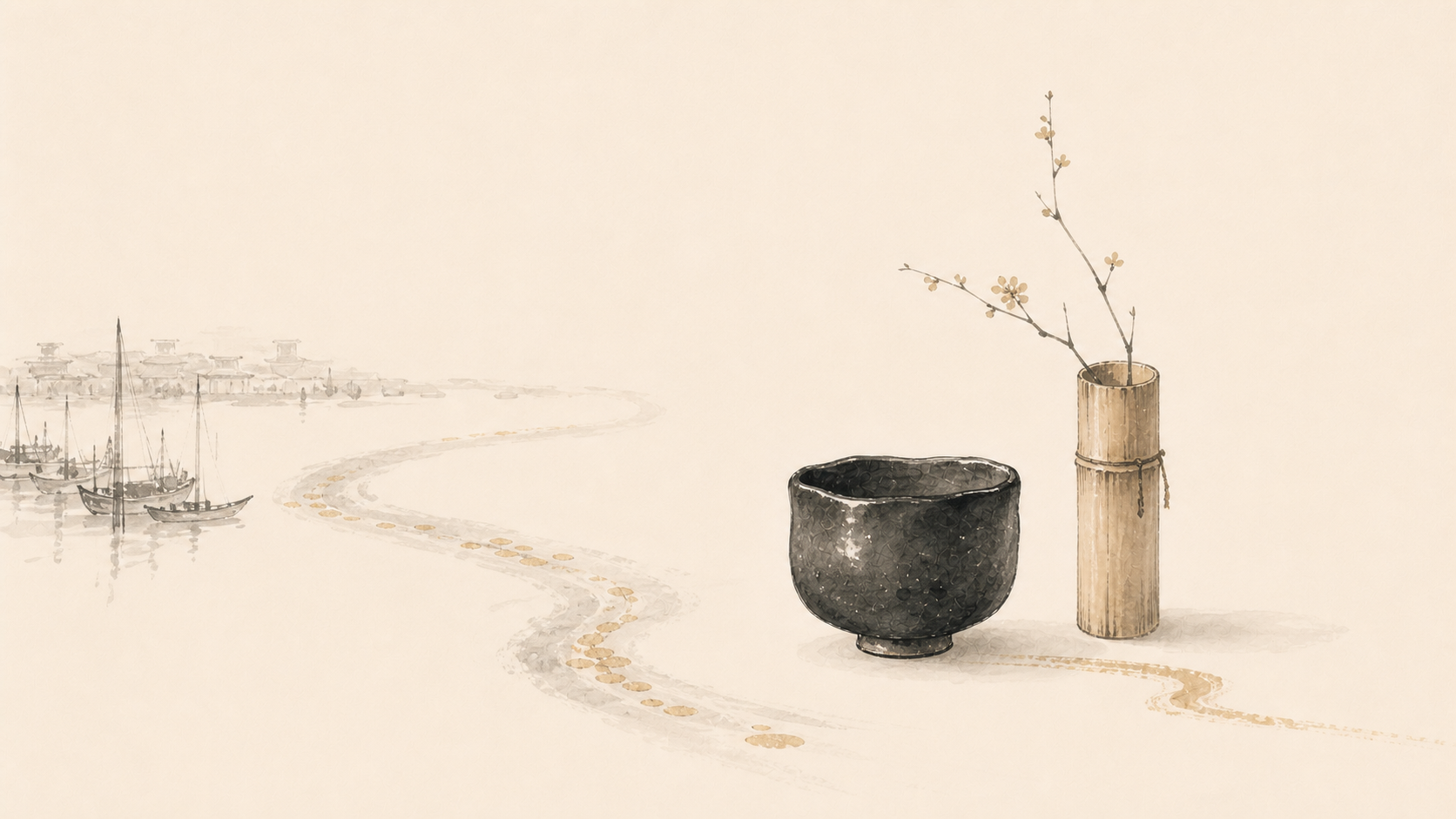
Born into a merchant family in Sakai, Sen no Rikyū served Oda Nobunaga and Toyotomi Hideyoshi. His reputation reached beyond the world of tea to become part of how Japanese culture is understood. His life and work, beginning with a boy named Yoshirō in a trading town, help explain why.
Yoshirō, born into a merchant family in Sakai
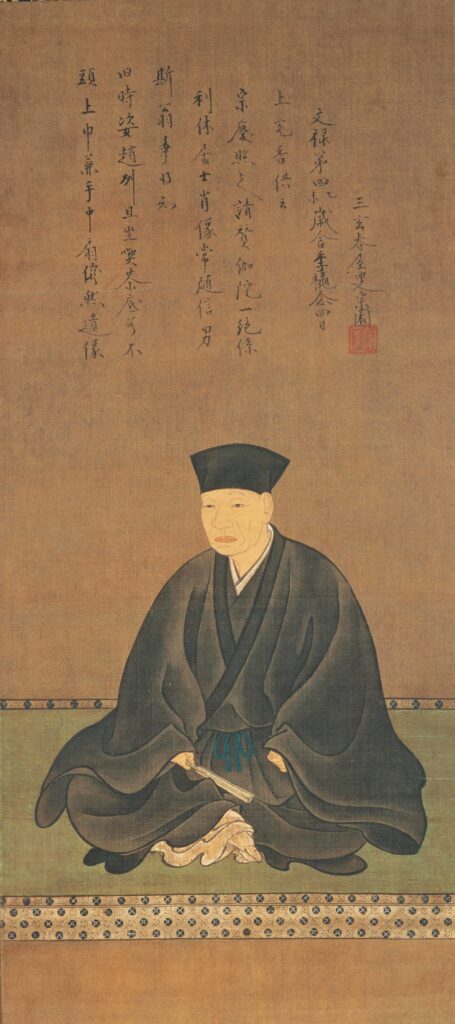
Sen no Rikyū was born in 1522, the second year of Taiei, in Sakai, a flourishing international trading city. His childhood name was Yoshirō. He came from the townspeople, raised in a wealthy merchant household known as Totoya rather than a warrior family.
Sakai merchants handled goods that came from China and the Korean peninsula. They helped carry culture as well as receiving it. Chanoyu was a practice of looking at utensils and receiving guests, and an occasion to exchange information and build trust. Rikyū’s start in a merchant city helps explain the work he did later.
Dates alone show only part of a life. At each stage, consider whom Rikyū received, what utensils he chose, and what spaces he used. In the course of drawing closer to power, he gave form to values distinct from splendor.
Learning from Kitamuki Dōchin and Takeno Jōō
Rikyū began studying chanoyu young, first under Kitamuki Dōchin and later under Takeno Jōō. Jōō developed wabi tea, which found beauty in simple settings and utensils close to everyday life alongside the treasured wares brought from China.
Rikyū made tea rooms smaller, commissioned new utensils, and brought the light and the guests’ path into the composition of a gathering. He took the forms he had learned and gave guests a more distinct experience of them.
Tea master to Nobunaga and Hideyoshi
Oda Nobunaga brought Sakai under his rule and used renowned tea utensils and gatherings in his politics. Rikyū became one of his tea masters alongside Imai Sōkyū and Tsuda Sōgyū. A tea master supervised gatherings and advised on utensils and how to present them.
After Nobunaga died, Rikyū served Toyotomi Hideyoshi. He was closely involved in the 1585 gathering at the imperial palace and the 1587 Grand Kitano Tea Gathering. The work extended beyond making tea. He brought the ruler’s wishes, the guests’ standing, the distinction of the utensils, and the character of the place together in one occasion.
The position called for practical judgment beyond the ability to prepare a bowl. Which object would be shown to whom? In what setting would it be used? How would a gift or an object bestowed by a ruler be handled? Those decisions worked in a political setting. Rikyū’s closeness to rulers means the aesthetics of wabi cannot be explained entirely outside the world of power.
Displaying a celebrated utensil was itself a display of authority. Rikyū worked within that system and brought bamboo, clay, and black surfaces into the gathering. At the center of power, the choice of what to leave out could carry particular force.
Choosing black and clay in an age of gold
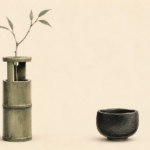
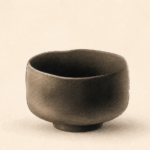
While Hideyoshi used a golden tea room, Rikyū chose black Raku bowls, bamboo vases, and small tea rooms with earthen walls. He knew the worth of renowned utensils well. That knowledge makes his presentation of another kind of beauty all the more striking.
He pared back what a guest needed in the moment of drinking, leaving room for the texture, light, and the distance between people to matter alongside price and provenance. This shift helps explain how the work of one gifted practitioner changed a culture.
Set the golden tea room and black Raku simply against one another, and Rikyū’s work looks like a rebellion against display. Different guests, purposes, and occasions called for a different degree of emphasis. A black bowl could concentrate the gaze in a way gold did not.
The subdued sheen of black Raku, the node on a bamboo vase, and the uneven face of an earthen wall bring hand and material into view at close range. They turn attention from price or scale to use. A change in the standard by which objects were seen mattered as much as a change of objects.
The break with Hideyoshi and Rikyū’s death
In 1591, the nineteenth year of Tenshō, Rikyū died by seppuku on Hideyoshi’s order. Accounts variously point to the wooden statue at the gate of Daitokuji, the buying and selling of utensils, or a political conflict. No one anecdote establishes the reason.
Rikyū occupied a position close to power as Japan’s preeminent figure in tea, and that power brought about his death. The quiet of a gathering did not isolate chanoyu from the politics and economy of the time.
Political tensions, the relationship with Hideyoshi, and later stories overlap in accounts of his death. Distinguish what can be established from what was told later. Then it is possible to see the criteria that survived in utensils, rooms, tea procedures, and transmission through the schools’ heads, beyond the tragedy of his death.
Stories about the end of a life can fix a person in the public imagination. Rikyū’s enduring impact can be seen in what happened afterward. Choices about utensils, the dimensions of rooms, and ways of receiving guests passed to other schools and makers and took on forms that could continue to change.
Rikyū’s work went beyond any one profession
In contemporary terms, Rikyū practiced tea, selected utensils, composed spaces, and directed events. Working with makers such as Chōjirō, he helped create conditions in which a new kind of vessel could emerge. No single job title covers that range.
His influence reached tea-room architecture, ceramics, flowers, food, gardens, and calligraphy. These fields came together in a gathering. Rather than giving them the same appearance, Rikyū arranged them around what one guest could receive.
As a Sakai merchant he knew how objects circulated. As a ruler’s tea master he knew the workings of power. As a tea practitioner he knew what an object felt like in the hand. Together, these positions may explain why he could show another way of valuing things in an actual tea gathering.
Rikyū became a cultural figure through more than distinctive objects. He brought things, people, and places into an experience that could change what people saw as valuable.
A timeline can foreground the drama of a man who moved from Nobunaga to Hideyoshi and then took his life. His ability to change tea culture grew over successive gatherings, each bringing the number and standing of the guests, the season, and the history of the objects into the time he had.
Conclusion: How one tea master became a cultural figure
Rikyū understood the worth of objects as a merchant and learned to attend to people as a tea practitioner. At the heart of power, he made room for quiet utensils and small spaces, beyond devising new objects or settling procedures.
His work changed how people looked at what they used. Over four hundred years later, that may be why his name remains connected with ways of seeing Japanese culture beyond a bowl of tea.
A Sakai merchant had to know both a thing’s price and who would find value in it. A tea master could turn that judgment into space and gesture. Rikyū combined those two kinds of experience and let guests discover a different sense of value through a serving of tea.
 What Did Sen no Rikyū Design? The Relationships Inside a Tea Gathering
 Why Did Rikyū Choose Small Tea Rooms? Two Mats and Four and a Half
 Why Did Rikyū Look beyond Lavish Tea Utensils? From Karamono to Wabi
 Why Did Rikyū Value Raku Tea Bowls?
