
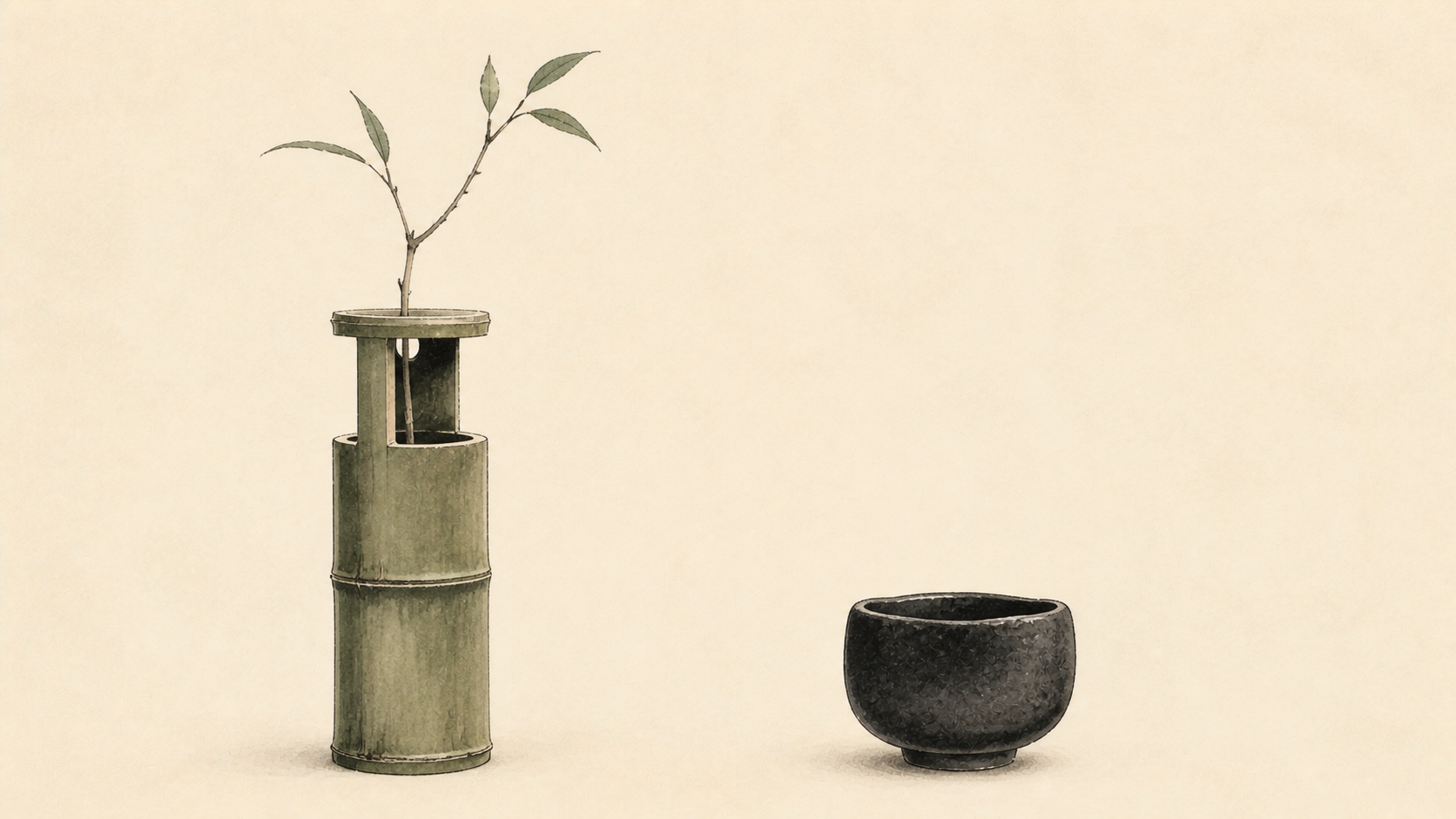
When prized imports from China signaled authority, Sen no Rikyū brought bamboo, clay, and black tea bowls into the gathering. His choices invite us to ask what makes a utensil valuable when someone actually uses it. Start with the authority those imported works carried.
When Chinese imports signaled authority
From the Muromachi to Momoyama periods, wares brought from China held great standing in chanoyu. Known as karamono, they included paintings, tea caddies, and tenmoku bowls. Owning a celebrated work with a known provenance and showing it at a gathering signaled wealth, learning, and political power.
Nobunaga and Hideyoshi collected famous utensils and expressed authority through their gatherings. Rikyū worked in the midst of that culture and knew the best imported objects well.
The bamboo and clay Rikyū chose
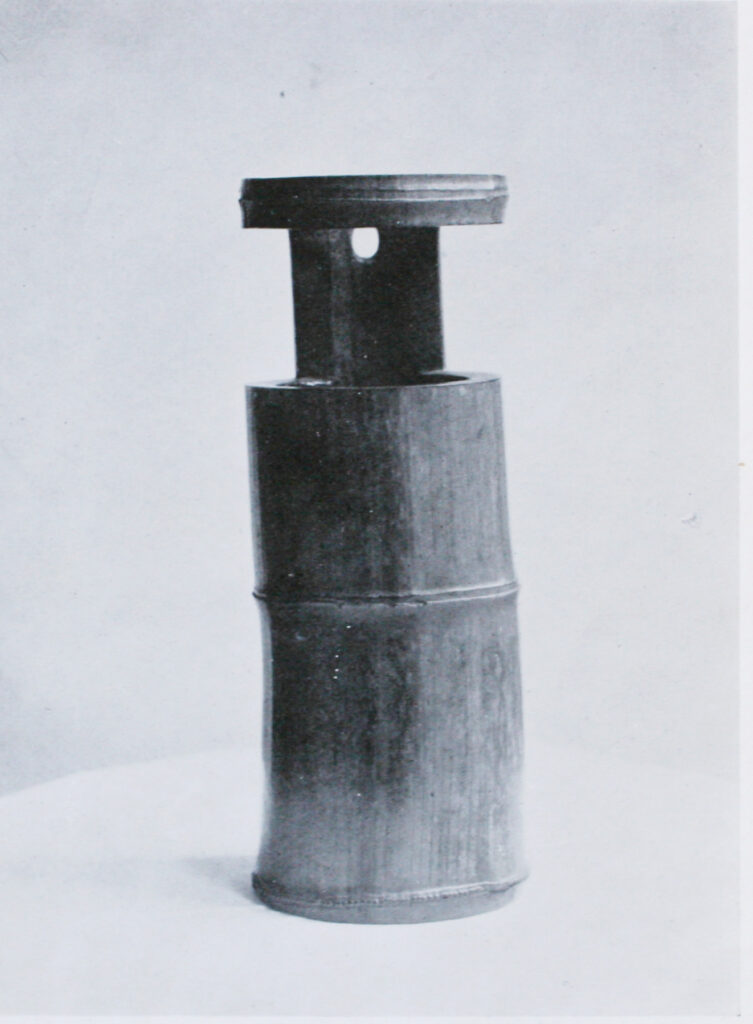
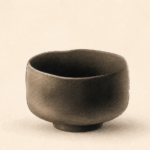
Rikyū brought bamboo vases and Raku bowls with the feel of clay into a gathering. Bamboo was familiar, and its form could look simple at first glance. A black Raku bowl carried none of the vivid color of painted decoration.
A spare form still takes care. Where is the node, how is the bamboo cut, and how does it balance the flower? What does the rim, weight, and feel of the bowl do in the hand? Those details suit the moment of use. The value moves toward what the person using it can feel.
Simplicity is something a maker can choose
Even a bamboo vase that looks natural reflects choices about where to cut, which face to turn forward, and how high to place the flower. The slight irregularity of a Raku bowl works when the guest holds it, touches the rim, and drinks.
Calling a wabi utensil “untouched” misses that work. With less decoration, the material, outline, and exact place of the object matter more.
A bamboo vase or clay bowl can look lightly worked, but someone decides where to cut, how to leave a node, how thick the bowl will be, and how to fire it. Simplicity depends on choosing where a material’s character can remain and where it needs shaping. The parts that look untouched are worth a close look.
Leaving every flaw visible does not make a utensil simple in a useful way. A crack in bamboo, an irregularity in clay, or a knot in wood can remain where it does not compromise strength or use. Deliberate simplicity keeps traces of the material alongside the precision a utensil needs.
The arrangement changes what a utensil does
The value of a tea utensil goes beyond the object on its own. Scroll, flowers, kettle, bowl, and sweets are brought together for the guests and season of the day.
A costly object that ill suits the setting adds little. Familiar bamboo can become part of an unforgettable view when it meets the right flower and light. Rikyū’s choices called attention to how things relate to one another and to people, beyond the price of each object.
Set price and maker aside for a moment and ask what remains in the material, weight, and gesture of use. A simple utensil can answer what a guest can sense and what a gathering needs. That is another way to judge an object alongside its price or name.
A bowl shows a different side of itself when paired with an imported caddy and a rich textile than it does with a bamboo scoop and a simple vase. Its role depends on the theme, season, and distance from other objects. A price list can tell us only part of its value.
Rikyū also used costly utensils
It is too simple to say Rikyū rejected expensive things and cared only for cheap ones. He also used imports and famous objects. Together with them, he brought in utensils whose qualities could not be judged by pedigree alone.
The question is what the occasion needs, beyond a choice between luxury and austerity. The innovation was to let more than one kind of value matter.
Rikyū understood both provenance and distinction and still asked whether a particular utensil was needed for the gathering. An object’s high price did not have to justify putting it out. We can read his choices as restoring the value of use alongside ownership.
Choosing only plain things without understanding the earlier standing of imports reduces the change to a preference for cheaper substitutes. Rikyū knew their standing and still reconsidered what the guests in front of him needed. The setting itself became a place to make that decision.
A name alone cannot establish a new value
Declaring a familiar material beautiful does little to make its value last. Rikyū’s bamboo vases and Raku bowls were used alongside scrolls, flowers, kettles, and the movements of actual guests. The guests could discover the value for themselves through the experience.
Bamboo had more to offer than a lower material cost than a metal or imported vessel. Its straight form, the division at the node, and water held at the cut opening suit a wild flower. Material and use come together.
Black Raku also brings different things forward. With little ornament, a guest can see the matcha’s green, the hand on the bowl, and the slight change of the rim. Restraint helps other details come into view.
What guides a choice today when the brand and the price are set aside? Does the material suit the purpose, does it help the person use it, and can it be lived with for a long time? Rikyū’s choices leave us questions we can test for ourselves.
A bamboo vase shows how fine the choices can be with a common material. Where will the node remain, where should the opening be cut, and what will a flower look like when the vase hangs on the wall? Quality depends on how well the maker reads the material.
Calling a plain object wabi cannot make its value last. It becomes a standard when guests handle it, see it with other utensils in a gathering, and carry away the memory. Rikyū’s choices gave utensils a place in which to do their work.
Conclusion: Value takes shape between the object and the setting
Rikyū’s plain utensils opened attention beyond cost to material, touch, season, and the relation with a guest. Their simplicity offered another kind of worth alongside the expensive objects in circulation.
Where will it be used, by whom, and how? Those questions can reveal a value previously overlooked in a familiar thing.
Ownership is only one moment in an object’s life.
A costly object can be worth choosing. Set its price aside for a moment and see what happens when you hold it, put it to use, or place it in a setting. More ways to understand value give you more freedom to see.
 Who Was Sen no Rikyū? The Life of the Man Who Changed Chanoyu
 What Did Sen no Rikyū Design? The Relationships Inside a Tea Gathering
 Why Did Rikyū Choose Small Tea Rooms? Two Mats and Four and a Half
 Why Did Rikyū Value Raku Tea Bowls?
