
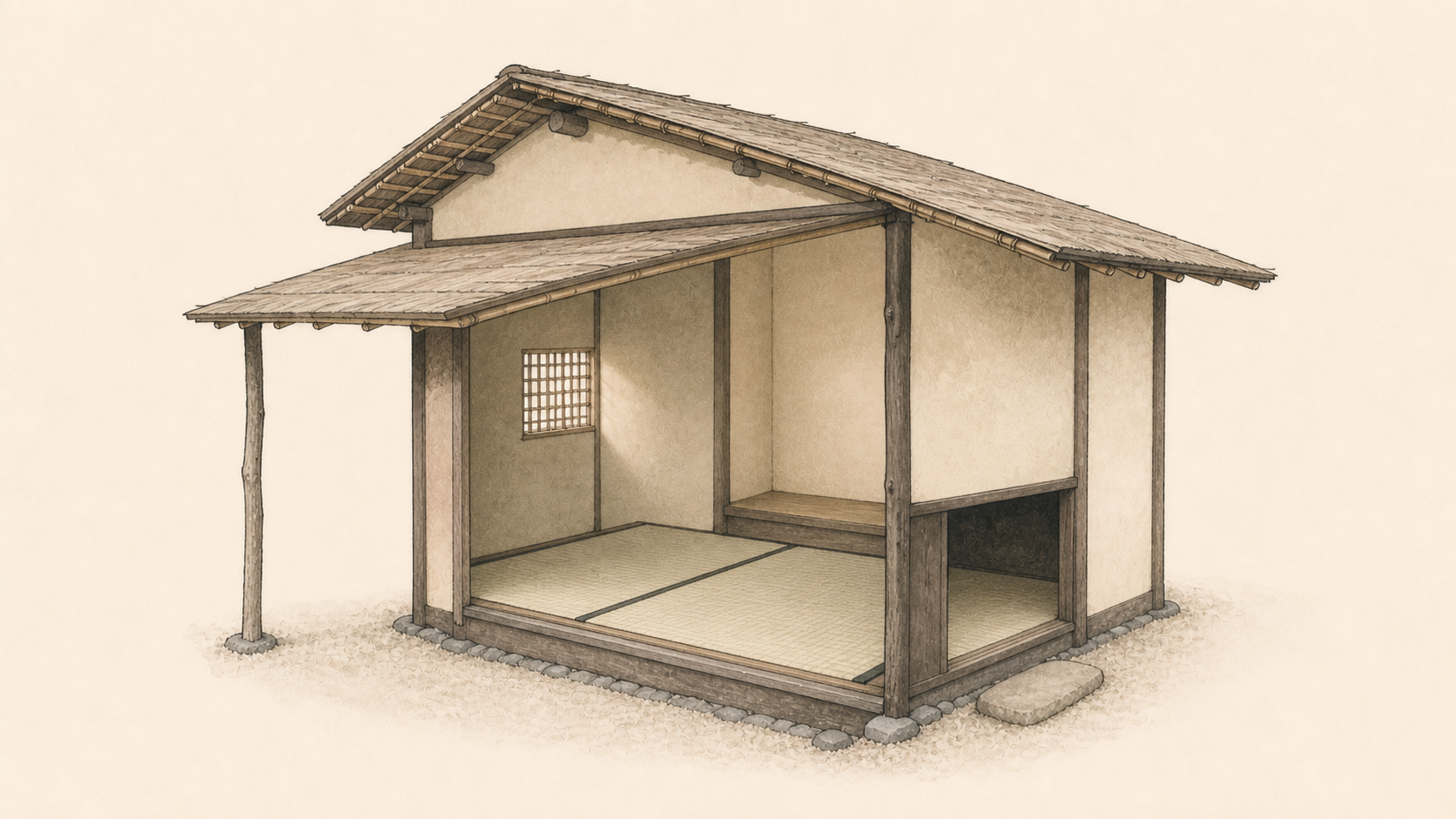
Tai-an, a two-mat tea room associated with Sen no Rikyū, offers a way to see how a low doorway, a rounded alcove, windows, and a route through a room can change how the body moves and what it notices.
This article looks at Rikyū’s small tea rooms, especially Tai-an and the difference between two mats and four and a half. The article on Rikyū’s tea rooms and contemporary design takes a wider view of the approach from the roji to the room.
Tai-an, a two-mat tea room
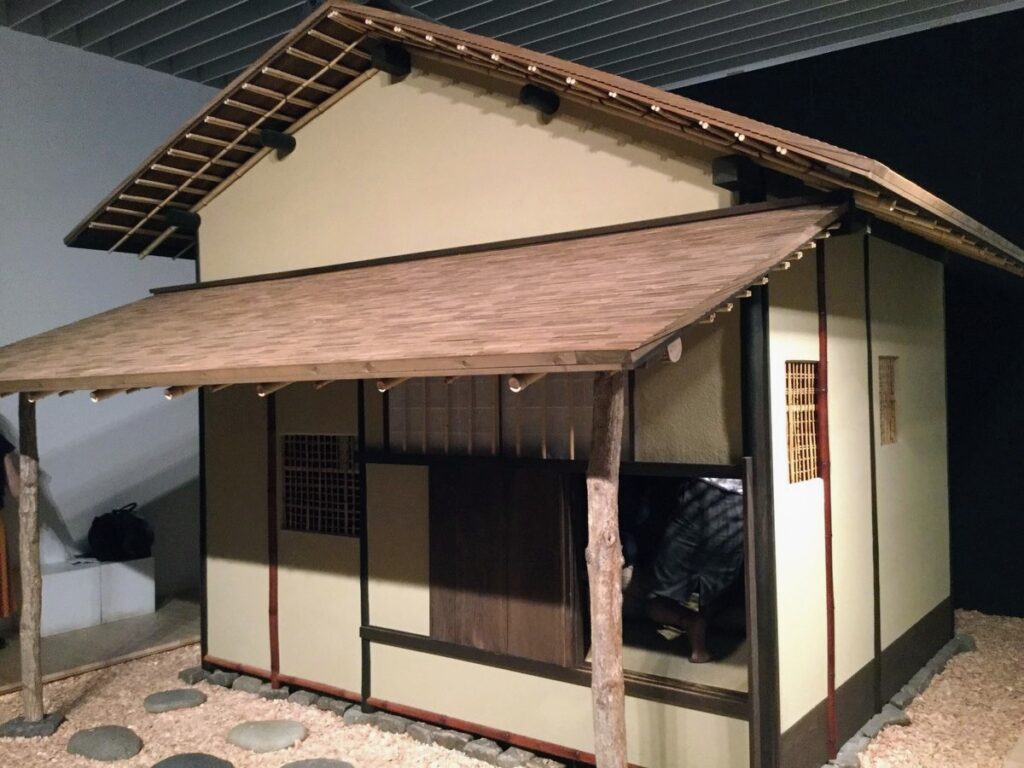
Tai-an, a National Treasure at Myōki-an temple in Ōyamazaki, Kyoto, is a two-mat tea room attributed to Rikyū’s taste. Beyond the main two-mat room with its guest seating are an alcove, an adjoining room, and a service area. The dimensions alone make the space sound remarkably small.
The Cultural Heritage Database describes how the ceilings and windows make skillful use of the limited interior. Smallness comes from more than reducing the floor area. The design brings the body, sight, and light into new relations within a fixed space.
Alongside the number of mats, consider the height of a seated person’s eyes, the distance to the window, and the angle at which a guest can see the host’s hands. A small room can gather attention around people, utensils, and light.
The nijiriguchi lowers the body
The nijiriguchi, the small guest entrance of a rustic sōan tea room, is too low to go through standing. A guest bends, lowers themselves to their knees, and bows the head to enter.
Dimensions change a person’s posture. The change can make it easier to set aside the standing and tension of life outside and attend to the gathering. The architecture communicates through what the body does. The nijiriguchi is an example of a building affecting the way a person feels.
The alcove and windows guide the eye
In a small room, the tokonoma alcove for a scroll or flowers can feel especially present. Tai-an’s horadoko, its rounded, cave-like alcove, has depth in the wall and a soft transition to the space around it.
Light from the windows is uneven. The bright areas and shadows bring out the glaze on a bowl, steam, and the host’s hand in motion. Contrasts draw the eye to particular things.
Windows in a small tea room do more than brighten it evenly. Light from windows with exposed lattice or wooden bars first reaches the wall, then creates gradations across utensils and hands. The alcove has depth, and the scroll or flowers come into the guest’s line of sight differently depending on where they sit.
A window’s position influences what is seen first. When the alcove is bright and the tea-making area subdued, the eye travels slowly from the scroll to the utensils. A small room can reveal itself in stages when the light does not show everything at once.
Proximity changes conversation
In two mats, the host sits close enough for the guest to hear the handling of utensils and the sound of breathing. A small movement can change the impression of the whole gathering in a way it would not in a ceremony before a crowd.
A small room reduces the places to which attention can stray. Guests can respond to the same sound of the kettle, the same flower, and the same bowl. The reduced space makes the relations among people more immediate.
At that distance, you can hear the preparation of the tea, see the steam from the kettle, and notice the pause when a utensil is set down. Gestures communicate even when little is said. A large room gives the eye more places to wander. In two mats, offering a bowl can become an event for everyone there.
The host’s hesitation and the guest’s response are both visible at close range. The room can use that tension to make small changes perceptible to others. A hand that receives a bowl or a change of breathing can count as a response in the absence of further conversation.
Limits give the experience a shape
A large room may call for furniture or decoration to bring its parts together. In a small tea room, what is left out matters as much as what goes in.
The dimensions, opening, windows, alcove, and hearth support a continuous series of movements. Considered as design, those limitations help give the guest’s experience a clear outline.
A two-mat room brings every decision about what to keep into question. Because hearth, alcove, entrance, and windows are so close, moving one changes where the body faces or how light travels. Tai-an gives a sense of why a tightly constrained room depends on adjusting relationships before adding more forms.
Fewer choices can give a small change far-reaching effects. Moving a window a few inches changes light and sightlines. Moving the hearth changes the distance between host and guest. In a small room, one choice can reach the whole.
What suits two mats, and what suits four and a half?
Judging Rikyū’s tea by the two-mat room alone can suggest that a smaller room is always better. Four and a half mats is a longstanding standard in chanoyu, and Rikyū also used rooms of different sizes. Space needs to change with the number of guests and the gathering’s purpose.
In two-mat Tai-an, host and guest, body and utensils, come unusually close. Four and a half mats leave more room for several people to sit and move when viewing utensils. The difference in area also changes how conversation and sight move through the gathering.
Ask what you want to happen in the room. Is it an intimate conversation, or should several people be able to share the same view? What dimensions fit depends on the purpose.
Rikyū’s small rooms show how to think again about size from the experience of people, beyond simply following a customary dimension.
In a small room, a few centimeters can be felt directly. A low ceiling can settle the posture, and a low window brings light to eye level for someone seated on the tatami. A difference that seems small on a plan can affect breathing and the volume of a voice.
The number of guests, the kind of temae, the standing of the utensils, and the distance for a conversation all influence the arrangement. Compare two mats and four and a half by asking whether a distance serves the purpose, beyond trying to reproduce the smaller footprint.
Conclusion: Small spaces help us see more
In a two-mat room, attention that faced outward comes back to the light, sound, moving hands, and the person sitting opposite.
A rich room depends on what someone can notice, as well as its size or how much it holds. Tai-an’s smallness becomes one way of making things visible.
When looking at Tai-an, imagine what someone seated there can see. How far away are the alcove, hearth, host’s hands, and other guest? The room’s richness is also visible in the density of the relationships that can be felt.
Light from a window, the height of the doorway, and the distance between seats act together. The richness of a small room comes partly from the strength of those relations among the things it contains.
 What Modern Design Can Learn from Rikyū’s Tea Rooms
 Why Can a Small Tea Room Feel Spacious?
 Who Was Sen no Rikyū? The Life of the Man Who Changed Chanoyu
 What Did Sen no Rikyū Design? The Relationships Inside a Tea Gathering
