
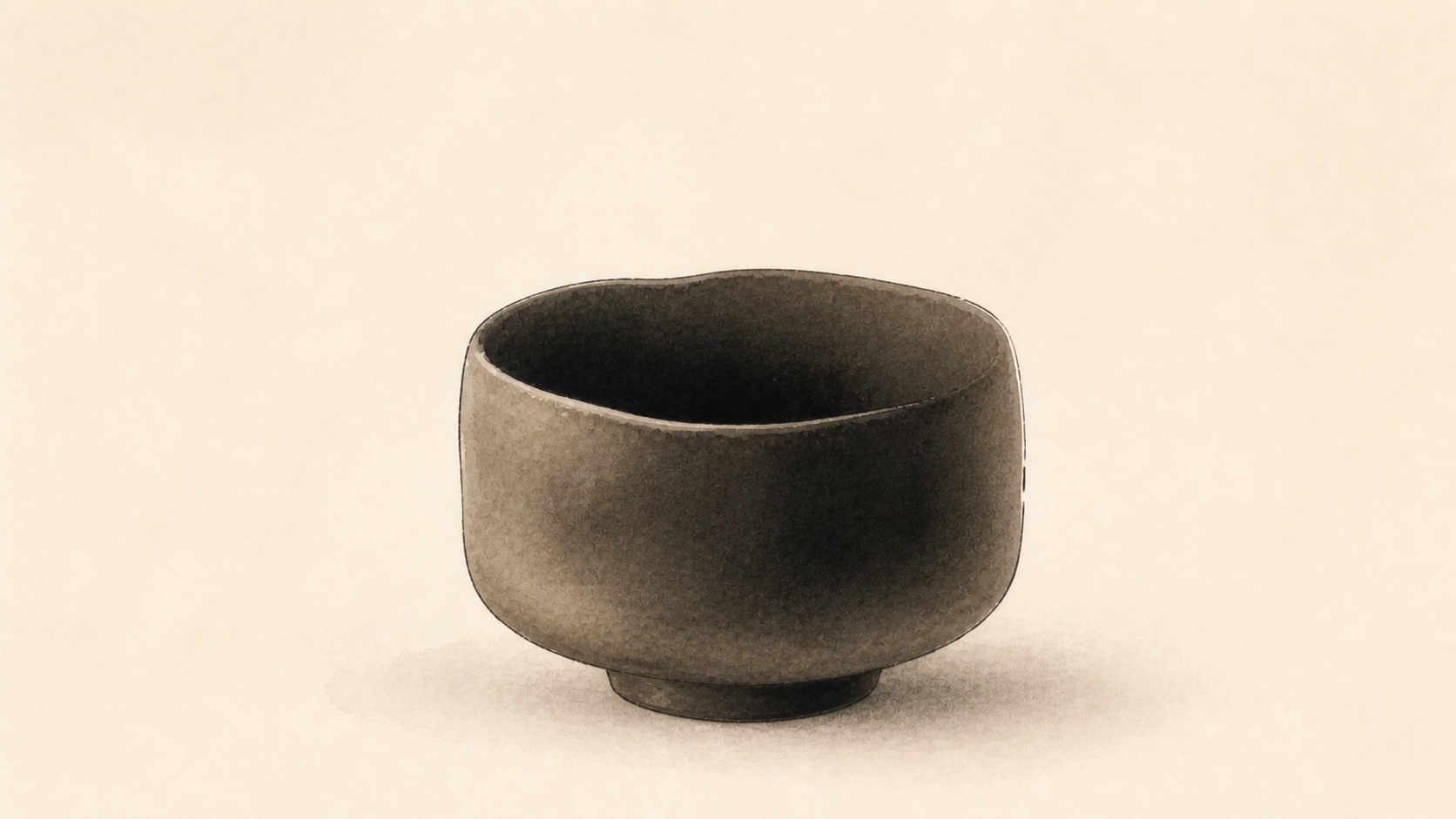
Raku bowls emerged in the time of Sen no Rikyū and Chōjirō. Their hand-shaped forms, black glaze, and dimensions come into their own when held. What kind of beauty leaves room for the hand that will use it?
Chōjirō and Rikyū’s tea
Chōjirō, the first generation of the Raku family, made red and black Raku bowls suited to Rikyū’s tea. His work marked the beginning of Raku ware. The family’s official history also connects his bowls with Rikyū’s guidance.
How much Rikyū specified about each detail is unknown. Chōjirō’s restrained bowls, shaped to be held in both hands, became closely associated with Rikyū’s gatherings.
Look at the thickness of the rim, the position of the foot, and the balance when both hands meet the bowl, alongside irregularities in the outline. The form leaves room for hand, mouth, and tea.
A form made without the wheel
A Raku bowl is shaped by hand, a process called tezukune, rather than thrown on a wheel to make an even circle. The clay is built up by hand and pared back to finish the body and rim.
The outline does not have perfect bilateral symmetry. Its irregularities change where a finger can find a hold or the mouth meets the rim. The bowl changes with the angle of view and with the gesture of holding it.
Black brings the matcha and the hand into view
Pour matcha into a black Raku bowl and the green becomes distinct. In a dim tea room, the outline of the dark vessel recedes enough for the color, steam, and moving hands to come forward.
Black reflects the light around it. Small variations in sheen and tone become visible. The dark surface gives the tea and light a background without adding painted decoration.
Against the dark interior, the edge of the green, the fineness of the foam, and the steam appear bright. Fingers on the bowl and a highlight on the rim can also come forward. Black helps certain parts of the tea and the body’s movement stand out.
Light can make a band of sheen across the black surface. That band moves as the bowl is turned during a drink. Black does more than set off green. It can make the passage of the hand visible in the light. A photograph that reads as a single black can contain brown or muted reflections when the bowl is seen in person.
Even tea left in the well can show how black holds traces of use.
A form with room left in it
Judged by the precision of a manufactured object, an irregular Raku bowl can look unfinished. A tea bowl is also a thing in use. People prepare tea in it, hold it in both hands, and bring it to the lips.
What counts as upright or balanced depends partly on the person using it. A form with room left in it can make space for a user even after the maker’s work is done.
The small differences in rim height, facets of the body, and offset of the foot can leave more than one possible grip or front. An irregular outline for its own sake could not do that. A different face can come forward each time, changing the relationship between person and bowl.
The irregular rim can still enclose an interior that holds tea. The foot still supports the vessel. An open outline and a stable structure work together, so different views do not make the bowl itself unsteady. What has been left open is the question of which face is the front.
Wabi is more than praise for a flaw
A mark or irregularity does not make any object an example of wabi. Chanoyu found forms that serve a purpose, work with the material, and gain meaning through use.
In a Raku bowl, the hand-shaped form, low light, the color of matcha, and the guest’s body come together. “Beautiful because it is imperfect” describes little of how the bowl works.
A chip, distortion, or rough place can get in the way of the hand or mouth and weaken the utensil. In Chōjirō’s bowls, an irregular outline can coexist with a quiet sense of balance. What looks imperfect becomes meaningful in relation to what the vessel has to do.
Before calling a mark beautiful, see whether it came from making, wear, or repair. Calling every trace of time wabi erases the history and handling of a piece. Find out what the mark is, then consider how it sits alongside the bowl’s use.
What changes from one bowl to the next?
Every hand-shaped bowl differs a little in the height of the rim, the fullness of the body, and the trimming of the foot. The person making tea feels how much room there is for the whisk. The person drinking feels where their hands can go and how the rim meets their mouth.
Uniform vessels offer a consistent ease of use. A vessel with individual differences asks something more of the user. Which face should come forward? Where is a good place to drink? How do the two hands sit? Each bowl gives the user a chance to look and decide.
In Rikyū’s tea, a utensil can draw out the guest’s attention without overwhelming it. The variations in a Raku bowl leave some choices with the person using it.
Leaving room for a user still takes precision. A maker has to decide what the vessel will settle and what it will pass into someone else’s hands.
Imagine holding the bowl instead of only seeing its front. How does its thickness carry heat? How do different heights at the rim meet the lips? How does the foot support the vessel on tatami? Its form acts alongside what the body does.
An individual difference does more than show a maker’s habits. A higher rim or fuller body changes the view of the tea, the weight on the palm, and the angle of drinking. That difference in use gives each bowl an individual character beyond repeating a type.
Compare bowls at corresponding points on the rim, body, interior, and foot. The degree of distortion alone tells little. When their quiet underlying forms become apparent, individual differences can be read as choices that change what the hand feels.
Conclusion: Letting the person using the bowl complete it
What drew Rikyū to a Raku bowl likely went beyond its unusual outline. It could be at its best when it held tea and rested in the hands. That quiet usefulness suited his gatherings.
Next time you see a Raku bowl, imagine setting both hands around it as well as looking at its profile. Some of its beauty arises between the object and the person using it.
Notice what an irregularity does in a particular gesture before calling it character. What looked incomplete can turn out to make room for a person’s senses. The time spent touching the bowl is part of its beauty.
 Who Was Sen no Rikyū? The Life of the Man Who Changed Chanoyu
 What Did Sen no Rikyū Design? The Relationships Inside a Tea Gathering
 Why Did Rikyū Choose Small Tea Rooms? Two Mats and Four and a Half
 Why Did Rikyū Look beyond Lavish Tea Utensils? From Karamono to Wabi