
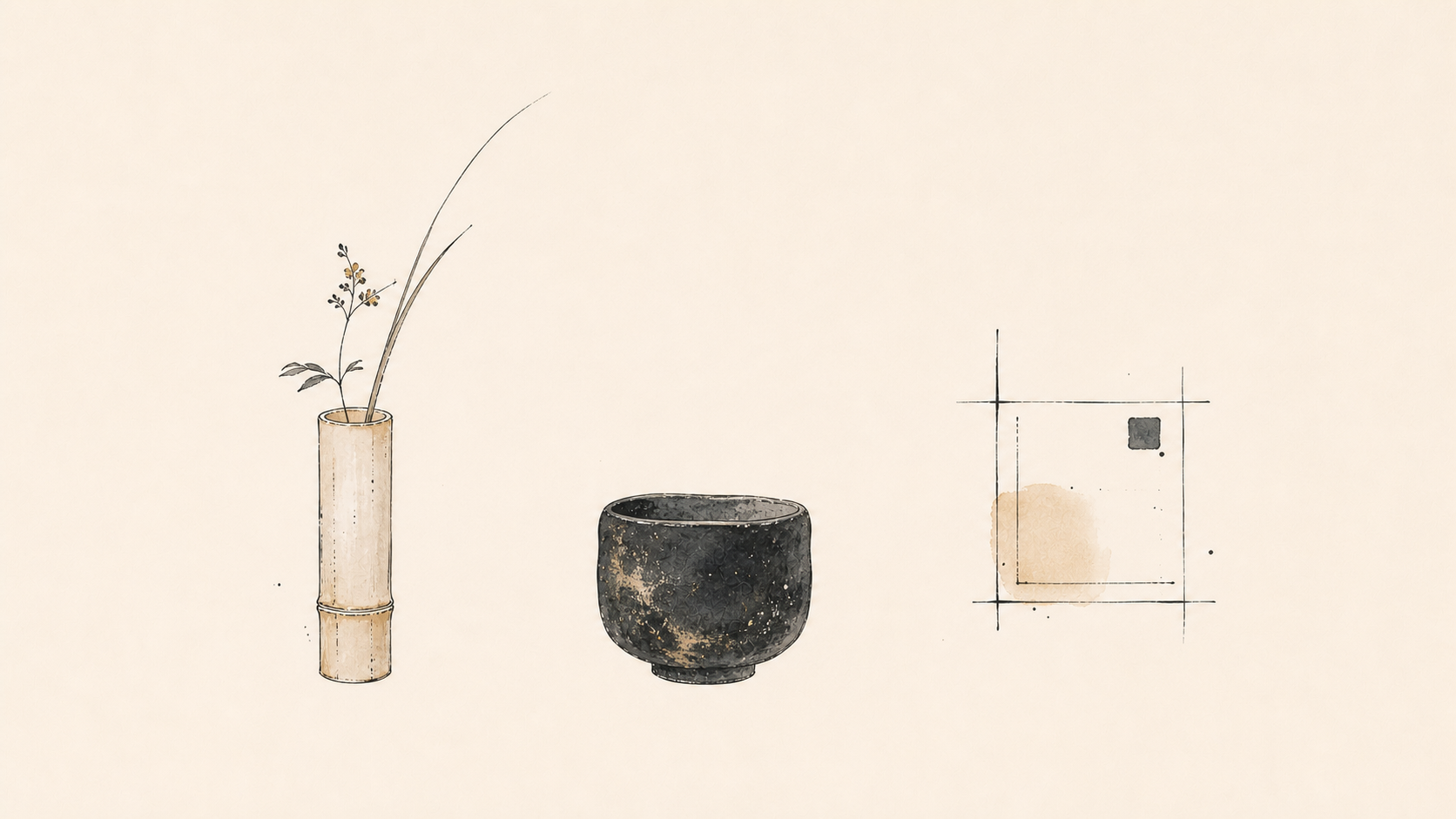
The Sen family was restored after Rikyū died, and chanoyu continued in many different lineages. Utensils and procedures survive, along with a way of looking. The restoration of the family is a place to begin tracing what was passed on.
The Sen family revived after Rikyū’s death
Rikyū died in 1591, and his tea practice continued. In Omotesenke’s account, Shōan Sōjun was allowed to return to Kyoto, where he restored the Sen family with his son Sōtan.
The three Sen houses, Omotesenke, Urasenke, and Mushakōji Senke, were among the schools that carried Rikyū’s lineage forward. The forms changed as people practiced and adapted them in different times.
To see what Rikyū left, look at what survived and how later people changed and used it. His legacy includes a way to reconsider the value of objects through relationships and experience.
What survived went beyond a single style
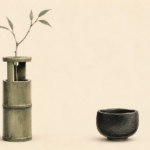
Look only at black Raku bowls, small rooms, and bamboo vases and Rikyū’s work can become a checklist of wabi forms. These things belonged together for a reason.
A guest would drink tea. Host and guest would spend the same time together. The gathering would suit its season and place. Objects and rooms took shape in response to those purposes. The reasoning behind the choices was passed on along with their forms.
A different way to look at utensils
Familiar utensils and simple tea existed before Rikyū. He brought them to the center of chanoyu, giving bamboo, clay, and black bowls a value distinct from the standing of imported treasures.
Renowned pieces kept their value. There were now additional ways to look. Alongside provenance, people could see material, feel, use, and the relations created by toriawase.
After Rikyū, utensils could be seen in light of who recognized their qualities, where they were used, and under what names they were passed down, as well as where they came from or what they cost. Use and arrangement could make a familiar material such as bamboo or clay the center of a gathering. Looking differently reordered the standing of things.
The new value of bamboo vases and Raku bowls was more than a victory of familiar objects. Rikyū noticed their possibilities, worked with makers, set the resulting utensils in actual gatherings, and gave guests something they could remember. A way of seeing also involves making the context in which an object can work.
A different way to look at space and time
A tea room is part of a whole experience. Guests come through the roji, view the utensils, drink tea, exchange words, and leave.
In Rikyū’s tea, the height of an entrance, light from a window, position of a hearth, and order in which utensils appear all meet the senses. Floor area and elapsed time are only two measures of what a room can hold.
The small room, garden, low entrance, windows, and hearth survived as parts of the sequence in which a guest comes in from outside, takes a seat, and receives tea. Seeing a space as a sequence of movements still matters in later rooms.
The route from the roji, the distance from the fire to the guest, and the time set aside to look at utensils can be carried forward beyond their original dimensions. Other places can bring attention in stages toward a single bowl without reproducing the room exactly.
Tradition lives by making choices about change
Raku bowls and the tea of the Sen houses have both changed over their long histories. Inheriting a practice has involved more than reproducing the first generation’s forms.
Ask what a form was for and consider that purpose again with the materials and lives of a different period. Tradition remains alive through choices about what stays and what changes.
Successive Sen houses, other schools, craftspeople, and collectors practiced and made objects in response to the guests and utensils of their own time. Part of passing a practice on is judging which changes it can absorb and which would take away its meaning.
Decisions about what to preserve deserve reasons. When materials and ways of living change, a fixed form can lose its original function. Sometimes a form can change to keep a relationship between a guest and an object. Transmission means making that choice anew.
What we can borrow from Rikyū are his questions
Dark earthen walls, old wood, and black bowls can evoke his rooms. Unless the design asks whom the form serves and what kind of time it creates, wabi stays on the surface.
Rikyū considered imported and Japanese wares, rulers and townspeople, and makers and users. He chose anew which relationships a particular gathering called for.
Ask similar questions now. Why this size? Why this material? Why this order? Does it suit what the people using it can do and feel?
Life and technology have changed, so the answers can differ from Rikyū’s. Carry the questions into present circumstances, and the tradition can move forward.
One reason his influence lasted is that it left room for more than finished answers. If black Raku alone had been correct, chanoyu could have stayed one style. Oribe and Enshū developed distinct kinds of beauty, and later people made new utensils and rooms.
Consider what might bring people nearer to objects, how to show a value other than price, and where to let guests respond. Such questions put Rikyū’s work to use in ways that black, bamboo, and clay on their own cannot.
Think about the distance between a person and what they encounter before borrowing a form. If the order of looking and the room for an answer are considered, the method can keep working with fewer visible quotations from the past.
Conclusion: Inheriting a way of seeing
No single object or practice can stand for everything Rikyū left. Rooms, bowls, tea preparation, and the lineage of the Sen houses all reach the present.
At their root is a willingness to look beyond established values. Why this form, for whom, and what does it do? Learning from Rikyū can mean inheriting a way to look again at how things and people meet.
What survives is the habit of asking what has value in the conditions in front of us. Preserving a practice and changing it can begin from the same question about what a form is for. That question helps Rikyū’s work reach the present.
 Who Was Sen no Rikyū? The Life of the Man Who Changed Chanoyu
 What Did Sen no Rikyū Design? The Relationships Inside a Tea Gathering
 Why Did Rikyū Choose Small Tea Rooms? Two Mats and Four and a Half
 Why Did Rikyū Look beyond Lavish Tea Utensils? From Karamono to Wabi