
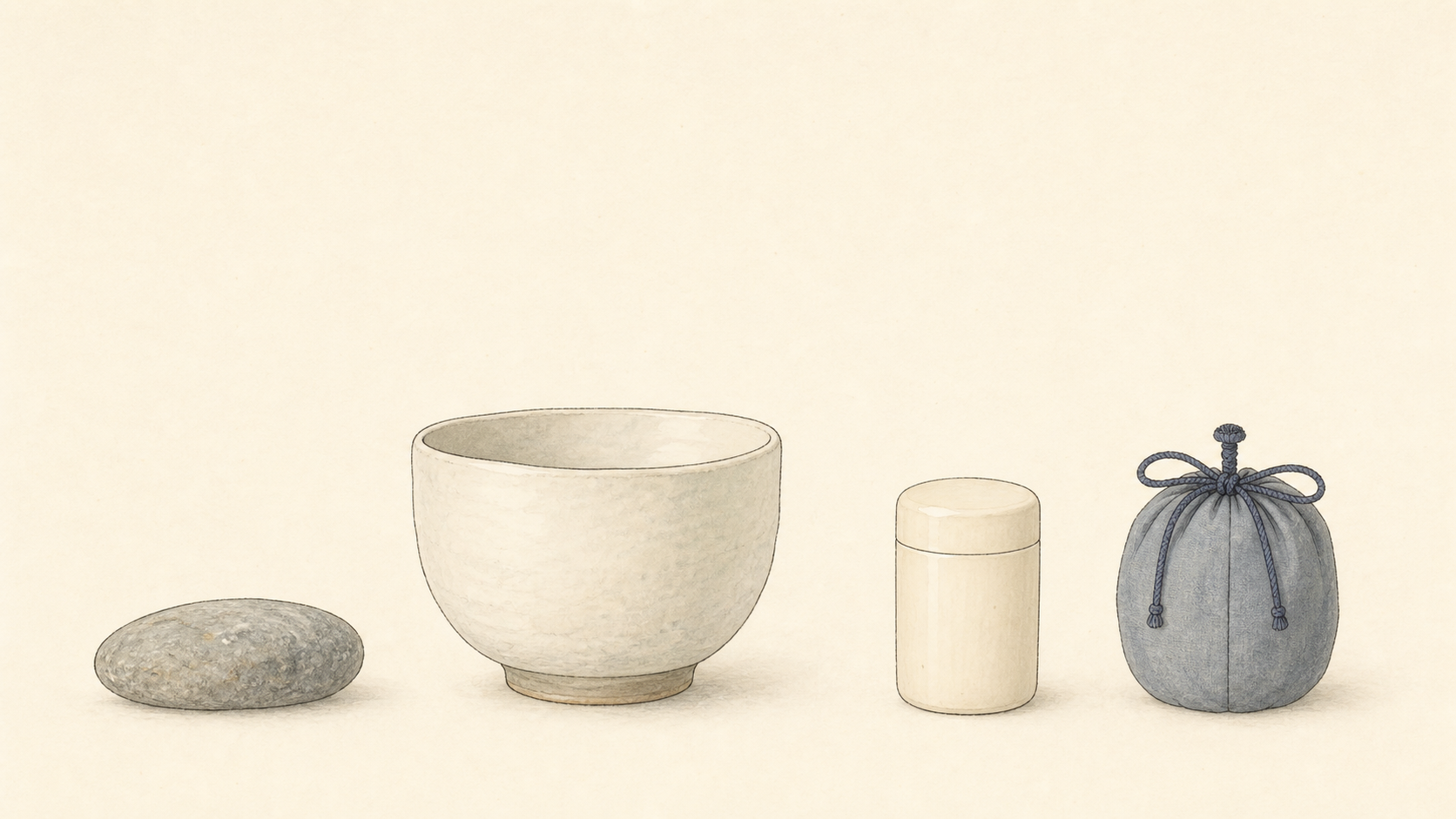
Kirei sabi brings brightness, elegance, and dignity to the quiet of wabi. The utensils associated with Kobori Enshū and the ways he brought them together show how that quiet refinement works. What is kirei sabi?
What is kirei sabi?
Kobori Enshū’s aesthetic is known as kirei sabi. It brings the elegance of classical court culture and the brightness of the early Edo period to the quiet of medieval wabi.
Treating kirei as ostentation and sabi as plain old age makes the phrase harder to understand. Its framework remains simple, and clear lines, color, words, and the way objects are fitted out give the whole a lucid dignity.
Within that simple framework, color, words, and dignity each have a place. The aesthetic comes into view in the way one thing meets another, as much as in any general definition.
The precision of a shape, freshness of color, and distinction of a name or provenance can sit comfortably within a simple framework. The contrasting qualities remain apparent rather than diluting one another.
Kirei sabi keeps the unadorned framework of wabi and adds a crisp outline, clear colors, and a distinguished history where they serve the whole. Each quality is given enough room to coexist with the others.
Enshū’s taste extends beyond shape
Utensils described as Enshū gonomi, or to Enshū’s taste, can have beveled surfaces, fine concentric grooves, or patterns of overlapping circles. Copying one of those features only gets you so far.
A tea caddy is matched with a shifuku cloth pouch, fitted with a box and wrappings, and given a name from a poem. The things around it help compose the view. Enshū’s taste lies as much in relating objects to one another as in the style of any one item.
Dimensions and patterns can tell you how to make a copy. They say less about who will see the object, when it will be used, or how it will sit alongside utensils of different standing. The word gonomi, “taste,” covers both the shape and the choice of how to use it.
A copy of an Enshū pattern or shape can do different work in a gathering where the guests and the level of formality have changed. The recorded forms tell part of the story. The reasons for pairing the object with others tell the rest.
A name from a poem gives an object a past
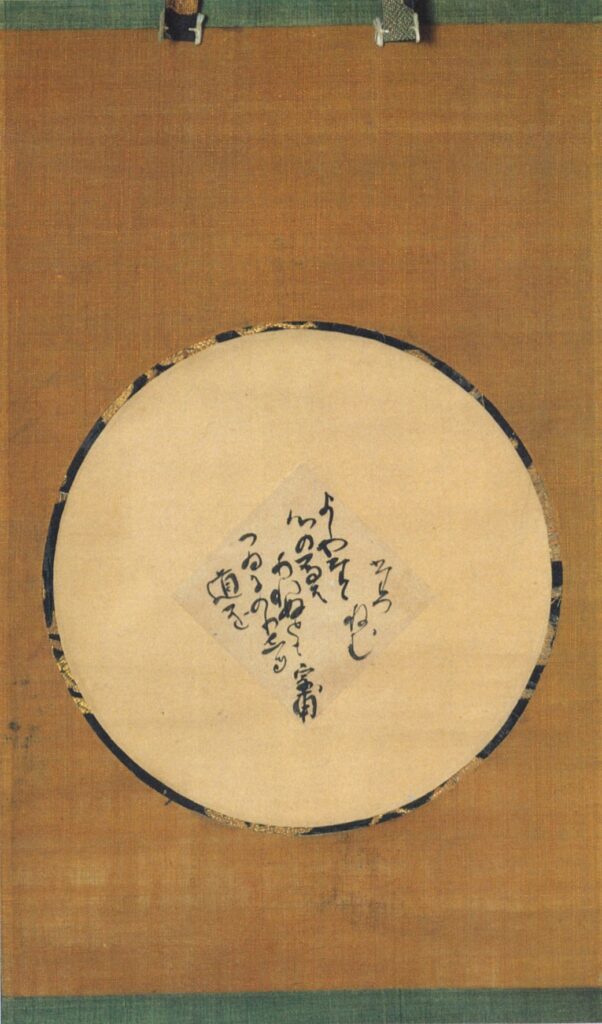
Enshū gave tea caddies and other objects names drawn from classical poems. The words can bring to mind seasons and stories that do not appear in the shape or glaze alone.
The name leaves the viewer free to move between the object and the poem and imagine a scene of their own. It offers a place to start making connections.
Rikyū paring back, Oribe reshaping, Enshū finding a balance
One way to make sense of the differences is to say that Rikyū pared back, Oribe reshaped, and Enshū brought things into balance. Their actual work is more complicated than that.
What Rikyū chose to value, what Oribe questioned, and what Enshū brought into a new order offer three ways to see beauty within Japanese culture.
Kirei sabi makes room for elements with different strengths, giving each a place where it can be noticed without erasing the others.
Imagine a composed tea caddy with a cloth pouch of distinguished provenance and a name from a poem that evokes a season or a classical text. Form, cloth, and words can be revealed in turn. A bright detail and the quiet of wabi can each remain apparent.
When looking at Enshū gonomi, start with the distance between elements rather than deciding which ones are lavish or plain. The refinement of kirei sabi comes from giving distinct qualities enough room to work together.
Refinement gives details an order
Refinement can sound like removing decoration until little color remains. Enshū’s utensils have colors, patterns, and sometimes more than one cloth pouch.
What matters is how those elements share attention. A leading detail and a supporting one, brightness and quiet, age and novelty can each have a different weight. Refinement can retain an abundance of detail and give it an order.
Wear, differences in materials, and a history of ownership all remain visible. Bringing them into order and varying their emphasis gives the guest a chance to take in one detail at a time. Even complex things can be presented quietly.
In a gathering with objects of different origins, the host can choose one object as the focus. Other details become apparent in their own time as the guest sees the box, hears the name, and examines the piece. That order lets the complexity remain while giving the guest less to take in at once.
An order of presentation can leave the details intact and still make a quiet impression.
Dignity takes more than expensive objects
Enshū was a daimyō as well as a tea practitioner. The celebrated chūkō meibutsu utensils he selected and the fine fabrics he used carried economic and social standing. Expense explains only part of the style.
Valuable materials can look busy if they all demand attention. A simple object can have dignity through its outline, color, and placement. What stands out in Enshū’s arrangements is how much of each object the whole setting allows the guest to see.
Care in wrapping an object, telling its story, and choosing it for the people and occasion helps give it dignity. Kirei sabi can admit both luxury and simplicity, keeping either from overpowering the gathering.
Look at the clean outlines: a beveled tea caddy, a tea container with fine concentric grooves, or a design of overlapping circles. The decoration leaves the edges of the form clear.
Color can work in the same way. Vermilion, gold, and fine cloth can occupy a small patch, sit alongside an unadorned area, or appear only when a box is opened. The brightness has a place within the quiet.
Several celebrated utensils can compete with each other. Choose one to lead and let the others support it through their material, color, or name. An arrangement of this kind can give the gathering dignity by making only the differences that matter stand out.
Conclusion: Quiet refinement grows out of relationships
Kirei sabi gives the origins, materials, colors, and names of different objects a place where they can come through.
A refined setting takes its character from the balance of the whole. Enshū’s work shows how much can be made by arranging what is already there.
At home today, you could look at the colors and materials of the things you already own and decide which to bring to the fore and which should support it. Making a room more composed can mean giving an object a different role.
The question is how objects of different materials and standing can coexist. Enshū’s quiet brightness comes through when the shape, name, and surrounding objects are in tune.
 Rikyū, Oribe, and Enshū: Three Aesthetics in the History of Japanese Design
 Who Was Furuta Oribe? The Tea Practitioner Who Followed Rikyū and Found a Style of His Own
 Why Oribe Ware's Distorted Shapes Are Beautiful
 How Furuta Oribe Changed the Tea Room
