
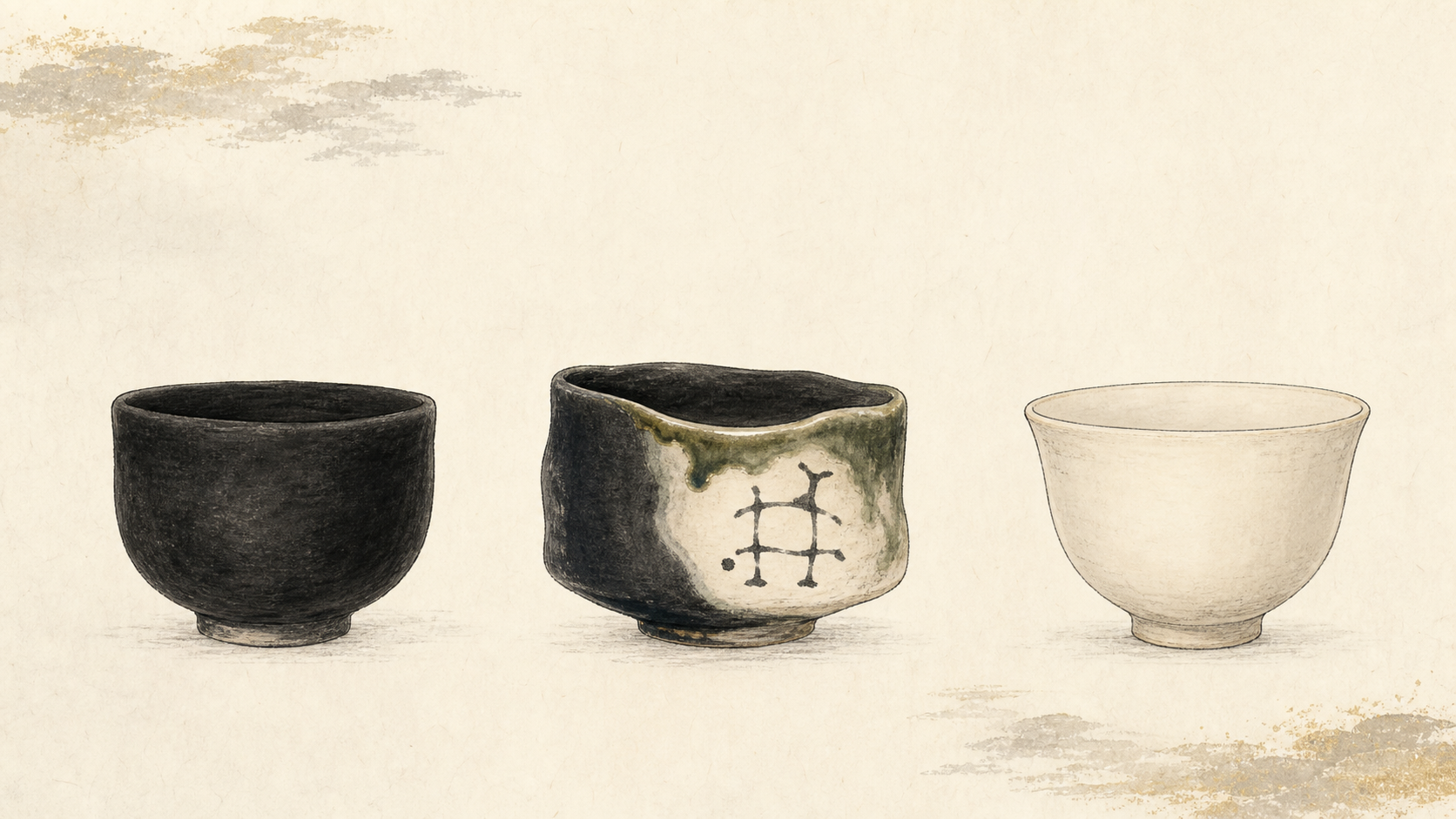
Sen no Rikyū pared things back, Furuta Oribe reshaped them, and Kobori Enshū brought them into balance. These three ways of working show how Japanese aesthetics changed as ideas about tea passed from one generation to the next.
Set the choices of Rikyū, Oribe, and Enshū side by side to see how the aesthetics of tea changed. A separate article looks more closely at Enshū’s kirei sabi.
Three generations, three different responses
The histories of Rikyū, Oribe, and Enshū are connected. Furuta Oribe studied with Sen no Rikyū, and Kobori Enshū studied with Oribe.
Each worked with different guests and spaces under different political and social conditions. Their aesthetics offer distinct responses to those circumstances.
Consider how each approached the same kinds of things: a bowl, a space, or the guests at a gathering. Those choices tell us more than broad descriptions of their personalities.
A straight line of progress would make each generation appear more refined than the last. Their guests, political settings, technologies, and means of circulating objects differed. Each changed a different part of what had been handed down.
Compare a bowl, an entrance, or a set of utensils assembled for a gathering. Ask what each person pared back, where they departed from a form, and how they arranged objects of different standing. A common point of comparison brings the differences into view.
Rikyū: Paring back
In an age when imported Chinese objects and elaborate decoration carried great prestige, Rikyū chose black Raku bowls, bamboo flower vessels, and small tea rooms.
Paring back draws the guest’s attention toward the tea and the person serving it. With fewer distractions, the relationship comes into focus.
It meant more than reducing the number of objects. Setting aside the prestige of imported pieces, the separation of people in a large hall, and the abundance of decoration brought the host and guest, and the bowl and hand, closer together. What remains gains force.
On a black Raku bowl, restrained color and the absence of painting bring out the rim’s uneven line, the sheen of the glaze, and the green of the tea. A plain wall in a small room makes the light from a window and the sound of a utensil being set down more apparent. What becomes perceptible matters as much as what was removed.
The distances associated with rank were part of what Rikyū pared back. The low nijiriguchi entrance, the small room, and the passing of a bowl gave people a shared physical scale. Political power remained present, and the room had to accommodate those tensions.
The joints in a bamboo vase and the hand-shaped surfaces of a Raku bowl can register strongly at close range. The space and the movements of the gathering helped make that possible. The choice to use less gains meaning when the objects that remain can be seen and used in a new way.
Oribe: Departing from the familiar
Oribe took up Rikyū’s simplicity and brought irregular forms, bold designs, and unexpected combinations into it.
A person who knows a familiar form can move one part just far enough to make a different kind of beauty visible. Oribe’s departures allowed individual character to show.
Into the closeness of Rikyū’s room, Oribe introduced shoe-shaped outlines, shifts between green glaze and blank space, and the different points of view offered by a seat for an accompanying guest. A departure in one place gives guests more scope to turn, discover, or talk.
The shift loses force if everything changes at once. A plain area in Oribe ware supports a pattern. A quiet wall gives an unexpected opening more presence. Choosing what to hold steady lets the playful detail become a point of interest.
A bowl with more than one possible front or a room that partly blocks a sightline gives a guest a reason to move and choose how to look. That opens up a place for the guest’s own participation around the focused experience Rikyū developed.
Momoyama ceramic techniques and substantial demand also made such forms possible. Trial pieces in the kilns, the distribution of work between glazing and decoration, and patronage among warrior tea practitioners give these departures a setting beyond a single person’s talent.
Enshū: Bringing things into balance
Enshū brought classical court elegance, calligraphy, poetry, buildings, and gardens together with the quiet of wabi and Oribe’s inventiveness.
Bringing things into balance means giving them different positions and degrees of emphasis so the whole has dignity. Their differences can remain apparent.
Enshū could bring a celebrated object, a poetic name, a textile, a garden, and a building into accord, each with its own provenance. In a daimyō gathering with many elements, he could choose which one would lead and which would support it.
Kirei sabi keeps a simple underlying form and introduces precision and brightness. Enshū gave things of different kinds room to coexist by attending to their standing and the distance between them.
Public building projects for the shogunate, daimyō ceremonies, and encounters with court culture gave Enshū experience in bringing many parts into an order suitable for public settings. His refinement offered a way of working with complex relationships.
Names, boxes, pouches, and provenance give a guest ways to approach an object and remember it later. Enshū made space for its shape, words, and history to emerge one after the other.
Using the three approaches today
Where there is too much information, pare back as Rikyū did. Where a convention has hardened, make a departure as Oribe did. Where elements are pulling in different directions, work toward a balance as Enshū did.
These three approaches are ways of reading a situation. Taken too far, subtraction can feel cold, departures can be hard to follow, and order can become dull.
Aesthetic choices respond to their time
All three worked with bowls and tea rooms. Their choices also responded to the power of established authorities, times when judgments of value were shifting, and periods when people were building a new order.
To read Japanese culture through design is to ask what called for a particular form as well as how to recognize it.
The three aesthetics grew in different periods and served different purposes. They can be seen where one element meets another. It helps to keep the guests, technology, politics, and materials of historical tea in view when using words from modern design.
In work today, pare things back when there is too much to take in. Make a deliberate change when everything is so uniform that nobody responds. Where different values compete, give them a workable order. Choose the operation for the problem at hand.
There is no need to adopt the appearance of any of the three. A crowded design may need fewer elements, a uniform one may need a difference people can explore, and a set of competing elements may need clearer priorities. In this way, historical aesthetics offer a method of thinking.
The methods can also work together on one project. Pare back what distracts from the center, introduce a change users can discover for themselves, and arrange the remaining parts so they do not compete. The three names then describe decisions you can make along the way.
Looking at choices, rather than personalities
Quiet, bold, and elegant are easy labels to remember. Looking at what each person retained and what each changed gives those words some substance.
Rikyū turned attention from the authority of imported Chinese wares toward the encounter between guest and host. Oribe made room for play and individual character when even Rikyū’s aesthetic was beginning to settle into a form. Enshū gave an increasingly varied practice a shape it could retain and pass on in court and daimyō society.
The methods are still available where the circumstances call for them. Before paring back, ask what matters most. Before departing from a form, see which convention has become rigid. Before putting things in order, see which differences should survive.
The black Raku bowls associated with Rikyū and Chōjirō give more attention to tea and the hands by restraining decoration. Oribe ware changes outlines and patterns so the viewer engages with the vessel itself. Enshū brought the tea caddy’s name, pouch, and box together so a guest could encounter its provenance and standing.
In space, Rikyū’s small room brings people close. Oribe’s adjoining seat and bold utensils bring another point of view into the room. Enshū’s buildings and gardens connect the order of a walk with views beyond the grounds. The scope and emphasis of their choices varied within the same practice of tea.
Rikyū worked with the power structures and the ranking of imported objects in the age of civil wars. Oribe worked amid Momoyama experiments in form and warrior sociability. Enshū worked with early Edo public building projects and daimyō culture. Their aesthetics were ways of responding to those conditions.
Others working under the same conditions made other choices. Each of the three put attention in a different place, among materials, guests, or rooms, and left different examples for others to follow. The work takes shape in the exchange between the person and the time.
Conclusion: More than one way to find beauty
Set Rikyū, Oribe, and Enshū alongside one another and you can see how quiet, play, and refinement can each retain a place in Japanese culture.
Paring back, departing from a familiar form, and bringing things into balance gave later generations different ways to see and make things.
Look at a single object and ask what was removed, where it departs from a familiar form, and which relationships give it order. Moving among those questions allows you to see the choices that shaped it.
Return those three approaches to particular bowls, rooms, and gatherings. In what each person chose to do, you can see the different demands of their time and the people they served.
 What Is Enshū Gonomi? The Quiet Refinement of Kirei Sabi
 Who Was Furuta Oribe? The Tea Practitioner Who Followed Rikyū and Found a Style of His Own
 Why Oribe Ware's Distorted Shapes Are Beautiful
 How Furuta Oribe Changed the Tea Room