
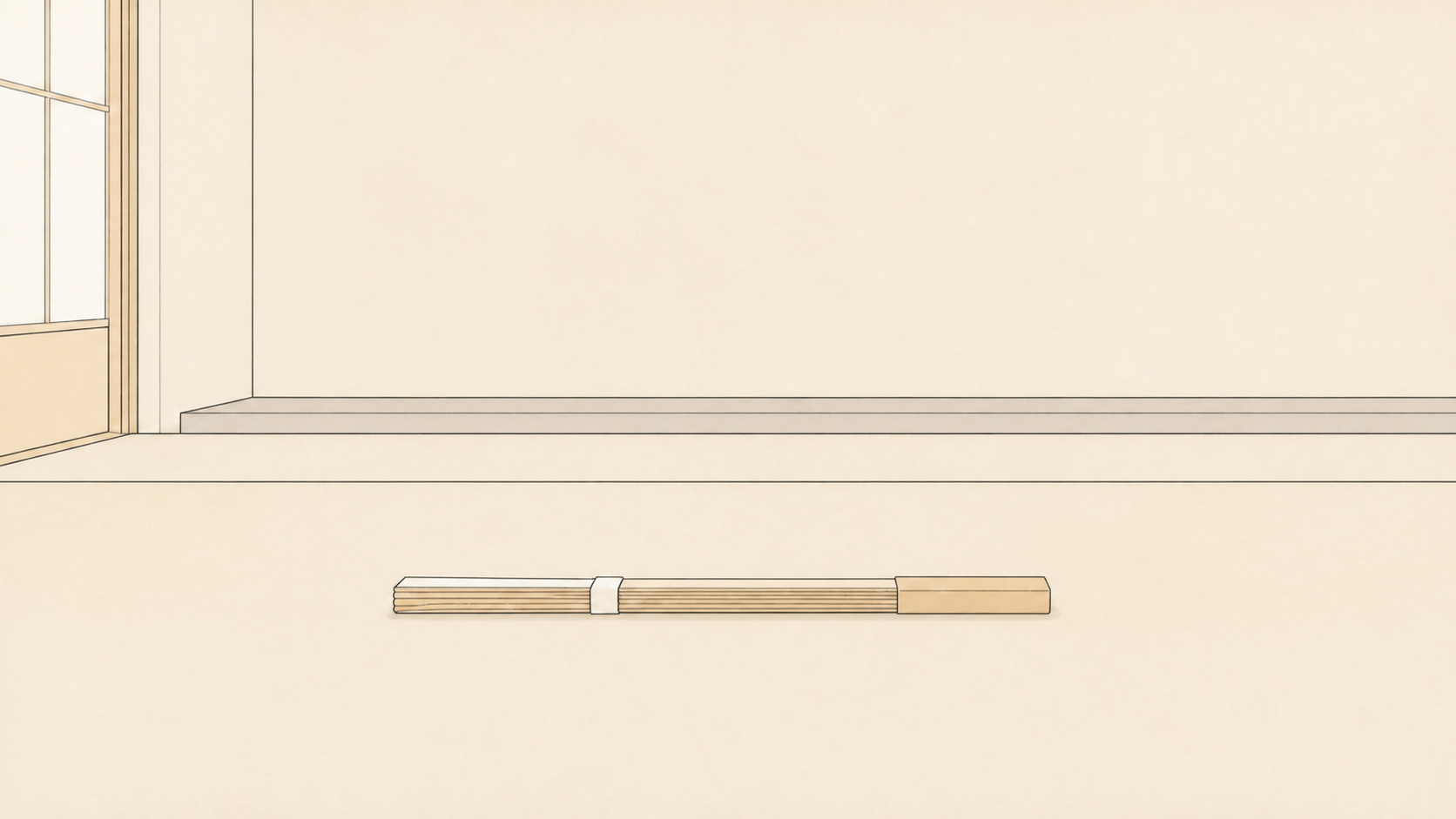
Guests carry a small folding fan into the tea room. Instead of opening it for a breeze, they set it closed in front of their knees to greet someone or view the alcove. What does this unopened fan put between one person and another, or between a guest and a utensil?
A utensil carried by the guest
Omotesenke’s glossary describes the fan as something guests always carry and set in front of their knees to exchange greetings or view the tokonoma alcove. It is smaller than an ordinary fan and used in all four seasons. It belongs among the personal articles that help a guest move through a gathering. Guests take it out as the occasion calls for it, when entering, greeting someone, or viewing a utensil. A bowl holds tea directly. The fan makes a change of action visible.
Bowing empty-handed and bowing after placing a fan in front of your knees give the body a different posture and set a different distance from the other person. The fan’s length and design vary with the school and its use. For a first gathering, ask the host or teacher what to bring before substituting a large fan from home.
The tea fan is carried to be placed in front of the guest during a greeting or formal viewing. It stays closed, in a narrow shape that makes direction and distance clear on the tatami.
How staying closed gives the fan another use
A folding fan normally opens to move air. In the tea room, it usually stays closed, and its long, narrow shape does the work. Open, it becomes a broad surface that draws the eye. Closed, it forms a line that can rest discreetly on a tatami mat. It stirs no air in the small room, leaving the presence of flowers, charcoal, and incense undisturbed.
The same object can act on its surroundings differently, depending on whether it is open or shut. The tea fan gains a use by limiting what it does to one thing the room calls for. Keeping it closed makes sense once you see that the gesture puts a line on the mat without making a breeze. Its purpose determines how to use its shape.
A closed fan at the knees marks the space for a bow
When you greet someone, putting the closed fan in front of your knees draws a short line between you. It asks both of you to notice where the other person’s space begins without putting up a wall. After the bow, the fan goes back into your hands and the room is as it was. A distance takes visible form for just long enough, without a permanent partition. I see a kind of spatial design in this very small gesture.
Courtesy has something tangible to work with: placing an object helps align posture and movement. On a mat where people sit close together, the fan marks a distance at which they can acknowledge one another. Once you know where to put it, the body settles into position for the bow. Hands, knees, and gaze line up, giving you a moment to face the other person.
The fan marks the distance from objects we view without touching
A tea bowl or caddy can be picked up for closer viewing with the prescribed handling. Other objects, such as the alcove scroll, the flower vase, or the kettle, are viewed where they are. Omotesenke’s English glossary describes placing the fan in front of the knees as you look. The fan gives the body a way to approach without encroaching. In a museum, a barrier or glass case protects the work physically. In the tea room, guests establish the distance themselves.
The distance changes with the object. A single article the guest carries helps mark how close to come. Haiken, the formal viewing of utensils, concerns how you approach as well as what you see. The fan does not physically shield the objects in the alcove. When visitors set down their own line to respect, they take on some of the responsibility for keeping what they came to see safe.
Putting the fan in front of the knees when viewing a utensil marks a line between your body and someone else’s object. It gives visible form to the respect shown by leaving it untouched.
A small utensil leaves room for everything else
A tea fan is smaller than an ordinary fan. It fits inside the front of a garment and takes up little space on the tatami. Even if everyone carries one, the room does not fill with utensils. The fan appears when needed and disappears when its work is done. That reversibility suits a small room. A permanent sign or partition keeps telling everyone the same thing. A fan comes into view with the movement of the person who carries it.
The fan follows the gesture rather than dictating how to use the room. Being portable, small, and a narrow line when closed helps it mark a place for courtesy in tight quarters. Slipped back into the front of a garment, it leaves the guest free to walk or hold a bowl. It also takes up little time: the fan appears only for the moment its presence matters.
The closed fan takes up little space and leaves the view of the alcove and utensils clear. It marks a boundary when needed and goes back into the guest’s hands when its part is over, supporting the etiquette without claiming a place of its own.
A marker of distance tells others how to approach
Today, lines on the floor, ropes, desks, and the edges of screen elements all mark distances or show which areas people may enter. The marks need to be clear, but too many fixed boundaries make a space rigid. A fan can be placed and picked up as needed, leaving the same spot available for a greeting, a conversation, or formal viewing. The point for a meeting room is less about borrowing tea etiquette than about making a boundary a signal that helps people approach with confidence.
People can focus on an object when they know how near they can get and when they may touch it. A good boundary tells people how to engage as well as what to avoid. In an online space, people also need to see who is speaking and where they can view or edit. The closed fan suggests how a quiet signal can communicate permissions.
Obvious barriers come at the cost of some of the room’s quiet. A closed fan is a small line that depends on the guest’s understanding and restraint. Guests keep a respectful distance from other people and their utensils through their own attention. That discreet way of marking a boundary tells us something about courtesy in the tea room. The small object sets the scale of a gesture. A line that barely draws the eye can reveal how much attention its user is paying.
Conclusion: A closed fan shapes an encounter
A tea fan stays closed. Set down in front of the knees, it marks a short boundary between the guest and the person they are greeting, or the utensil they are viewing without touching. Small enough to carry, it appears for the occasion and returns to the guest’s hands after the bow. It adjusts the distance as people move, without putting up another wall. Next time you see one at a gathering, look beyond its pattern and materials. Watch when it comes out, where it goes, and how people change their posture when it is put down.
Closing the fan gives its shape a second use. An object for moving air becomes a way to mark courtesy with a single line. For the bow to mean something, the guest has to attend to the person beyond the fan or the history of the utensil being viewed. The fan prompts that attention. A large barrier or an explicit instruction would be easier for everyone to read.
 What Does a Hanging Scroll Convey in a Tea Gathering?
 How the Mizusashi Changes the Tea Room: Water, Lids, and the Season
 Chabako: A Small Box Opens into a Space for Tea
 Reading Tea Records: Reconstructing a Gathering in Words