
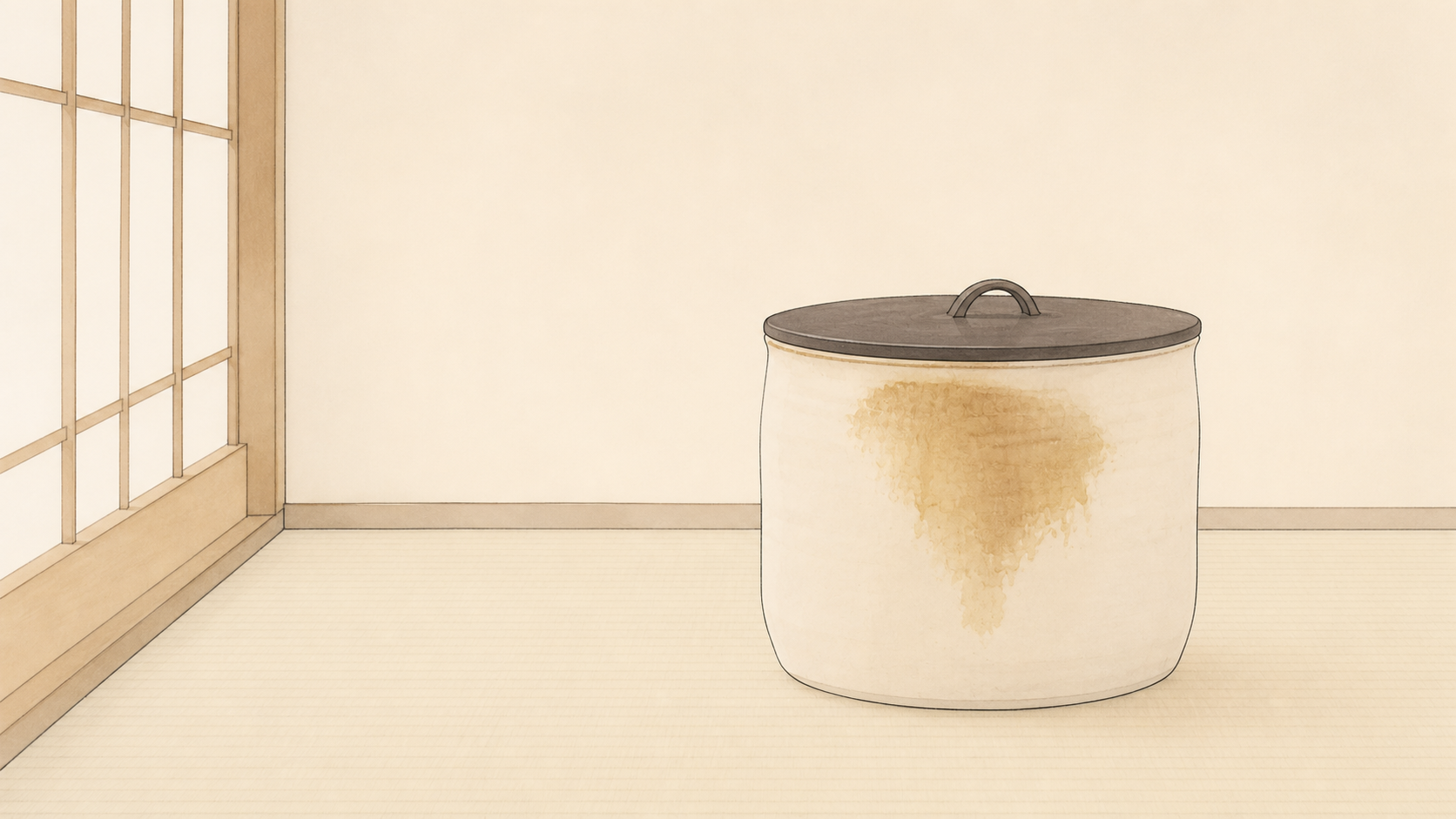
The mizusashi holds the fresh water a host needs to make tea. Its material and lid express the season, and its size anchors the host’s workspace. The design begins with the job of keeping water at hand.
The Mizusashi Holds the Water for Making Tea
The mizusashi may receive less attention than the tea bowl or tea caddy. Look where the host works, though, and its size and position anchor the arrangement. It makes me think about how much a large object can set the tone without being the focus. The vessel holds plenty of water and shows very little of it. Its quiet work depends on how vessel, water, season, and gesture fit together.
The mizusashi supplies water to replenish the kettle and rinse utensils such as the tea bowl. Capacity, the width of the mouth, the lid, and the material all affect how it is handled.
Watch where the host’s hand reaches and how the ladle goes in and comes out. Those movements show what the vessel’s shape does.
A Large Vessel Anchors the Host’s Workspace
Larger than the tea bowl or the natsume caddy, the mizusashi gives the eye a broad, steady surface. A strong color or shape affects how the surrounding utensils appear.
Like a large area of color on a page, the mizusashi can anchor a composition. Its presence should be strong enough to settle what surrounds it without taking all the attention.
I think about the vessel the way I think about a broad area of color in graphic design. It holds the composition together.
What Changes When the Lid Is Made of a Different Material
A matching ceramic lid and a lacquered lid give the same kind of vessel a different look and feel in the hand. When a ceramic body is paired with a wooden or lacquered lid, the materials share the work of one utensil.
The join between them is what interests me. Each material can make up for a limitation of the other and help guide the hand. The pairing is part of how the vessel works.
An Object Becomes a Mizusashi Through Mitate
Vessels made for different uses or in other places have found their way into the tea room as mizusashi. Ceramics from Vietnam and elsewhere acquired a new role when tea practitioners chose to use them for water.
The vessel keeps something of the culture and form it comes from as it enters a different relationship with other objects. In that sense I see mitate, finding a new use for something, as an act of editing.
Keeping Water Present and Mostly Out of Sight
The mizusashi stores water with the lid closed. Guests see the water at particular moments when the host opens it.
The lid keeps water on hand until it is needed. Bringing it into view at the right point in the sequence helps maintain the sense of cleanliness in the room.
The Season and Shelf Change How It Appears
The mizusashi sits and looks different depending on whether the host uses a ro hearth or a furo brazier, carries the utensils in, or uses a shelf. A description of its shape alone misses those changes.
Atmosphere depends on getting such details right.
Designing for a Supporting Role
The mizusashi has a visible presence, and its main work is to keep water ready. The lid opens and closes, the ladle goes in, and the surface of the water appears when needed. When that sequence flows smoothly, attention can move on to the bowl and to the tea itself. The vessel supports what happens next by doing its own work.
The vessel holds water. The lid protects the surface, gives the hand a place to open it, and forms the top of the closed vessel. Choosing a lid of a different material, such as lacquered wood, also changes the hardness, weight, and sound at the point of contact. Those differences matter to how the parts share the work.
Creative work also depends on things that get little attention: the schedule, the data, the space around the content, and the way work passes from hand to hand. The mizusashi holds the water and gives the arrangement a center without announcing the theme on its own. I see it as part of the design that makes the gathering possible. When I look at one, I notice what sits beside it, how much space it has, and where the host’s hand reaches from.
The Mizusashi Among the Other Utensils
Seen on its own from the front, the vessel draws attention to its shape and decoration. In the room you can see whether there is a shelf, how large it is beside the bowl and kensui waste-water vessel, the color of the lid, and even the line a ladle makes when set down. Its size gives the other utensils a point of reference and affects how closely they seem to sit together.
I start with the line between vessel and lid. How does the lid fit the lip? Where is there room for a hand? Where does the lid go once the host lifts it off? Follow the opening and closing, and the choice of material and size takes on more significance than it had in the closed vessel.
Sources can give us names, dimensions, origins, and rules for the mizusashi. After checking those facts, I ask what the rules do to the speed of a hand or the distance between people. Historical details and editorial interpretation each have their place. Together they can help us see how a form or practice fits the objects, people, seasons, and time around it, and give us something to notice in daily life.
How Water Makes Itself Felt in the Tea Room
The mizusashi holds fresh water under its lid. A guest may see the surface just as the host dips in the ladle. A necessary movement, rather than an ornament, makes the water’s presence felt.
A season comes through in more than a pattern. The temperature of the vessel’s surface, the material of the lid, the space the vessel occupies, and how dark the water looks when it opens all belong to that day in the room. The body protects the water and the lid controls when the host can reach it.
The next time you see a mizusashi, look at the lid and the hand after checking where it was made and by whom. Notice what the lid is made of, the shape of the mouth, how much room there is for a ladle to enter, and how far the host reaches. The shape of the vessel becomes part of a movement.
Labels like “Japanese” and “minimal” can cover up what a mizusashi has to show. Look first at marks on the material, places the hand touches, the space around the vessel, and the order of the movements. Then compare those first impressions with the historical sources.
Conclusion
The mizusashi keeps water available, brings the material of the vessel and lid together, anchors the host’s workspace, and gives a glimpse of water when the host needs it. Alongside questions of formality, provenance, and mitate, we can look at how its shape guides the hand and affects the room. I see a design that supports everything around it quietly.
Notice the material of the lid, the width of the mouth, the moment the water appears, and the distance to the kettle, as well as the decoration. Holding cold water is a task that shows in the vessel’s shape and handling. Ceramic, bare wood, or a leaf used as a lid can make the season feel different. The vessel gives us a sense of water while showing very little of it.