
A tea gathering happens once, but its record can survive. The date, the guests, the scroll, the flowers, the bowl, the food, and the selection of utensils all leave traces. What can we learn from those brief entries when we were never there? We look at how words can put a vanished gathering back together.
A tea record preserves the structure of a gathering
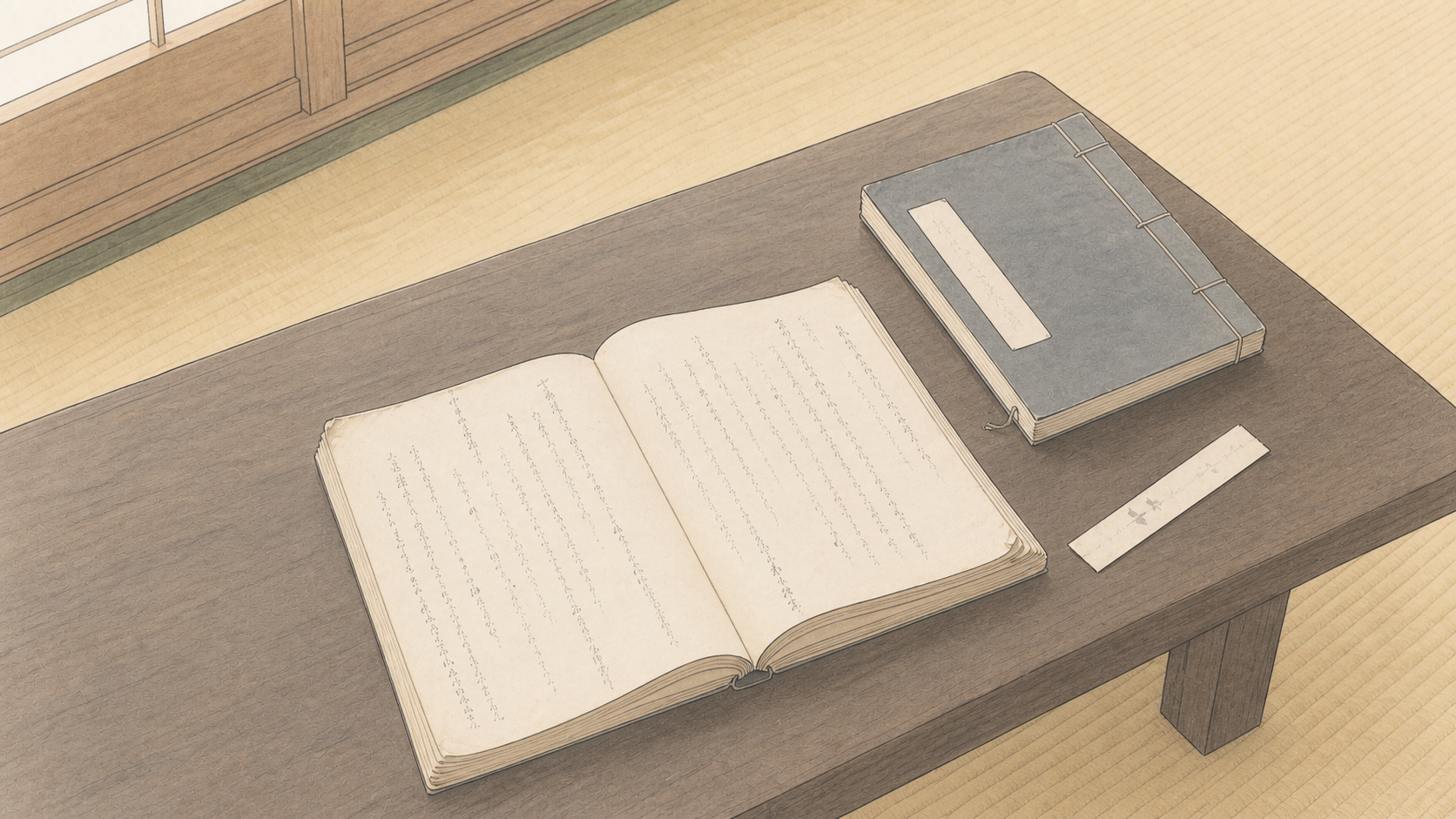
A chakaiki is an account of a tea gathering kept by a host or guest. It may give the date, place, host, guests, scroll, flowers, kettle, tea caddy, bowl, scoop, food, sweets, and details of the proceedings. Omotesenke describes records that hosts kept to remember a gathering and express gratitude and that guests kept to recall the occasion and appreciate the utensils. Before photographs and sound recordings, a gathering’s setting and the movement of its participants disappeared once it ended.
Even so, a person could choose to write down what was used, where it was used, and who was there, allowing later readers to trace a general outline. A chakaiki preserves a framework for thinking through an experience again. Its form and level of detail vary with the period and the writer. Entries do not always form a complete set as they would in a modern table. Readers may have to decipher an unclear character or compare different names for the same thing.
Dates, places, guests, utensils, and dishes can appear together in a consistent format. Even when the record contains few impressions, the order and the choices recorded can help reconstruct the theme and timing of the gathering.
Reading the relationships in a list of utensils
A tea record read merely as a list of individual masterpieces tells us little about how the gathering worked. Look at the words on the scroll alongside the season of the flowers, the standing of the tea caddy alongside the texture of the bowl, and the shape of the kettle alongside the time of year when the hearth was in use. Similarities and differences between neighboring objects begin to show what the host brought forward and what was played down. The same bowl takes on a different meaning depending on the guests, the season, and what was placed with it.
Toriawase is the arrangement of relationships among utensils. Even when the objects are scattered or lost, their relationships survive in the order of the words. Looking each item up can tell us what it was. Reading across the entries lets us ask why the items were brought together in that particular order. A focus on status alone makes the host’s choices look like a display of possessions. The season, the guests, and the purpose of the gathering can reveal a decision to set aside a showpiece and give a plain object the central place.
Consider why the scroll, flowers, tea caddy, and bowl were brought together. Set their places of manufacture, names, seasons, and owners next to one another and a list begins to show the shape of an arrangement.
Four major records from Rikyū’s time
Omotesenke dates the beginnings of tea gathering records to the Tenbun era. It describes four major records from Rikyū’s time as important accounts of looking at and appreciating utensils. They include the Tennōjiya kaiki kept by the Tsuda family in Sakai and the Matsuya kaiki kept by the Matsuya family in Nara. Later biographies can turn individuals into a few emblematic phrases. Records close to their time show who invited whom, which objects were used, and the exchanges among people in which chanoyu took place.
Records place figures like Rikyū and Oribe among the merchants, warlords, tea practitioners, and craftspeople they knew. They recover the complexity of actual gatherings. A name that recurs in several accounts can help us trace the reach of those acquaintances or the movement of an object. Put accounts of individual gatherings together and the social network that sustained chanoyu starts to emerge.
Paying attention to what went unwritten
Even a detailed record leaves something out. The kettle’s sound, the temperature of the food, a guest’s expression, a pause in the conversation, the smell of tatami, or the strength of the rain may fall outside its entries. An element may have been present even if no one wrote it down. Hosts and guests also notice different things. When reading a source, consider both the facts it records and what the writer chose to include or leave out.
A chakaiki presents a gathering from one person’s perspective. Knowing that limit leaves room to consider how rich the occasion might have been while keeping speculation distinct from historical fact. The writer may have omitted gestures that everyone took for granted. When explaining a record to readers today, we have to take care that a conversation or feeling imagined to fill a gap does not pass for evidence.
Surviving objects can help recreate a gathering
Utensils can outlive their owners. When the objects survive and a record gives their arrangement, it may be possible to recreate an old gathering. The original guests, season, and light are beyond recall. Setting out the scroll, caddy, and bowl according to the record still lets people experience the distances among the utensils and test the host’s choices in a room. A reconstruction is a way to test a reading of the record in the present.
Something that seems too conspicuous on the page might reflect surprisingly little light in an actual tea room. Going back and forth between the record and the objects turns a question of chronology into a question of space. A reconstruction may use pieces from the same period in place of missing utensils. Stating those choices lets people encounter the old arrangement while seeing where a new choice was made.
What should we keep so others can revisit an experience?
Today we can keep volumes of photos and videos. More material does not automatically tell us what mattered. A chakaiki selects the date, people, objects, and order because it cannot preserve everything. That selection lets later readers follow the structure of the gathering. A meeting, exhibition, or dinner can be documented with more than a row of photographs. A short record of the purpose, participants, central objects, reasons for choices, and what happened before and after helps others review those decisions later.
A good record lets someone else go back and ask questions. The relationships it makes legible matter as much as what it contains. Consistent names, places, and dates make it possible to read across events or follow the provenance of utensils. The level of detail determines the questions a reader can ask in the future.
Names and objects can help us imagine the gathering while the unwritten parts remain open. Some things become knowable because a record survives. Others cannot be resolved even with the record in hand. Taking that difference seriously lets us pass on the vanished occasion without turning it into a story of our own convenience.
Conclusion: The record offers a way back into the gathering
After a gathering, the guests go home, the flowers wilt, and the kettle cools. The chakaiki takes what would disappear and keeps the date, people, utensils, food, and their arrangement in words. It cannot preserve every scent or expression. By reading relationships among the names and considering the writer’s viewpoint and omissions, we come closer to the shape of a gathering that has passed. When you next read a chakaiki or an exhibition checklist, try drawing connections between objects that appeared together and the people who were there.
What a record leaves us is a way to reassemble earlier choices and test how we see them today. Reading a chakaiki is a form of editing too. We arrange fragments, acknowledge gaps, and compare the evidence with objects and other records to form a provisional picture of the gathering. The record leaves room to reconsider it precisely because the past cannot be replayed in full.