
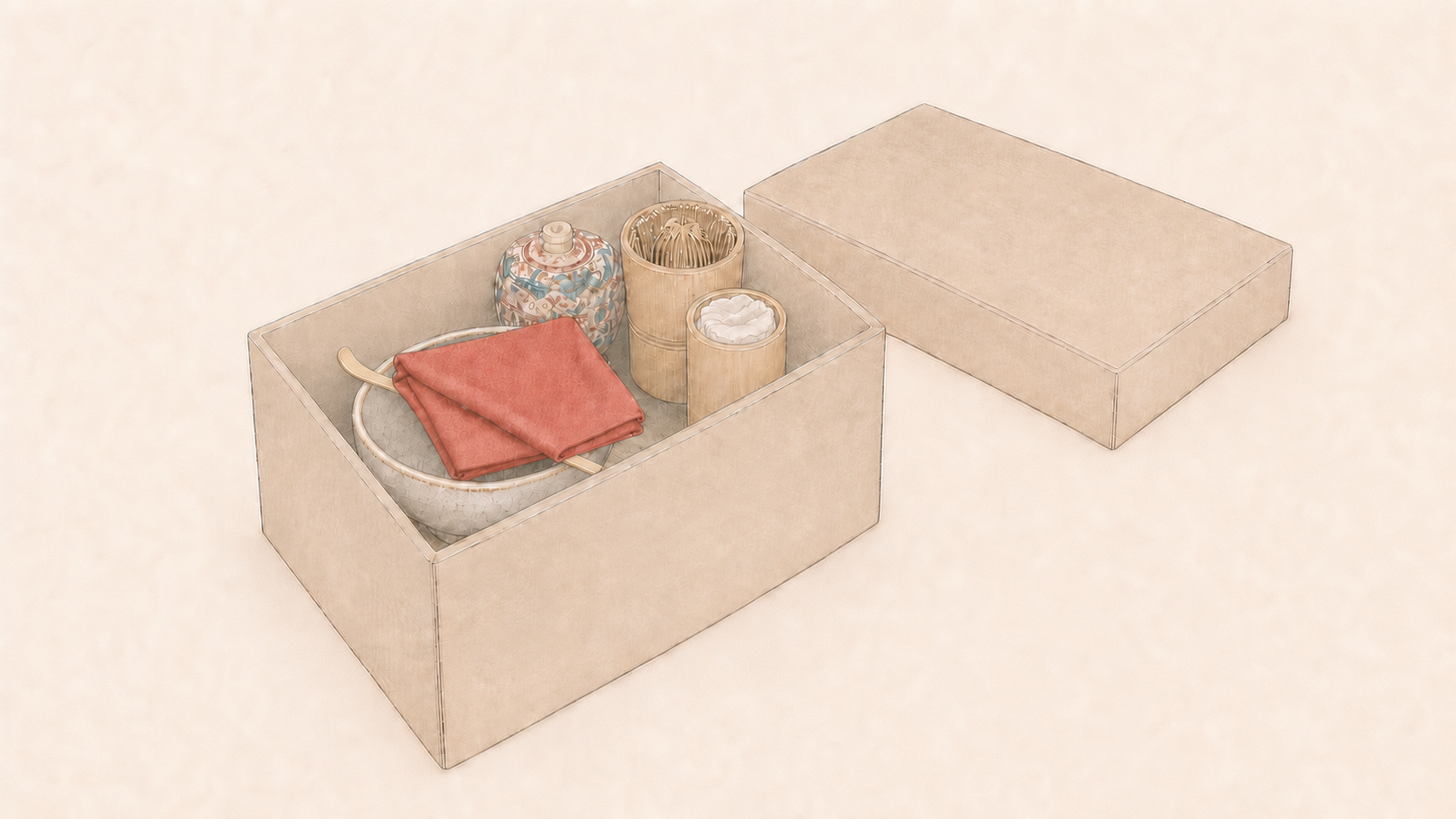
A chabako holds a tea bowl, a caddy, a whisk, and other utensils in a small space. Open the lid and take the pieces out in order, and you can make time for tea on a journey or outdoors. To see how the box holds a space and a sequence, begin with the way the utensils fit inside.
Fitting the Utensils for Tea into One Box
A chabako brings together a bowl, caddy, whisk, scoop, and cloths for making tea. The pieces are fitted so that they will not damage one another and can be taken out in order. The limited space makes it clear what is needed and what can stay behind. The arrangement inside the box prepares the first moves of making tea as well as finding a place for each piece. What comes into contact with what matters as much as the number of things packed.
Cloth separates hard ceramic from fine bamboo. Things can be layered in reverse order of use. A box needs space to slip in your fingers and put a piece back without damage as well as a way to fit things closely. Compact storage and easy access can compete. The box makes room for both over the course of preparation.
The arrangement has to protect the bowl, keep the caddy from bearing on the whisk, and let the utensils come out when they are needed. A closed box holds the order in which it will be used.
From Travel Kit to a Form of Tea Preparation
According to the Chado Research Center Galleries, chabako have served as travel boxes since Rikyū’s time. They went to military camps, on the journeys of feudal lords under the alternate-attendance system, and on other travels and outings to see cherry blossoms or autumn leaves. After a long period of flexible use, Gengensai, the eleventh head of Urasenke, devised the snow, moon, and flowers forms of chabako tea preparation. A practical way of carrying utensils developed into forms that could be used for different seasons and occasions.
A new place brings different light, wind, and company into the arrangement. Later forms of preparation kept that original portability. Giving the practice a form people could learn and repeat made it easier to share a way of taking tea on the road.
A travel set has to withstand the journey and make it possible to serve tea at the destination. The box, dividers, and pouches protect the utensils and let the arrangement adapt to the place.
Making It Small Means Rethinking How the Pieces Fit
Reducing the size of every utensil is only part of making a useful box. What fits inside the bowl? How can the lid be used? Where do the pieces go when they come out? The box, tray, and sequence have to provide the places that a mat or shelf would in a tea room. Making the space smaller calls for fitting the relationships between objects more closely and deciding which aspects of tea have to be retained.
A box, a tray, and hot water available nearby can take on the work that a full-size water jar and kettle would do. With fewer elements, the actions of cleansing, whisking, offering, and tasting remain connected. The experience can be carried into a place with different conditions by keeping the actions it depends on.
Opening the Lid Changes What a Place Is For
A closed chabako is a single bundle to carry. Open it and start to set out the utensils, and a mat, table, or cloth outdoors can become a place to make tea. Without a permanent alcove or hearth, the placement of the pieces and the movements of the people there make a center. A place for tea can come into being for a while through what people do there.
Set down a lid or tray and bring out the pieces, and a surface that was empty takes on a role. A permanent shelf gives the objects fixed places. With a chabako, the temporary arrangement comes from the sequence of use. Afterward, the utensils go back into the box and the place returns to its other use. Tea can fit into a day at home or on the road because it does not need to occupy the place indefinitely.
Limits Give the Arrangement Its Character
Within the fixed size of the box, the bowl, caddy, and cloths show what the owner likes. Fewer objects make the relations of color, material, and size more visible. A handful of pieces need to work together both inside the box and when set out. The limit makes the choices clearer.
In the close space, colors or materials that clash stand out. Choose the bowl, caddy, fabrics, and sweets dispenser with the view of them together in mind. Each piece has a role in the small arrangement. There are few places to hide an awkward choice, which makes a chabako a particularly clear example of bringing objects together.
What stays behind helps give the selection its shape. Avoid doubling up on a job and choose a point of emphasis in color, material, or season. The constraint can give the gathering a character of its own.
Taking Tea Out into the Season
People have taken chabako outside the tea room on journeys or to see spring and autumn foliage. Outside, light, wind, sound, and the ground are not under the host’s control. The utensils go out to meet their surroundings. A small box lets that day’s conditions become part of a bowl of tea. Portability broadens what the gathering can encounter.
Outdoors the wind can move a cloth, the ground can slope, and hot water can cool faster. Having the utensils in order makes it possible to make tea in those changing conditions. The day’s light and sound can remain part of what happens. The value of the portable set is the chance to make a connection where you are.
The wind, light, and level of the ground differ from indoors. Notice those conditions when opening the box and place the pieces accordingly. The tea that has traveled with you can then take part in the season where you stop.
Closing | A Box Holds More Than Utensils
A chabako holds a set of tea utensils in a small space. It also holds the order of taking them out, the places they will go, and a selection that can speak of a season. Closed, it can be carried as one object. Open, it can make a center for tea. Look at where each thing fits and what place it makes when it comes out.
The box carries a way to begin tea in another place. Its value comes into view when the lid opens and the objects start to work together outside it. Neat packing and a usable arrangement belong to the same piece. A good portable tool is small on the way and makes as much room as needed when it is used.
That room outside the box is part of what it can hold. A small set can give a full experience room to open elsewhere.