
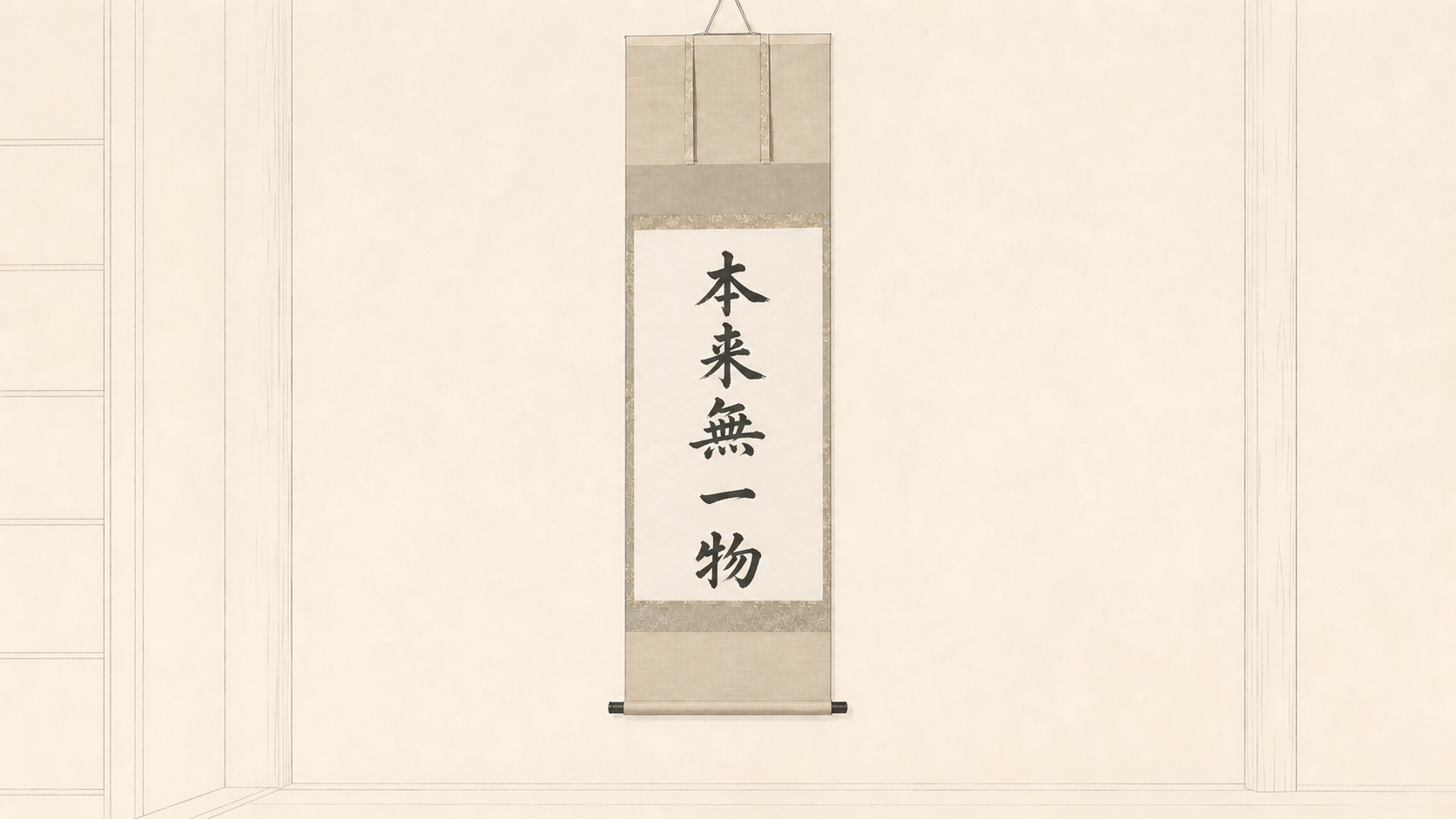
A hanging scroll gives a tea gathering a direction. The words, brushwork, mounting, placement, and space around it affect how a guest takes in the room. Begin with what the scroll makes visible before anyone reads it.
A Hanging Scroll Gives the Gathering a Direction
The scroll in the alcove is one of the first things a guest encounters. Before the words can be read, the density of the ink, the pace of its lines, and the unmarked paper already give the gathering a certain tension. The scroll quietly suggests where to direct attention in the rest of the room.
The Kyoto National Museum explains that scrolls are chosen to suit a gathering’s theme and can include tea-related sayings, letters, waka poems, or pictures. The scroll offers a way to enter the gathering and see what follows from a particular angle.
Change the scroll and the same utensils can look different. The words give the gathering a frame from inside the room.
The Brushwork Arrives Before the Meaning
It is worth finding out what the words mean. A fine, dry line and a broad, wet stroke can give the same words a different feeling. The spaces between lines, the blank paper, and the way the characters are abbreviated can work like the volume and pauses of a voice.
Reading the words is one part of seeing the scroll. Following the ink with your eyes lets you retrace a movement the body made with a brush.
The Mounting Gives the Work Its Surroundings
The fabric, paper, and rollers protect the work and connect it to the architecture. The contrast with the alcove wall, the space above and below, and the height of the scroll all change how strongly the work speaks.
A showier frame will not always give the work more force. Some elements can come forward and others recede. The mounting helps determine how far the work carries.
A Scroll Can Begin a Conversation
A host’s choice of scroll can give the gathering its center. Guests may bring different knowledge or associations to it. The differences give people a reason to talk.
The scroll can quietly give guests a direction from which to read the occasion.
The Scroll’s Standing and Provenance Affect the Room
Who held the brush, how the work came down to us, and whether it is a letter or a piece of calligraphy all matter. The beauty of the words is part of the encounter, as is the time the object has passed through before it came into the room.
The standing of a scroll can express the care and formality with which a host receives the guests. It also helps set the tone for the other pieces. A forceful scroll needs companions with room to receive its force.
A celebrated hand does not make a scroll right for every occasion. A well-known piece with little relation to the season or the guests can be as out of place as a bold logo without a context. A good arrangement takes account of both standing and circumstances.
How a Scroll Brings Words, Form, and Space Together
A scroll carries a written meaning, the movement of a brush, the materials of paper and fabric, a particular height above the floor, and the depth of shadow in the alcove. Several different media meet on a tall, narrow surface.
In the terms of contemporary communication, the copy, typography, and exhibition space are inseparable. They work together to decide what voice the words have, how far away they can be heard from, and how quickly they reach someone.
If you cannot read the scroll at first, take in the force of the line, the blank space, the mounting, and the quiet around it. Look up the words and the work’s history afterward. Going back and forth between sensation and knowledge brings more of the gathering into view.
How Do You Look at a Scroll You Cannot Read?
Unfamiliar characters may bring you to a halt. Understanding the exact meaning at first glance is only one way to see a scroll.
Begin with whether the ink was dry or wet, how quickly the line moved, how closely the characters sit, and the color of the paper. Find out who wrote it, what it says, and why it was chosen for this occasion. Reading and looking can deepen one another.
A hanging scroll offers a place to start moving between observation and research.
How the Host Chooses One Scroll
The host considers the season, purpose, guests, utensils, and flowers when choosing which voice to place at the center of the gathering.
A celebrated writer or powerful phrase can dominate the space. Does the force of those words welcome someone, or is it there to display what the host knows? The choice tells us something about the host’s attitude.
A scroll brings its background with it. The most fitting choice is the one whose meaning can come through to these guests on this day.
What It Means to Put Words in a Room
Advertising copy depends on more than the words. Its voice changes with the typeface, size, position, surrounding images, and place where it is read. A hanging scroll shows the same principle with ink, paper, and an alcove.
The tall proportions draw the eye up and down. The empty space of the alcove slows the reading. Words become a form the body encounters.
Tokyo Muichimotsu looks at how words become an object, shift the room’s center, and start a conversation.
What a Scroll Brings into Focus
The first urge may be to find out what the scroll says. Before the words are understood, the scale of the characters, the space around them, and the height of the work have already shaped how you receive the room. The force of the ink and the white paper can set a tone ahead of the meaning.
A Zen saying that still makes little sense after you look it up might feel different after drinking the tea and seeing the other utensils. The words can give the experience of the day somewhere to settle. A good phrase leaves room for what the guest experiences later.
Treat a scroll as an admirable saying alone and this effect disappears. The writer, provenance, mounting, season, and point of the gathering help explain why those words are there today. The standing of the scroll can give weight to the way it reaches people. The host brings that weight into relation with the guests who are actually there.
Imagine the Time Spent Before the Scroll
In choosing a scroll, I would start by thinking about what state a guest might arrive in. On one day words of encouragement may be too forceful. On another, one unexplained character may stay in the mind. Placing words in a room requires attention to how they will be received.
Closing
The words, brushwork, mounting, and distance from the alcove all guide what guests notice and what comes to mind. A scroll works before it is read and can remain with you afterward. Who wrote it? How was it passed down? How does the ink move, and how does the scroll meet the flowers or wall? These details give guests a way to look at the gathering.
The meaning of the words is one part of what the scroll conveys.
The scroll speaks early and quietly. Follow the characters, space, and mounting into their relation to the season and guests and you can see the alcove as a place where the gathering takes focus.
 Reading Tea Records: Reconstructing a Gathering in Words
 Honrai Muichimotsu: What It Means to Be Free of Attachment