
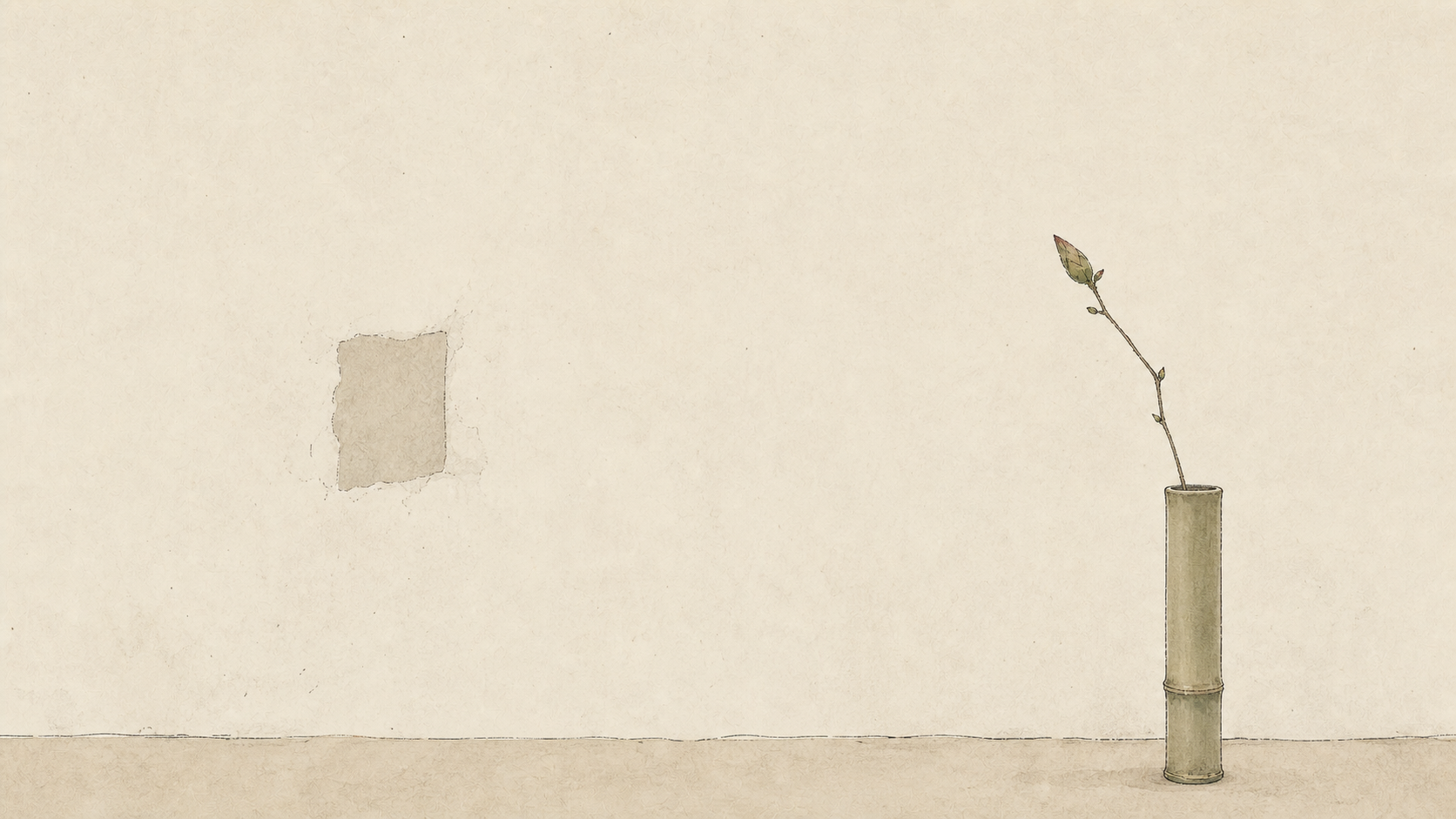
Wabi once named the distress of things not going the way one wished. In chanoyu, a sense of lacking something could open onto another kind of richness. The change begins with the word’s life before it named an aesthetic.
Wabi did not begin as a word for beauty
Wabi once carried a sense of frustration or loneliness when things did not go as one hoped. It had little to do with describing a display of beauty.
In chanoyu, limits became a place to find resourcefulness and quiet. The question shifted from enduring the absence of costly implements to choosing and arranging the things at hand.
Wabi changes what we notice within the conditions we have. Instead of looking for an object with the right appearance, ask what you can see, hear, or touch more clearly because fewer things are present.
From Murata Jukō through Takeno Jōō to Rikyū
Wabi tea developed over time, through Murata Jukō and Takeno Jōō and on into Rikyū’s era.
The Kyoto National Museum describes a tea culture grounded in wabi emerging in a period that prized Chinese imports. Its practitioners also used familiar utensils from daily life. Rikyū carried that current forward, giving it a form people could feel through small rooms, Raku bowls, and bamboo utensils.
When something is missing, the choices show
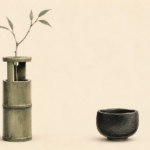
Many celebrated objects in a large room send the eye in several directions. One scroll and one flower in a two-mat room make the few things chosen easier to see.
An absence acquires beauty only through choices about what stays and what goes. Wabi depends on what people do with limited conditions, beyond the amount they take away.
When there are few objects or materials, people can see what was kept. With one flower, the direction of its stem becomes distinct. With one bowl at the center, subtleties of the rim and glaze seem closer. Limits make the reasons for a choice difficult to hide.
Creating an absence on purpose is only the beginning. Make sure the guest can do what they need, then consider how much explanation or ornament can be removed. If attention gathers around one flower, bowl, or sound, having less can give the scene a focus.
Quiet lets us hear what is there
A tea room shaped by wabi still has sounds. Water in the kettle murmurs. The whisk touches the bowl. Guests move across the mats. Those noises reach us when there is less to drown them out.
Quiet lets us notice changes that would otherwise pass unheard. The space opens the senses to small things.
When you hear the kettle, the whisk on the bowl, and fabric brushing fabric, the distance and the changes in each become clear. Wabi’s quiet comes from paying attention to particular sounds.
Even in a quiet room, the kettle grows louder, steam changes, and wind moves the shōji. A small number of sounds can remain audible without crowding one another out. The setting stays quiet while small changes continue.
Wabi goes beyond an aged appearance
Dull colors, marks, and fewer things do not ensure wabi. Imitating its surfaces leaves out the question of why a form was chosen.
Consider what the object is for, what it is made of, where it is, and who uses it. Bamboo works as a vase because its qualities can work with the flower. A small room is rich when proximity changes what people notice.
An aged color, a chip, or a rough surface cannot create those conditions alone. A new object can serve its purpose without excess, make room for others, and become more meaningful with use. What matters is what it does in the setting beyond its age or texture.
Distressing a new bowl cannot give it the time it would have spent with an owner. Wabi has to do with how meaning grows through repeated use. Choose a material and way of handling it that have room for time, instead of copying the state a thing reaches after years.
A relationship with nature goes beyond decoration
Natural materials and a sense of season often come up in accounts of wabi. Wood, bamboo, and clay can deepen that relationship when we accept the time in which they dry, change color, and take marks.
A tea flower does more than reproduce a tiny outdoor scene indoors. Notice which way today’s stem grows and which bud is about to open, then arrange it in relation to its vase. Start from the form the plant has at the moment.
Earthen walls and bamboo utensils associated with Rikyū’s tea show changes over time. Their character deepens as people use and care for them. Wabi can lie in that openness to change, rather than a surface altered to look old.
Designing in relation to nature means attending to the properties of materials and the changes of season.
Make wabi a visual style and it can become a collection of old wood, dark color, and chipped bowls. What turns a shortage into something worth seeing is the attention people give the few things there.
Before filling a gap, notice the attention, ingenuity, and relationships the limit has made possible.
Transferring a leaf or stone to an ornament does little by itself. Leave room for the light to change, the material to age, and the person using it to make adjustments. The practice comes closer to wabi when nature can continue to change beyond the finished drawing.
To carry wabi forward, ask what a person needs to be able to notice before choosing earthen colors or reclaimed wood. Learning how Rikyū directed attention makes his aesthetic more available to present conditions than copying its surfaces.
Conclusion: What can we see when there is less?
Wabi asks us to pay attention to the objects, time, and movements that remain before rushing to supply what seems to be missing. It does not make inconvenience or poverty beautiful by naming them so.
Measure richness in more than the number of objects and the same flower, bowl, or pause may look different. Perhaps wabi changes the eye that finds value more than it changes the number of things.
With one flower, the bend in its stem and the direction of the bud come into view. In a small room, the kettle and another person’s movements feel near. The quiet of wabi comes into view when having less gives us a chance to attend more closely.
Before looking for age or imperfection, look at what was left, and where attention goes.
 Who Was Sen no Rikyū? The Life of the Man Who Changed Chanoyu
 What Did Sen no Rikyū Design? The Relationships Inside a Tea Gathering
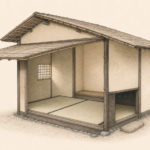 Why Did Rikyū Choose Small Tea Rooms? Two Mats and Four and a Half
 Why Did Rikyū Look beyond Lavish Tea Utensils? From Karamono to Wabi