
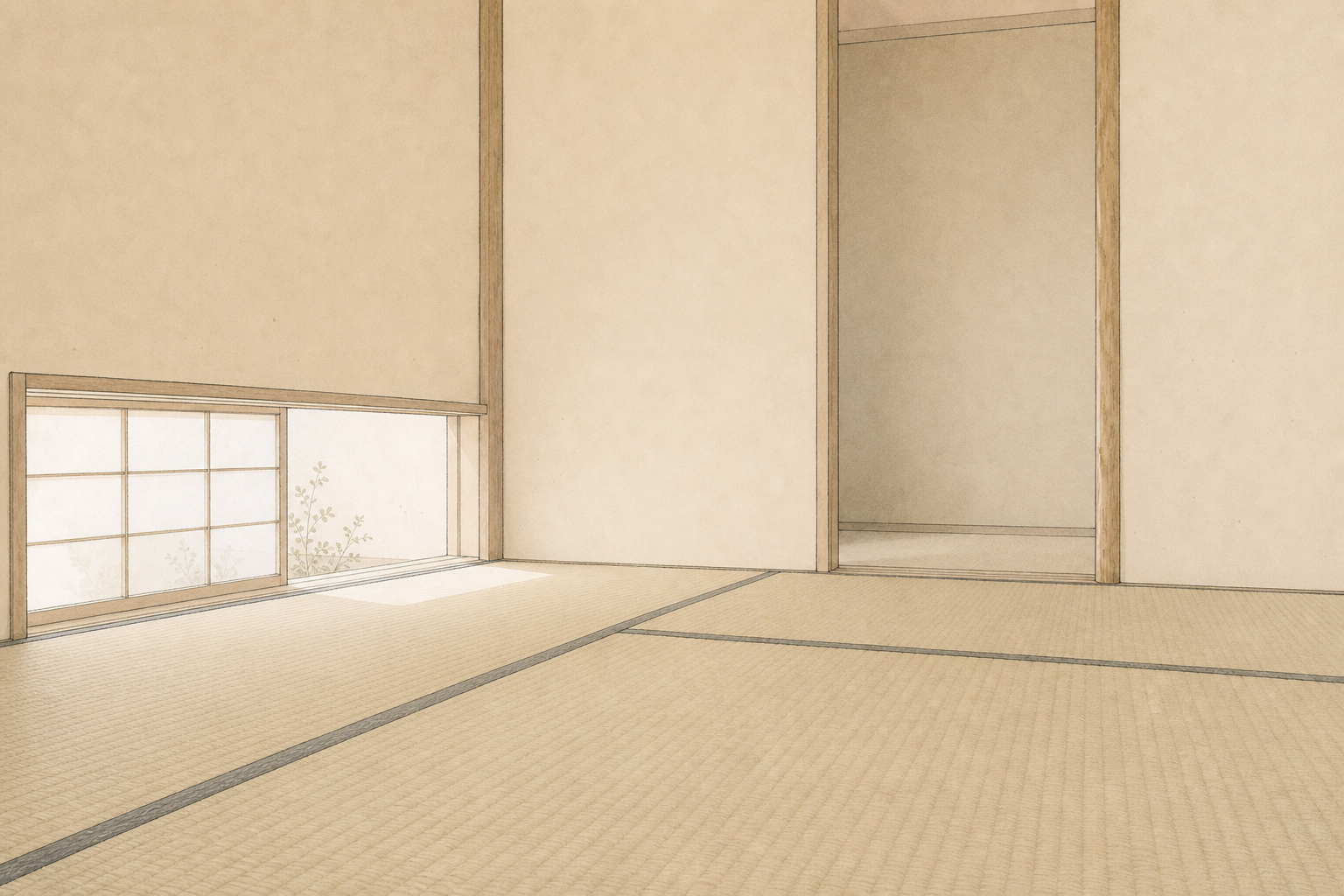
The smallness of a tea room sets a limit and draws attention closer. Dimensions, light, the entrance, and sightlines can change the experience of the room. Start by noticing what smallness brings into reach.
A small room draws attention closer
Some spaces occupy very little ground and loom large in memory. The spaciousness of a tea room is hard to measure by floor area alone. Where we look, how we enter, and how quickly we move change its felt dimensions. Smallness concentrates the direction of the body, the places through which light enters, and the distance to utensils. Things that usually recede into the background come to the fore.
In a wide space, the eye can wander far away. In a small tea room, the weave of the mats, the texture of the wall, the sound of the kettle, and the person sitting next to you are all near. Small details are more densely present.
Smallness gathers attention that might otherwise disperse.
The entrance changes the body’s way of moving
A small entrance such as the nijiriguchi makes a person bend down and slow. Moving from outside to inside becomes something the body feels as a change of posture.
The entrance can communicate physically before anyone explains what the room is for. The height of a doorway, the position of the windows, and the layout of the mats guide both movement and sight.
Light gives the eye an order to follow
In a uniformly bright space, things appear with much the same strength. In subdued light, the alcove, utensils, and hands come into view depending on time and position. Shadow gives looking a sequence.
Earthen walls, tatami, wood, and paper reflect light differently, adding to the sense of depth. Their surfaces help determine how the light reaches us.
Spaciousness depends on relationships as well as area
A little room can feel easy to inhabit when the distances among people, utensils, the alcove, and the entrance are clear. Even a large room can feel crowded if its elements compete.
Design can use the limitations of a tea room to shape attention, posture, and conversation. Those are ways to give a small place breadth.
The history and purpose of a room shape its size
Tea rooms include rustic sōan rooms and spaces in the shoin style. Their scale and layout differ with their history and purpose. It does little justice to that range to rank rooms by smallness or simplicity.
The nijiriguchi, the position of the hearth, the layout of the mats, and the tokonoma alcove have distinct roles and conventions. Their dimensions set where the host and guests sit, where utensils go, and which way people bow.
Traditional arrangements show why a particular dimension or placement answered a need. What carries forward is the way it orders relationships, beyond the surface of the form.
The tea room directs attention toward the bowl
A guest goes through the garden entrance and follows the roji before stooping at the tea-room doorway. As their eyes adjust to the dim interior, their attention turns from the day outside to the gathering. The experience includes the approach as well as the room itself.
Windows give light to particular areas of a wall or utensil as well as lighting the interior. Where things are harder to see, the eye works slowly and begins to pick out small differences in materials.
A modern room can take a cue from how attention is guided before people enter, as they cross the threshold, and after they sit. A space shapes how people perceive what it holds.
Avoid romanticizing confinement
A small tea room can give rise to a particular concentration. Smallness alone does not ensure intimacy. Without workable paths and light, it can become physically tiring or oppressive.
Consider what kind of gathering the room serves and who uses it. A historical tea room and a modern public space have different requirements.
The idea to carry forward is how limited conditions can organize attention and relationships, rather than a set of dimensions to copy.
A partly obstructed view can create depth
From an entrance where everything is visible, the room can be grasped at once. A wall, post, or window that exposes the wall lattice can partly interrupt the view and leave room to imagine what lies beyond.
Alternating stops and openings in the line of sight creates a sense of depth even where the actual area is small.
Exhibitions and websites can also reveal things in stages. A person’s understanding can deepen as they move forward instead of seeing everything at once.
Light orders objects and time
Uniform lighting can show an object clearly. In a tea room, the light varies by position, bringing part of a utensil into view and letting another part recede.
The appearance of walls and mats changes with the sun’s position. Light carries the time of the gathering into the room.
Designing a space includes asking what can be seen, when, from where, and to what degree. Those choices give perception an order.
Smallness gives the eye more to discover
Mirrors and white walls are common ways to make a small place look larger. A tea room can feel spacious for a different reason. Change the direction of the body, lower the gaze, and follow the light from a window, and several distinct scenes emerge within a few mats. Those layers of experience can make a room feel larger than its dimensions suggest.
In a small tea room, a low entrance catches your attention first. Then the eye reaches the brightness of the alcove, and the dark corner only becomes apparent later. A photograph presents these things together. The body encounters them one by one. The limitation makes the room richer.
The tea room offers a way to judge a place beyond the labels “spacious” and “cramped.” Where does the body change posture, what comes into view first, and at what distance do people sit? Its dimensions are specific conditions for those relationships. The experience of the body is worth examining without turning smallness into a spiritual virtue.
Look at the tea room again from where you sit
A room often feels different from its drawing. In the tea room that difference is used with particular care. The ceiling height, window positions, lines of the tatami, and distances between guests work together. Look beyond any one measurement to how several limits, working together, open up what a person can sense.
Conclusion
An entrance changes posture, light guides sight, and materials and distance sharpen attention. A small tea room can feel spacious because of the density of those experiences as well as the impression its area gives.
The body, light, sightlines, and movement are brought into a precise relationship. This is how small dimensions produce a sense of depth.
If you visit a tea room, look first at the view from your seat before standing in the center for a full view. At what angle does the alcove enter the frame? How do other guests divide the view? Where does the window light move with time? The room unfolds differently for each body that spends time in it.
This way of looking can also apply to a small home or shop. Before adding decoration to make it look bigger, consider the direction people face, where the eye can travel, and the order in which things appear. A tea room cannot answer every spatial question, but it shows how smallness can make an experience more concentrated.
 What Modern Design Can Learn from Rikyū’s Tea Rooms
 Why Did Rikyū Choose Small Tea Rooms? Two Mats and Four and a Half
 Why Is the Nijiriguchi So Low and Small?
 Honrai Muichimotsu: What It Means to Be Free of Attachment