
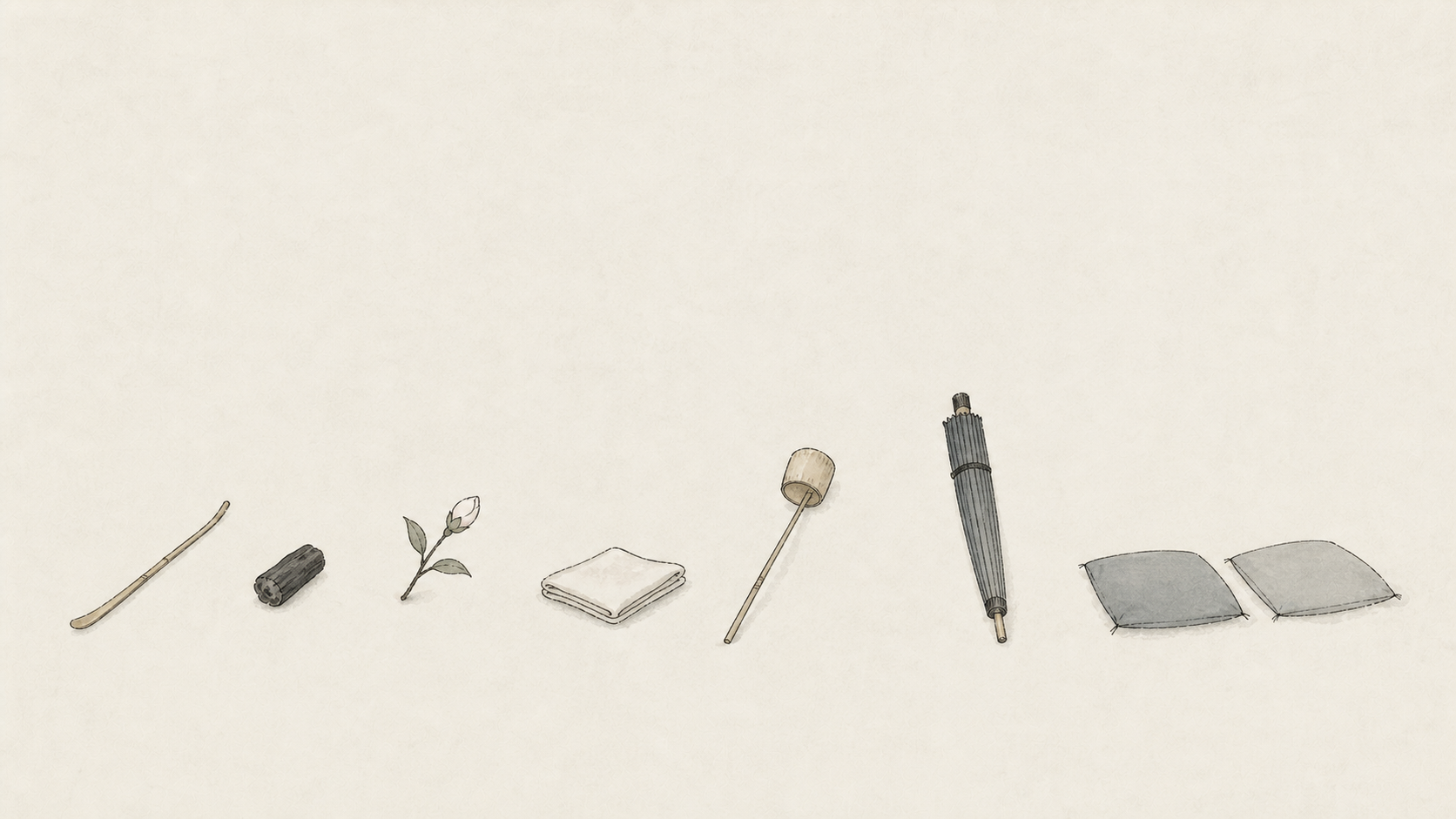
Tea, charcoal, season, flowers, time, rain, and the other guests: Rikyū’s Seven Rules ask how ordinary choices can make someone comfortable. Their starting points are familiar. The work lies in carrying them out.
The Seven Rules begin with familiar things

The Seven Rules are passed down as teachings of Sen no Rikyū. Urasenke presents them as guides for those who practice tea, starting with tea prepared to suit the person drinking it and charcoal laid so the water will boil.
The words can sound obvious. Making them work as the guests and weather change is harder. Read this way, they offer steps for observing and preparing a gathering.
The rules direct attention to the temperature of the tea, the work of the charcoal, the state of the flowers, the hour, the weather, and the relations among the guests. Before learning the words by heart, ask what each rule tells someone to look at or adjust.
Turning the rules into general service slogans would lose what makes them practical. Tea, charcoal, flowers, time, and weather belong on the same list because care for people can be expressed in conditions you can actually change: temperature, fire, the state of a flower, and timing.
Tea and charcoal: Make each serve its purpose
Make the tea so it will be good to drink. Lay the charcoal so the water will boil. The first asks what suits the person receiving the bowl, and the second asks whether the fire will do its work beyond looking well arranged.
An elegant procedure falls short if the tea is hard to drink and the water does not heat. The first two rules connect form to what it has to accomplish.
They do not call for the thickest tea or the hottest fire. Adjust strength and temperature to the matcha and the guest. Choose how to set the charcoal by the heat it can sustain. The purpose guides the technique.
Even reaching a boil is only part of the work. The fire has to last for the gathering, and the kettle’s sound and the state of the water have to suit the tea-making. More concentrated tea is not necessarily more considerate. A serving should suit both the tea and the guest.
Summer, winter, and flowers: Anticipating the senses
To give a sense of coolness in summer and warmth in winter involves more than room temperature. In summer, utensils may call air or water to mind. In winter, a nearby fire or warm colors can help. The question is how the body receives the season.
To arrange flowers as they are in the field, look at which way they face and how they grow. Bring them into the room without losing their character. A guest should be able to see the plant beyond the host’s skill.
A screen, water sprinkled on the ground, the position of the hearth, and the choice of bowls and sweets all affect comfort. Arranging the flowers as they are in the field calls for attention to the direction and vigor they had while growing, with only as much shaping as they need.
Light, air, fire, vessels, and sweets work together to suggest coolness or warmth. The shade in the alcove and the distance from a scroll also change how natural a flower appears. To anticipate what guests will sense, consider how the elements interact as well as what to set out.
Time and rain: Prepare before the need arises
Be ready ahead of time, leaving room for preparations and respecting the agreed hour. Have an umbrella ready even if it does not rain. The possibility matters before the inconvenience begins.
Hospitality starts before the guests arrive. Preparation that may never come into view lets the day unfold quietly.
Time in reserve and readiness for rain can keep an unexpected change from becoming the guest’s problem. A margin built into the preparations can absorb a delay or a shower without interrupting the gathering.
An umbrella can be ready without making guests conscious of the trouble taken over it. Put it where it is easy to use and let it go unnoticed if the rain holds off. Time in reserve can work the same way, taking up a delay without making the guests feel hurried.
Consider the other guests: Hospitality is shared
The last rule asks people to consider their fellow guests. Care comes from the host and from the people sitting together. There is more to the gathering than a transaction between a provider and a recipient.
The principal guest’s words, the next guest’s pause, and a utensil passed along all help create the atmosphere. The Seven Rules include the relations among the people present as well as the objects and actions of a host.
Before applying the rules to contemporary services
Read as practical guidance, some rules carry straight into shops and inns today. Serve a drink at a suitable temperature, make the room comfortable, prepare for bad weather, and consider who shares the space.
The value of the rules also lies beyond efficiency. Tea, water, flowers, season, and people can each do their own work if the host sets the conditions. The aim is a guest who can spend the time at ease.
Services today can look more valuable for adding features, explanations, or surprises. The rules give us a reason to check the basics. Is the drink easy to enjoy? Is anyone left waiting? Is the room too hot? Is help available before it is needed?
Look at the other person’s body and time before adding something new. These old teachings remain readable because technique alone cannot replace the work of welcoming someone.
The rules make no mention of buying a special utensil or staging a surprise. Heat water, arrange a flower, keep to the time, and prepare for rain. In such ordinary work, the person’s attention shows directly in the result.
Responsibility for the other guests is not assigned entirely to the host. The principal guest can leave room for others to speak. The next guest can watch when to receive a utensil. Everyone can help sustain the time of the gathering.
Conclusion: Hospitality starts with noticing other people
Tea, charcoal, heat and cold, flowers, time, rain, and the person sitting next to you are all close at hand. The rules work with what is already there.
Look at what the other person will experience before deciding what you want to do. That principle connects the rules to service design today. Preparing from the guest’s point of view is an approach that can outlast any particular technique.
Coolness in summer is more than a number on a thermostat. The sound of water, the feel of a vessel, light, and the shape of a sweet can all make a difference. Hospitality takes the guest’s whole experience into account.
 Who Was Sen no Rikyū? The Life of the Man Who Changed Chanoyu
 What Did Sen no Rikyū Design? The Relationships Inside a Tea Gathering
 Why Did Rikyū Choose Small Tea Rooms? Two Mats and Four and a Half
 Why Did Rikyū Look beyond Lavish Tea Utensils? From Karamono to Wabi
