
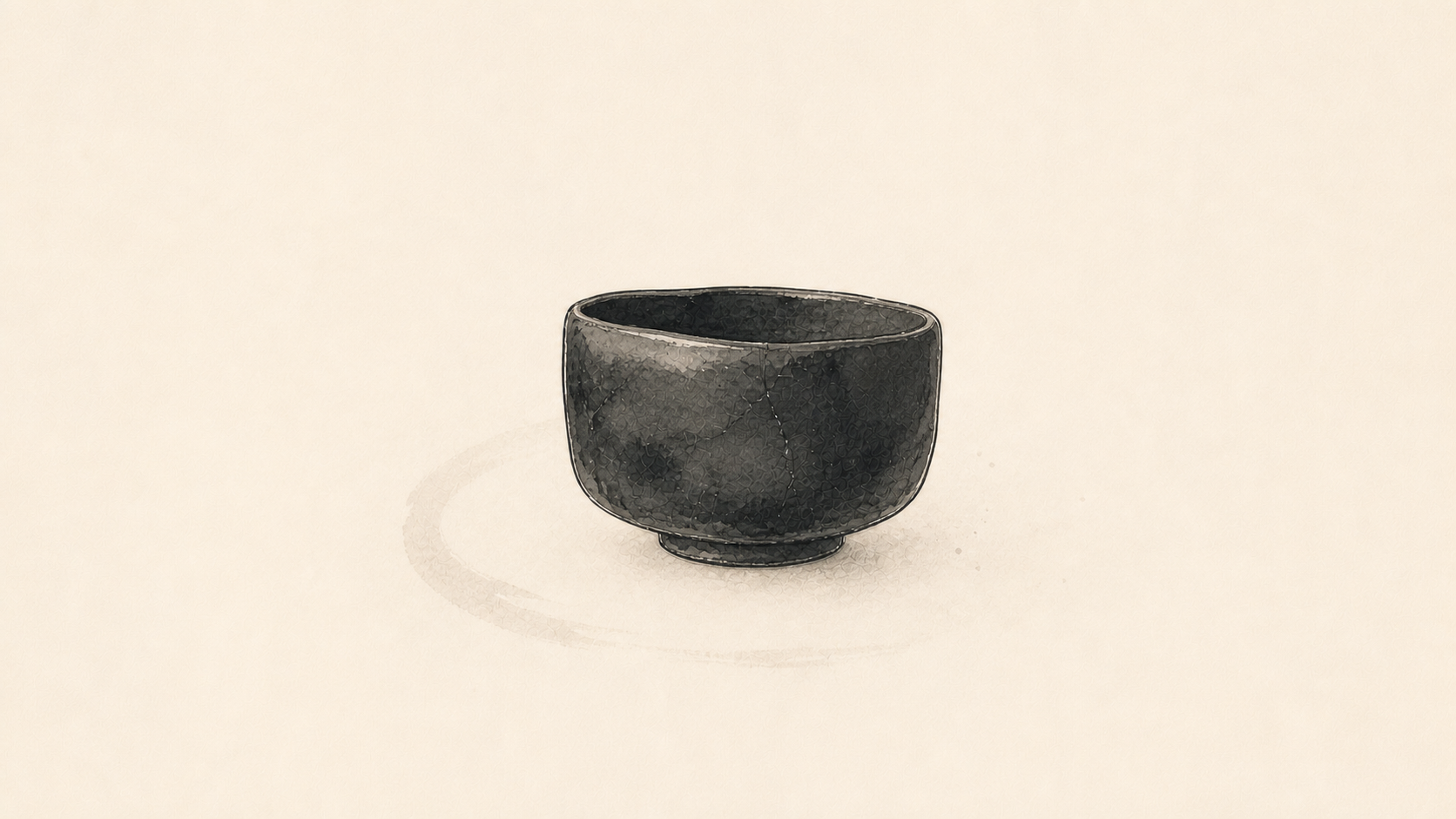
The expression ichigo ichie became widely known after Rikyū’s lifetime, carrying forward an idea from his time. Even when the same people meet again, they cannot repeat the same gathering. How does chanoyu receive a moment that cannot return?
Where did ichigo ichie come from?
Ichigo ichie is widely understood as “a once-in-a-lifetime encounter.” The familiar four-character expression is known from the late Edo daimyō and tea practitioner Ii Naosuke, who gave it particular emphasis in his Chanoyu ichie shū.
The Yamanoue Sōji ki, written by Rikyū’s accomplished pupil Yamanoue Sōji, urges the reader to regard a gathering as an occasion that occurs once in a lifetime. The idea had already taken shape in Rikyū’s time, before it found its later expression in the words ichigo ichie.
Ichigo ichie can be felt in an ordinary adjustment: noticing today’s guest, weather, or condition of a utensil and changing the plan a little.
The same gathering cannot happen twice
Use the same room and bowl and invite the same guests, and the gathering will still be different. The weather, the way a flower opens, the sound of water, how people feel, and a movement of the host’s hand all change a little.
Procedures can repeat. The time in which they happen cannot. Chanoyu accepts the difference as one of the conditions of a gathering.
Prepare carefully and leave room for change
The fact that the time comes only once makes preparation all the more important. The host picks utensils, cleans the room, lays charcoal, and gets sweets ready. Preparing carefully makes it easier to answer a change in the weather or what guests need on the day.
Leave enough room to take in what changes instead of fixing every moment in a script. The unrepeatable character of the meeting grows between preparation and improvisation.
The host prepares fire, water, flowers, sweets, and utensils. The weather and a guest’s expression cannot be fixed in advance. Preparation gives the host a way to respond when something changes. Decide what needs to be settled and what can be received in the moment.
Make the plan too tight and a flower that opens early or a guest’s unexpected question can seem like a failure. With nothing decided, there is no basis for responding to a change. Good preparation gives the utensils and sequence a place while leaving room for what this day does differently.
Guests help make the gathering
Guests examine the scroll and flowers, receive tea, and exchange questions. Their responses change the length of a conversation and what a silence means. A gathering depends on their actions as well as the host’s.
Urasenke calls the shared understanding between host and guests that makes a gathering feel at ease ichiza konryū. Ichigo ichie describes a time that the people present make together.
The pace at which guests come in, the time they take to view utensils, the way they ask, and the attention they give their fellow guests all help give the gathering its rhythm. The same preparations can yield a different experience when the guests respond differently.
A guest’s pace of looking and choice of question can deepen the theme the host prepared. There is no need to say everything you notice. Leave a moment for others to see, then open one question to the room. The attention of the guests helps make the gathering a shared work.
A once-only meeting need not make you hurry
Hearing that something will never return can make a person feel that nothing may go wrong or that something special has to happen. In chanoyu, the attention can stay with what is already there.
Prepare the usual tea with care and listen to the other person. Look at the flowers and the light you have today. Thinking of the moment as unrepeatable can return attention to details you might otherwise overlook.
Knowing the time cannot return gives us a reason to notice what happens, even when the plan changes. The sound of the water and the way a flower is opening are conditions of that day.
Reduce a once-only meeting to “enjoy it now” and the time spent preparing and remembering falls away. Long practice and the objects’ histories enter with the people. They respond to what changes and think back on the gathering afterward. The brief moment comes at the meeting of longer stretches of time.
Utensils carry traces of an unrepeatable meeting
The time is gone when the guests leave. Its traces can remain in bowls, scoops, and a record of the gathering. A utensil does not contain the time itself. It can carry the memory of who used it and what was put with it in a certain season into the next gathering.
Put the same bowl in front of another guest and it takes on a new relationship. An object with a past can participate in a time that has never happened before. That is one reason the transmission of tea utensils matters.
Provenance does not settle what you have to see in a bowl. Having a famous former owner does not oblige anyone to be moved. Knowing its background is compatible with noticing its light and feel for yourself today.
Ichigo ichie leaves a place for accumulated time. Respect what has come down from the past and let the present gathering take shape in its own way. Each meeting of tradition and the present produces a new occasion.
Thinking too hard about a once-only chance may make it feel like a day on which nothing can go wrong. The practice of tea asks us to see the weather, the guest’s face, and the condition of the hot water and respond in a way that suits what we encounter.
A utensil has a time of making, and a history of owners, gatherings, and repairs. The arrangement chosen for one occasion changes at the next. Chanoyu can preserve the object while letting the scene in which it appears change.
Conclusion: Receiving a moment we cannot keep
Ichigo ichie directs attention to the people and things in front of us. We can attend to them precisely because the time will not return.
A good moment cannot be planned in full. We can prepare, accept change, and make something together. That is how a time that comes once can become rich.
Practicing the same procedure is compatible with each gathering being different. A form learned by the body leaves a host free to notice what was not planned. Preparation and improvisation come together in the time of that day.
The idea applies even to an ordinary day. Prepare thoroughly, and take in what changes in the guests, weather, fire, and water. Once you notice what cannot be reproduced, even the same practice can hold an unrepeatable moment.
 Who Was Sen no Rikyū? The Life of the Man Who Changed Chanoyu
 What Did Sen no Rikyū Design? The Relationships Inside a Tea Gathering
 Why Did Rikyū Choose Small Tea Rooms? Two Mats and Four and a Half
 Why Did Rikyū Look beyond Lavish Tea Utensils? From Karamono to Wabi