
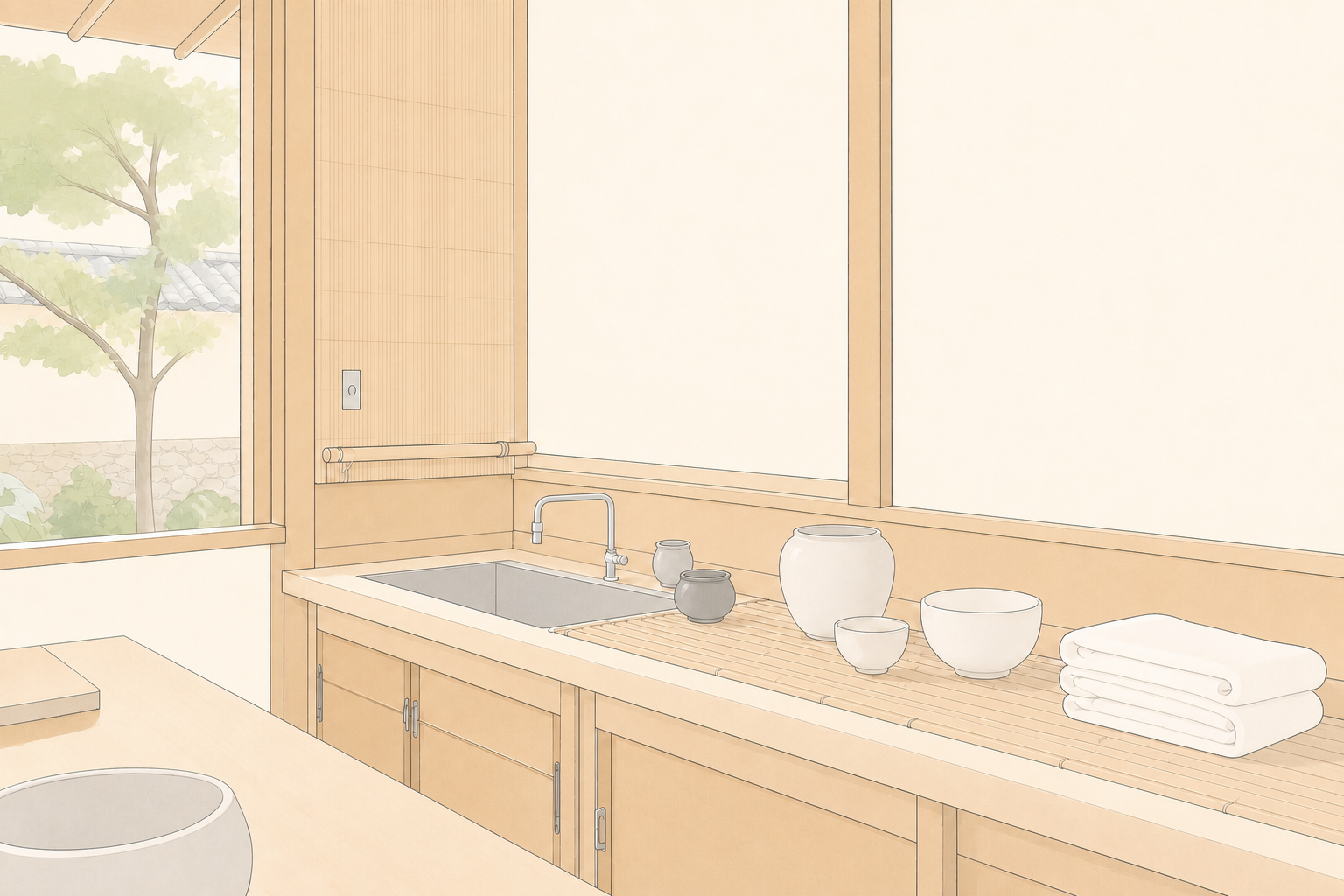
Behind the tea room that guests see is the mizuya. Utensils are washed there, water is replenished, and things are set out in order. A tea room can look spare because the unseen work has a place of its own.
The Preparation Room Beside the Tea Room
The mizuya is the space next to a tea room where people prepare for a gathering and its tea service. Bowls and utensils go on the shelves, water is handled over a slatted drainboard, and storage holds the pieces that are not needed right away. A larger mizuya may have a hearth or stove for preparing the kaiseki meal. The guest sees a few utensils. Behind them are the bowls that could replace them, hot and cold water, cloths, and vessels for the meal. The room can stay spare because the other things have a place in working order nearby.
It is easy to underestimate the mizuya by treating it as space left over from the tea room. In a smaller area it can hold more kinds of tasks: those that make things wet, those that need fire, and those that need a clean surface for vessels ready to go out. The tea room gives attention to looking and conversation. The preparation room gives it to decisions and work. The two parts of a building can operate at different speeds.
The Work the Guest Does Not See
Washing up and other preparations do not all take place in front of the guests. Keeping them in a separate space helps the guest attend to the bowl and the gathering. In the mizuya, people move, check the timing, and pass utensils from hand to hand. A quiet room on one side can require advance decisions on the other. The mizuya gives that work a reliable place to happen.
Keeping the work out of sight can make it easy to forget the labor too. Bowls are washed, water is carried, cloths are wrung out, vessels are warmed, and the next utensils are checked. The sounds and movements of that work can stay where they belong while the tea room remains quiet. Accounting for the labor supporting that quiet changes how we see the room.
The work that stays farthest out of view may be noticed first when an object is missing or water comes late. Keeping preparation to one side calls for precision so a problem does not come into the gathering.
Shelves Set the Order of Work
The pieces used often are put within reach. Wet and dry utensils, things about to go out and ones just brought back, each have a place. When people know what goes where, someone else can step in and work with the same arrangement. It reduces searching and mix-ups and sets the order in which objects will pass through the host’s doorway.
The shelves serve as a guide to the work. Height and depth affect both storage and bodily effort. Put a frequently used object far away and people have to turn or change their grip more often. If dry cloths have to pass over wet bowls, it is harder to keep them clean. Arranging things in order of use can shorten the routes and keep them from crossing. What matters is where the work can move without getting in its own way.
A floor plan can be read as a set of movements people will make.
The Host’s Doorway Connects the Two Rooms
A sadōguchi, the host’s doorway, stands between the mizuya and the tea room. Utensils appear through this small opening, and the host comes and goes through it. The doorway keeps the preparation room close and opens a connection at the right time. A short distance helps keep hot water and food warm and gives the host less ground to cover. The front room and the preparation room are linked by one door.
The opening controls how much the guest sees. It shows less of the preparation than an open kitchen and allows more through than a wall. The host and the utensils pass through as needed, and guests can wait a little for what comes next. The pause gives the gathering part of its rhythm. One door can help the work proceed and shape what is revealed and when.
Where Water, Fire, and Time Meet
As the name suggests, water is central: bowls are cleaned, the chakin cloth is wrung out, and the fresh-water jar is filled. Fire is involved where hot water or food has to be prepared. Cold and hot water, wet and dry utensils, things to use now and things to use later, can all be present at once. The room is arranged to get each thing to the gathering at the right time and in the right condition.
Setting the space in order also sets the timing. The state of each object tells people something about the progress of the work. Keeping washed vessels, vessels waiting to be warmed, the next sweet dish, and utensils just returned separate shows where things stand. The shelf itself can tell people how far the gathering has progressed. A workplace today can also benefit from an arrangement that makes progress visible in the objects instead of relying on a screen alone.
How the Work Behind the Room Changes What We See
When a bowl arrives with an easy movement, imagine what happened just before in the mizuya. The bowl was washed and checked for damage. The cloth and whisk were set inside and the bowl was placed in order. What looks fluid in the room has been made possible by earlier decisions. The work behind a gesture is another way to see its design.
From the guest’s side of the doorway, there is a bowl ready to use. From the preparation side, someone chose it from among several, checked it for damage and dirt, and added the necessary utensils. When I think about that preparation, I see the movement less as a piece of beautiful improvisation. Some of the hesitation it might have involved was already removed.
The spare view in the tea room has many choices behind it.
Closing | Quiet Has a Place
The mizuya is out of the guest’s view, but the objects, movements, temperatures, and timing of the gathering are prepared there. Shelf positions suggest the order of work, the doorway keeps the rooms close, and the places for water and fire help the tea room stay spare. Look beyond the alcove and hearth to the space on the other side of the host’s door. Its work makes the stillness in the room possible.
A photograph of what the guest sees shows part of the architecture. Follow where a utensil came from and where it goes after use and you can see a round of work, with the mizuya as a meeting point. A tea room that will work over time gives the preparation side dimensions and an arrangement that allow that work to happen easily.
 Why Switch Between the Ro and Furo? How Moving the Fire Changes the Tea Room
 Is the Empty Space in a Tea Room the Same as Negative Space in Graphic Design?
 Why Can a Small Tea Room Feel Spacious?
 What Is Sadō? How the Japanese Practice of Tea Designs Relationships