
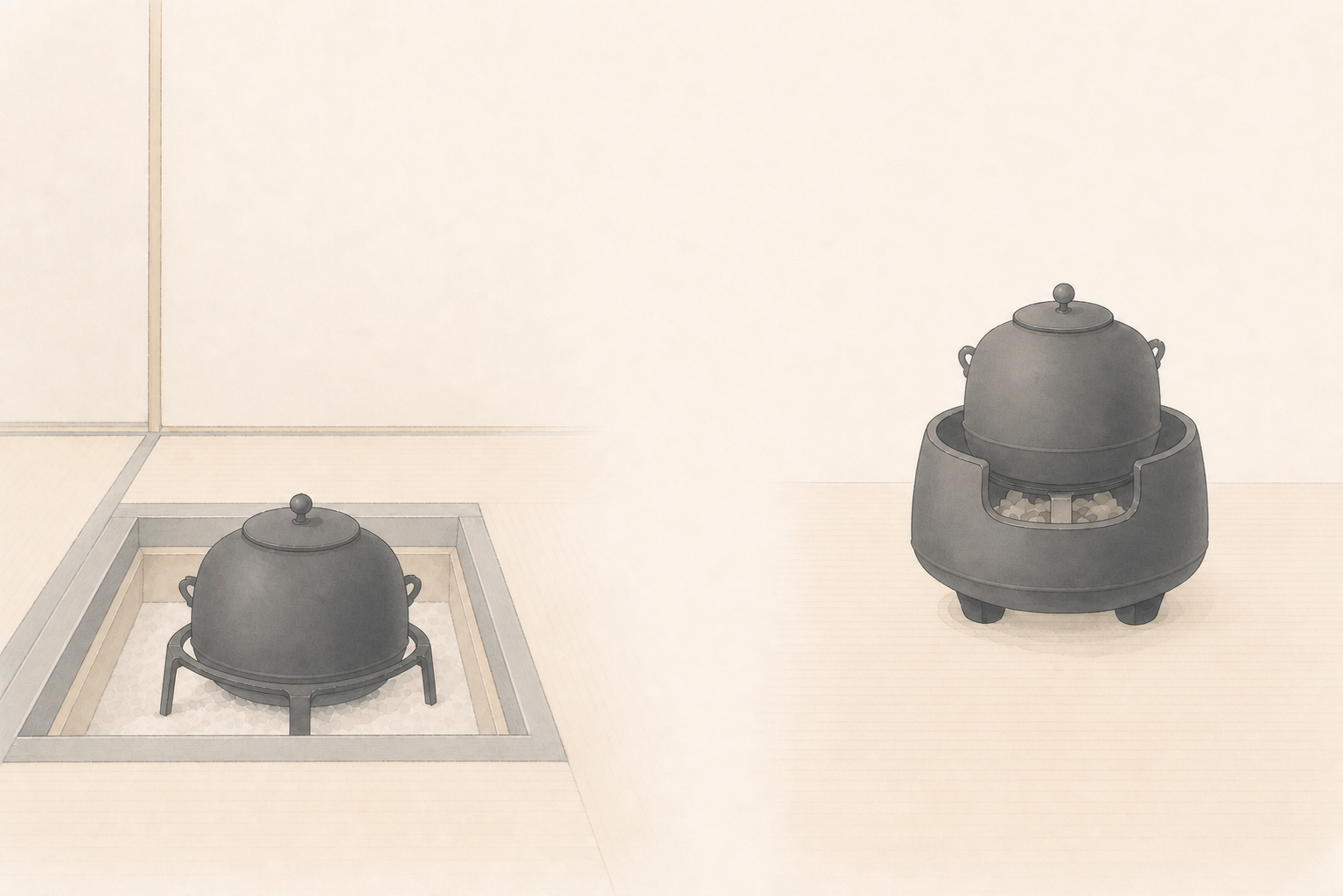
Changing from the ro hearth to the furo brazier moves the fire. It also changes how the host reaches for utensils, where they are set down, and how close guests feel to the heat. The two ways of placing the fire give us a starting point for looking at the room and the movements within it.
Two Ways of Placing the Fire
The ro is covered and the furo takes over. Months later the brazier goes away and the hearth opens again. What interests me is how far that change goes. Moving the fire moves the kettle, changes how the host sits and reaches, alters the distance to the guests, and shifts the route each utensil takes. In chanoyu the season enters the structure of the room as well as its colors and patterns.
The ro is a hearth set into the tatami floor. The furo is a brazier placed above it. They are generally used in different seasons, although the dates and details depend on the school and local conditions.
Follow where the fire and kettle move, and the change becomes visible throughout the room.
Moving the Fire Changes How Near It Feels
In the colder months the fire in the ro can feel nearer to the guests. In warmer weather, keeping the fire farther away is one consideration when using the furo. Along with the difference in heat comes a change in how close people feel to the fire.
What draws me to this arrangement is the way it changes our relationship to the fire with the season, in place of maintaining one constant level of comfort.
How Placement and Movement Change
Temae, the sequence of movements for preparing and serving tea, has different arrangements for the hearth and brazier. If an illustration casually mixes the two sets of utensils, it can show a layout that would never work in practice.
A simplified diagram can obscure those differences. For the techniques of a particular school, turn to its instructors. Here the focus is on what the two arrangements do to the room.
The Season Changes How the Room Works
Spring flowers and autumn leaves can bring a season into view through decoration. Changing from ro to furo alters the physical relationship between fire, utensils, and people.
I find this a thoughtful way to treat the season as a condition the room has to meet. As the environment changes, so does the way the room is used.
The Tatami Floor Opens and Closes
Opening or covering the hearth changes the floor of the same tea room. The building takes on a different arrangement as the year goes round.
The idea of letting a room change with time also has a place in contemporary architecture. The resemblance is worth tracing with the hearth’s history in view.
Each Change Takes Preparation and Care
At the change of season, utensils come out of storage or go back in, ash and kettle are tended, and people adjust the movements they practice. Repeated work goes into making the change look effortless.
I want to account for that work when I describe how the season appears in a room. A seasonal practice stays alive when people have a way to keep doing it.
The Hearth and Brazier as Two Systems
When the fire moves, the placement of the kettle and utensils, the direction the host faces, and the heat the guests feel change with it. The arrangement of the whole gathering responds to the season.
Descriptions of a summery or autumnal room can easily turn into a list of colors and patterns. With the hearth and brazier, the air temperature and movement, the distance between bodies, and the time the water needs to stay hot all matter. The location of the fire is one response to those conditions.
Keeping one look all year is easier than changing how the room works with its surroundings. The hearth and brazier each organize a system around fire and people. In creative work too, changing circumstances ask what to keep and what to move. See the same tea room in different seasons and those decisions come into focus: where the kettle sits, how far apart the host and guests are, how the heat feels, and which stretches of tatami remain open.
Comparing the Two Arrangements
Rather than compare the kettles alone, I follow the lines between the host’s knees, the bowl, the kensui waste-water vessel, and the guests. The sunken hearth puts the fire into the fabric of the room. The brazier holds it in a vessel above the floor. That difference changes sightlines and the paths the host’s hands take.
See the same room at different times of year and the floor itself changes. Part of the tatami opens or closes, the utensils shift, and the guests feel the fire from a different distance. Even the direction from which the heat reaches a seated person can change.
Sources provide names, dimensions, origins, and rules for both arrangements. After checking those facts, I ask what the rules do to the speed of a hand or the distance between people. Historical details and editorial interpretation each have their place. Together they can help us see how a form or practice has accommodated the objects, people, seasons, and time around it, and give us something to look for in daily life.
Feeling the Season Where the Fire Sits
The dates of the switch to the hearth and back to the brazier tell only part of the story. Does the fire feel closer? Which way does the steam rise, and where does the sound come from? Changes like these let the body register the season before anyone explains it.
The shift to a new season calls for adjusting the relationship between fire, people, and utensils. The ro and furo show how deeply a seasonal change can enter the workings of a tea room.
The next time you see a tea room, start with the fire. Before looking for seasonal utensils, notice where the fire and kettle sit and how the host and guests face one another. The rest of the layout begins to make sense from there.
The ro and furo are a concrete example of Japanese design. They let a gathering take on a different arrangement with the seasons.
Labels like “Japanese” and “minimal” can cover up what is there to see. Start with the wear on the materials, where the hands make contact, the spaces between things, and the order of the movements.
Conclusion
Each switch between ro and furo changes where the fire and kettle sit, the distances between people, the arrangement of the utensils, the movements of temae, and even the floor. The history and differences among schools matter when we look at how the seasons enter the running of the room. I see a system that responds to its environment through all those relationships at once.
The distance from the guests to the fire, the direction the host faces, the sound of the kettle, and the open space on the tatami all shift. The center of the same room moves. Before any seasonal motif comes into view, the body can already feel a difference in heat and distance.
 Nakaoki: Moving the Brazier Toward the Center of the Mat in Late Autumn