
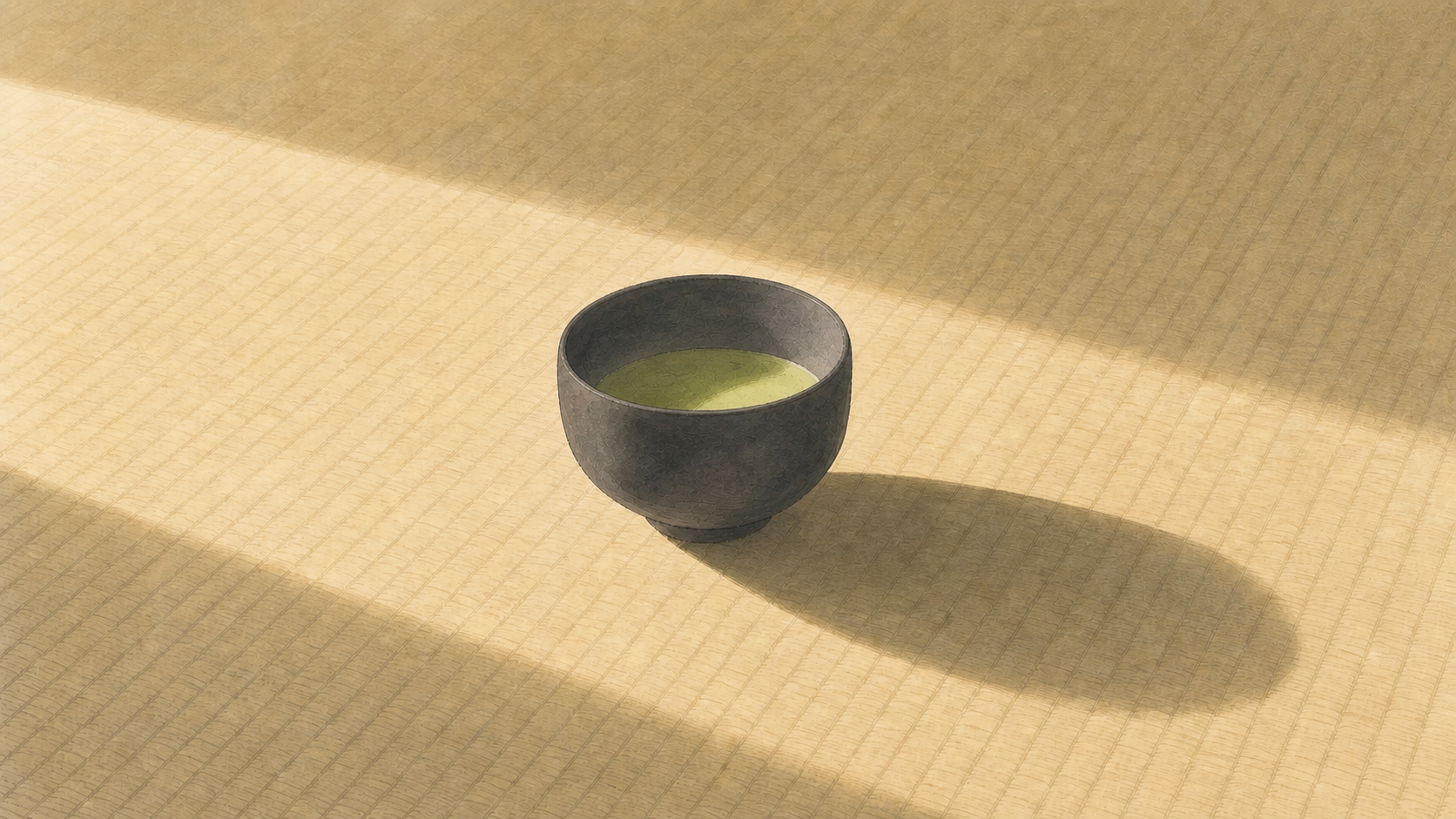
The Japanese practice of tea brings people, objects, space and time into relation. Starting with what makes a single bowl of tea possible, we follow those relationships through the arts, the way utensils are brought together, the work of practice, Zen and design.
Six Elements That Make a Bowl of Tea Possible
When you think of the Japanese tea ceremony, you may picture someone whisking matcha or handling a tea bowl.
Look closely at one gathering and you will also find architecture, the garden, ceramics, lacquer, bamboo, metalwork, calligraphy, painting, flowers, food, sweets and fragrance. The gestures of the host and guests, their conversation and their silences shape how the time passes.
The host chooses and arranges these elements for the season and the guests, drawing them into an experience that leads towards a bowl of tea.
In everyday Japanese, sadō and chanoyu are used with much the same meaning. Here both refer to the Japanese practice of tea.
To see the practice as a whole, begin by looking at six elements of a single gathering. In the room they overlap, each depending on the others.
1. Tea
At the centre is a bowl of matcha. For koicha, or thick tea, the matcha is kneaded with hot water. For usucha, or thin tea, it is whisked to incorporate air. The amount of tea and water, the temperature and the motion of the whisk can give the same matcha a different feel in the mouth and change how its fragrance comes through.
The host adds hot water and finishes the tea in front of the guests. The temperature at that moment and the pace of the gathering are part of the tea from the start.
2. Utensils
The bowl, bamboo whisk, tea scoop, lacquer and ceramic tea containers, fresh-water container and kettle each do a particular job. Their materials, forms, names and histories also bring something of their own to the gathering.
The gathering gains coherence from how the utensils sit together. A bowl with a strong presence may call for restraint elsewhere. What kind of tea container might go with a simple bamboo scoop? An object looks different depending on what you place near it.
3. Space
The tea room is a setting that changes how guests carry themselves. They walk through the garden path, wait on a bench, cleanse their hands and mouth, and enter through a small opening called the nijiriguchi. On the way, their stride, posture, volume of speech and line of sight all change.
Inside, the sunken hearth or brazier, alcove, host’s preparation area and guests’ seats have a bearing on one another. The route from the door to the place where a bowl is delivered helps determine how people move, as do the walls and tatami.
4. Season
In tea, the season comes through in the choice and use of utensils. The host moves between hearth and brazier, which changes how the kettle and fresh-water container appear. The flowers, scroll, sweets and the colours and shapes of bowls are chosen to suit the weather and character of the day.
Seasonal choices range from matching motifs to shaping how guests feel the weather. The host can make water feel close on a hot day or bring the sense of a fire nearer on a cold one. Even the temperature and distance the body feels are part of the arrangement.
5. Host and Guests
The host prepares the gathering, and the guests take in what the host has set out to convey. The principal guest speaks on behalf of the others. All the guests help the gathering along by passing utensils and observing the sequence.
Guests help complete the gathering. By looking at the scroll, taking a bowl in their hands or asking a question, they bring the host’s preparations into play.
6. Gestures and Timing
Clean the utensils, put tea into the bowl, add hot water and offer the bowl. The sequence makes it possible to handle the utensils safely, see what will happen next and give guests time.
Bring out the same object earlier and it will make a different impression. Charcoal builds the fire, water comes to the boil and tea follows the sweets. When something appears is as much a material of the gathering as where it goes.
Where Architecture, Craft, Flowers, Food and the Body Meet
Tea is often called a composite art because so many practices come together around a bowl. Omotesenke traces the beginnings of chanoyu to the development of utensils, methods of preparing tea and places made especially for it. Tea practitioners helped develop both the room itself and the tea bowls, kettles and flower containers that go into it.
What Shapes the Space
The tea room has an architecture of its own, and beyond it lies the roji. The garden is a route for guests to follow as well as a place to look out on. The spacing of the stepping stones affects the length of a step, and the small entrance changes how the body goes through. Earthen walls, bamboo, logs, tatami and shōji affect how the light falls and how sounds carry.
Architecture and garden make a continuous experience of entering the gate, waiting, cleansing and approaching the room. The space of a gathering comes into view when we take in the approach as well as the interior.
Craft Objects Put to Use
The bowl is held, the kettle heats water and the tea scoop lifts the matcha. A scroll can be appreciated for its painting or writing, and in the tea room it also sets the theme for the gathering, shaping the choice of flowers and utensils.
Tea utensils draw on ceramics, lacquer, wood and bamboo, metalwork, textiles, paper and ink. Their beauty stays in contact with use: the hand that holds them, the tatami they rest on and the water they touch, hot or cold.
Words, Flowers, Taste and Scent
Classical Chinese verse, Zen phrases, waka poems and seasonal words come together in scrolls and in names given to tea bowls and scoops. Omotesenke connects the aesthetics of wabi tea with the traditions of waka and linked verse. It also points to yoriai, the practice of forming a gathering around shared rules, as part of chanoyu’s background.
Tea flowers bring something of nature into the room. Kaiseki and sweets do more than engage the palate. They prepare the body for the tea. The scent from charcoal or incense and the sound of water in the kettle can be felt only by being there. Tea is an art that opens several senses over time.
How Toriawase Brings the Arts Together
Ceramics, calligraphy, flowers, food and architecture can share a room and still feel like separate things. The work of bringing them together for a particular gathering is called toriawase.
Toriawase is a question of what to place at the centre, what to hold back and what relationship to create. Set the green of matcha against a black bowl. Answer a strong scroll with a single flower. Lay a fresh bamboo scoop by an old utensil so two kinds of time can be felt in one room. The pieces come together around a theme while keeping their differences.
The objects do not all appear at once. The guests first encounter the garden path and the alcove, then go through the meal and sweets to thick and thin tea. The tea container and scoop are offered for close inspection after they have been used. Sequence lets guests first see an object in use and then come close enough to look at it on its own.
The host owns or looks after the utensils, but the main work is arranging relationships. The host takes account of the season and guests, selects the utensils, prepares the food and tea and decides when each will appear. The guests give the gathering its particular shape that day by looking, using, asking and responding.
Tea brings many arts together by letting the guests take them in with their bodies as one experience unfolding in time.
What Practice Teaches the Body
There are detailed procedures for receiving a bowl, setting down utensils and cleansing them in order. They keep the utensils from being damaged, help people move without getting in one another’s way and let hosts and guests share a sense of what comes next. Graceful movement is only part of their work.
Practice begins with receiving thin tea as a guest and proceeds to making tea as a host. The course of study varies by school. It widens to include charcoal, thick tea, kaiseki, formal gatherings and knowledge of utensils. Students learn to handle several elements of a gathering with their bodies alongside the skill of preparing the tea itself.
As the form becomes familiar with repetition, less attention goes into remembering the steps. That leaves room to notice the state of the hot water, where the utensils are, the guests’ breathing or a silence that has opened up in the room. A fixed form can support attention to many things at once.
It takes knowledge and a trained body to put these arts in motion. A hand holding a bowl, the body lowering at the door and the breath while waiting for someone else to move are how the relationships of a gathering actually unfold. Practice develops both an eye for objects and a body that pays attention to other people.
Zen as One Current in the Practice of Tea
The way practice brings attention back to the act at hand has points of contact with Zen. Murata Jukō, Takeno Jōō and Sen no Rikyū associated with Zen monks, and calligraphy by monks came to be hung in the tea alcove. Chanoyu developed close ties with Zen, especially with Daitokuji.
Seated meditation deepens practice through the body. In tea, too, repetition leads to understanding beyond learning facts. Bring attention to a single gesture, reduce unnecessary movement and handle the object and the encounter with the other person carefully in that moment. In these practices, tea has something in common with Zen.
Zen alone cannot account for the range of arts found in tea. The practice also draws on the aesthetics of waka and linked verse, gatherings, seasonal observances, folk customs of cleansing, social life among warriors and townspeople, and artisans’ skills. People who practised tea also belonged to a range of religious schools.
Seen as one current that has shaped the practice and aesthetics of tea, Zen gives us another way to read a scroll. The words in the alcove invite guests to consider how to attend to this gathering, alongside the simplicity we see in the room itself.
Tea as the Design of Relationships
To see tea as design, look at how the shape of the bowl and the beauty of the room work with what is chosen, where it is placed, when it appears and who moves in response.
The stepping stones give the garden a pattern and set the guest’s stride. The small door gives the body a reason to lower as it enters. The scroll makes a mark on the wall and sets a theme against which the flowers and utensils can be read. A form can direct both movement and attention.
In mitate, an object made for one use can be given another in tea. With a new setting, different utensils alongside it or a different person using it, the same form can take on a different meaning. Changing the relationships around an object is itself a way to work with it.
Next time you look at a tea room or its utensils, follow what a form does to the people around it as well as noticing what looks Japanese. Where does a guest slow down? Which utensil catches the eye first? What does the host prepare first, and what stays out of sight until the end? The design of tea lies between one object and another, between the person and the object, and in the passage from one gesture to the next.
Tea is a practice of participation and time. The people who prepare the gathering and those invited into it share a space and complete it by responding to one another’s movements.
Closing | The Culture of Bringing Things into Relation
Around a bowl of tea there are utensils, space, season, host and guests, gestures and time. Architecture, gardens, craft, writing, flowers, food, sweets, fragrance, Zen and classical literature all have a place there too.
Tea makes a composite art of these practices by choosing what goes together, giving it a sequence and making it into a gathering that guests take in with their bodies. Repeated practice schools the body and attention to handle those relationships.
The beauty of tea comes through when bowl and tea, scroll and flower, fire and water, host and guests come together at a distance that suits the day.
Around a bowl of tea, the practice brings objects, people and time into relation. Attending to those relationships offers a way into the aesthetics of Japanese culture.
References
- Omotesenke Fushin’an, “An Introduction to the Tradition of Chanoyu”
- Omotesenke Fushin’an, “Chanoyu and Classical Literature”
- Omotesenke Fushin’an, “Chanoyu and Religion”
- Omotesenke Fushin’an, “Chanoyu and Folk Customs”
- Omotesenke Fushin’an, “The Tea Room and Its Garden”
- Omotesenke Fushin’an, “On Practice”
- Omotesenke Fushin’an, “Works of Art and Tea Utensils: Appreciation and Use”
- Omotesenke Fushin’an, “Mitate”
 Honrai Muichimotsu: What It Means to Be Free of Attachment
 What Does a Tea Bowl Convey? Standing, Provenance and the Feel in the Hand
 What Did Sen no Rikyū Design? The Relationships Inside a Tea Gathering