
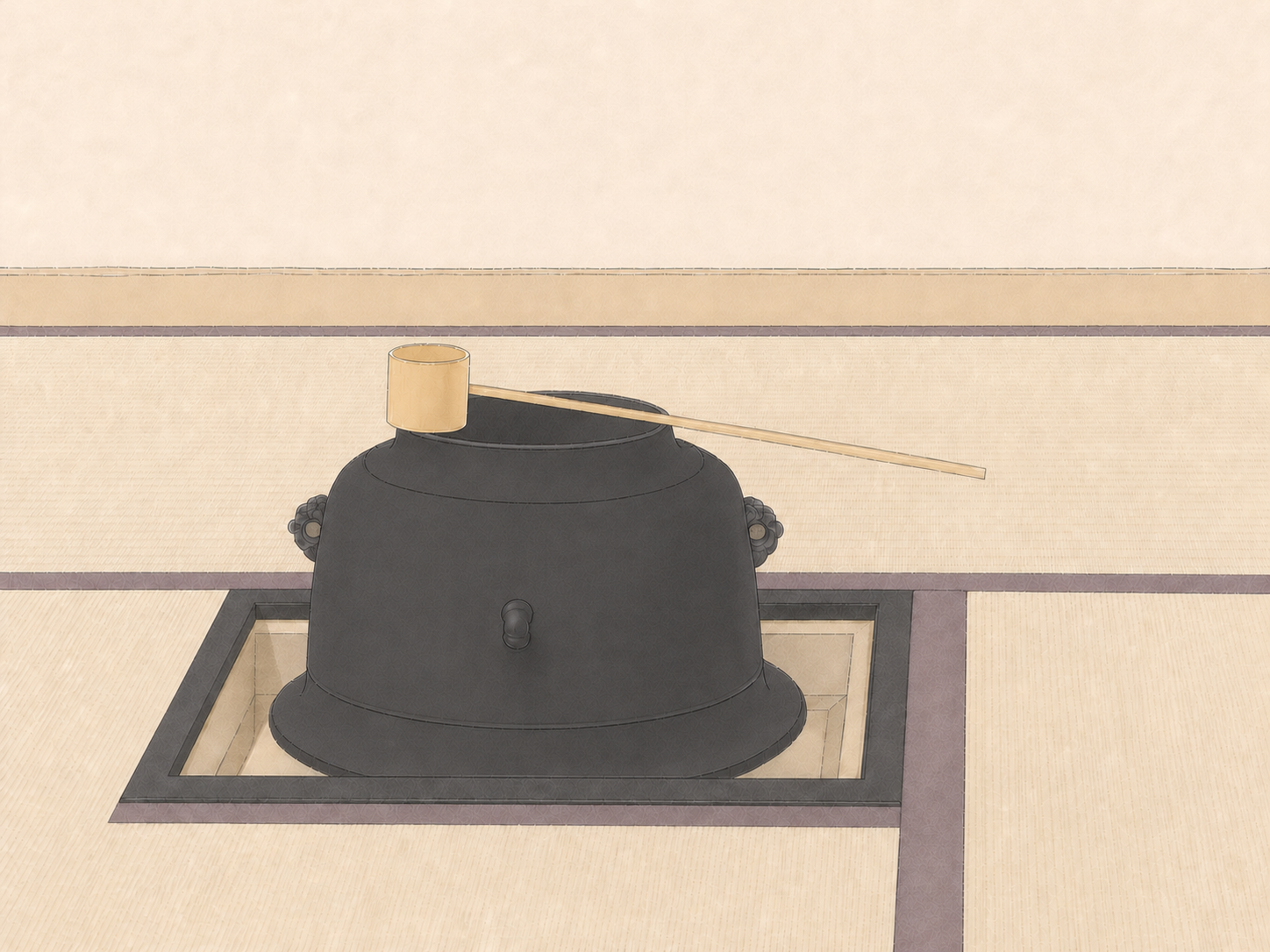
A bamboo ladle carries water between the kettle and the fresh-water jar. The long handle keeps the hand back from the fire. The small cup teaches the hand how much a ladleful holds. How do a few parts account for measure, distance, and season?
A Bamboo Tool Between Kettle and Water Jar
A hishaku is a ladle for drawing hot water from the kettle and fresh water from the jar. It has a bamboo handle and a cup called a gō. A metal handle would conduct heat readily, while a long, slender ceramic handle would be difficult to make and keep intact. Bamboo is light, flexible, and easy to work, well suited to reaching over the fire and carrying water quietly. Its surface darkens when wet, so using it brings out the character of the material.
The handle and cup have different jobs, but the joint recedes into a single outline. The maker takes account of the thickness, nodes, and curve of the bamboo and brings the ladle to a weight that is easy to handle when it holds water. There will be differences from piece to piece. The craft keeps them within a range that suits the task.
The maker reads the character of the material and turns it to use.
The Handle Keeps the Hand Back from the Fire
Heat and steam rise above the kettle. A long, slender handle lets the host draw water while keeping the hand at a distance. The length makes it possible to move accurately without reaching too close. It also limits how far the host’s arm has to move and how much they have to lean in front of the guest. The handle sets a distance both from the fire and between the people in the room.
That distance affects posture as well as safety. A shorter handle would bring the host closer to the kettle and call for more movement in the shoulder and upper body. A suitable length helps the host stay centered on the tatami and keeps a large sweep of the arm from crossing the space between the guest and the kettle. The dimension affects both ease of use and what others in the room see.
The Cup Makes a Ladleful a Measure
The cup has no graduations. By using the same ladle repeatedly, a host learns what a ladleful feels like. Warming a bowl, preparing tea, and adding water to the kettle call for different amounts or ways of pouring. The host can gauge the amount by the weight in the hand, the angle of the tilt, and the sound of the stream. The ladle measures and teaches the senses to measure.
An unmarked cup still asks for precision. The host can feel the weight of the water in the flex of the handle and check the result in the bowl or the kettle after pouring. The measure comes back as a sensation in the hand. Repeated use makes it easier to tell how the water is moving without relying on sight.
The cup’s capacity determines the scale of one movement between vessels as well as the quantity of water. How it is filled and tilted can change the flow from the same ladleful. Amount and speed have to be considered together.
Bamboo Takes a Different Form for Hearth and Brazier
In tea, the sunken ro hearth is used in cold months and the portable furo brazier in warmer months. Each has its own kind of ladle, with variations in the cuts and the placing of the bamboo nodes. Details differ by school. An implement with the same general use can change with the position of the fire and the seasonal setting, including the way the ladle is handled.
The ro is set into an opening in the tatami. The furo is set on top. The change in the position of the fire and kettle changes the angle of the approaching hand and how the ladle looks when set down. The form of the tool brings a seasonal change into the movements of the room. Distance and action can convey warmth and coolness alongside colors or patterns.
The cut end of the handle and the orientation of the cup may differ between kinds of ladles, giving a seasonal distinction to the object even at rest. Look at how those details respond to the placement of the fire and water as well as learning to recognize the shapes.
What the Ladle Does Between Uses
Resting on the kettle or the lid rest, the ladle shows where the preparation has reached. When the handle and cup are set in place, the place to reach next is clear. Their position guides the host’s next movement and gives the guest a way to recognize a pause.
A ladle at rest on the kettle or lid rest can have a quiet beauty. Its orientation also marks a stage of preparation. Even without knowing every step, the guest can sense one action ending when the ladle goes down and another beginning when it comes up. What an implement does while waiting for use can be as clear as what it does in motion.
The way the ladle rests, turns downward, or leans can tell a guest whether water is needed next or how far the preparation has gone. Even in stillness, the straight line of the bamboo marks a point in time on the tatami.
Changing the Flow by Hand
The angle of the ladle makes the stream thicker or thinner. Drop the water quickly and it makes a sound. Pour it slowly and you can see the steam and the change at the surface. A round rim and the movement of the wrist control the flow without a separate spout. The spare form leaves a place for skill developed through practice.
Light and sound appear as the water crosses the rim. A broad stream can warm the bowl, and a fine one can quietly adjust the water in the kettle. With no fixed spout, the movement of the wrist shows in each pour. A device that always dispensed the same amount could save effort. The ladle leaves the hand room to adjust to the water and the bowl at the same time.
Pour quickly from high up and there is more sound and splash. Pour close to the vessel and the water can run quietly along it. The elbow and the angle of the handle, as well as the wrist, help set the speed for the occasion and the season.
Closing | Measure and Distance in a Bamboo Ladle
Very few elements make up a hishaku. The bamboo handle gives distance from the fire, the cup holds the water for one movement, and the nodes and cuts reflect how the ladle is used in the season. Set it down and it prepares the place for the next action. Tilt it and the flow responds to the hand. The next time you see a ladle, look at what its length and small cup make possible.
The length, the position of a node, the capacity of the cup, and the angle at rest each have a job in the relation between the body, fire, and water. The shape has a quiet beauty when those jobs are visible.
Notice where the hand grasps the slender handle and the point where person and tool meet becomes clearer.
 Where Is the Scent in a Tea Gathering?
 What Does a Kettle Tell Us? Listening to the Water in a Tea Gathering
 How the Mizusashi Changes the Tea Room: Water, Lids, and the Season
 What Is Sadō? How the Japanese Practice of Tea Designs Relationships