
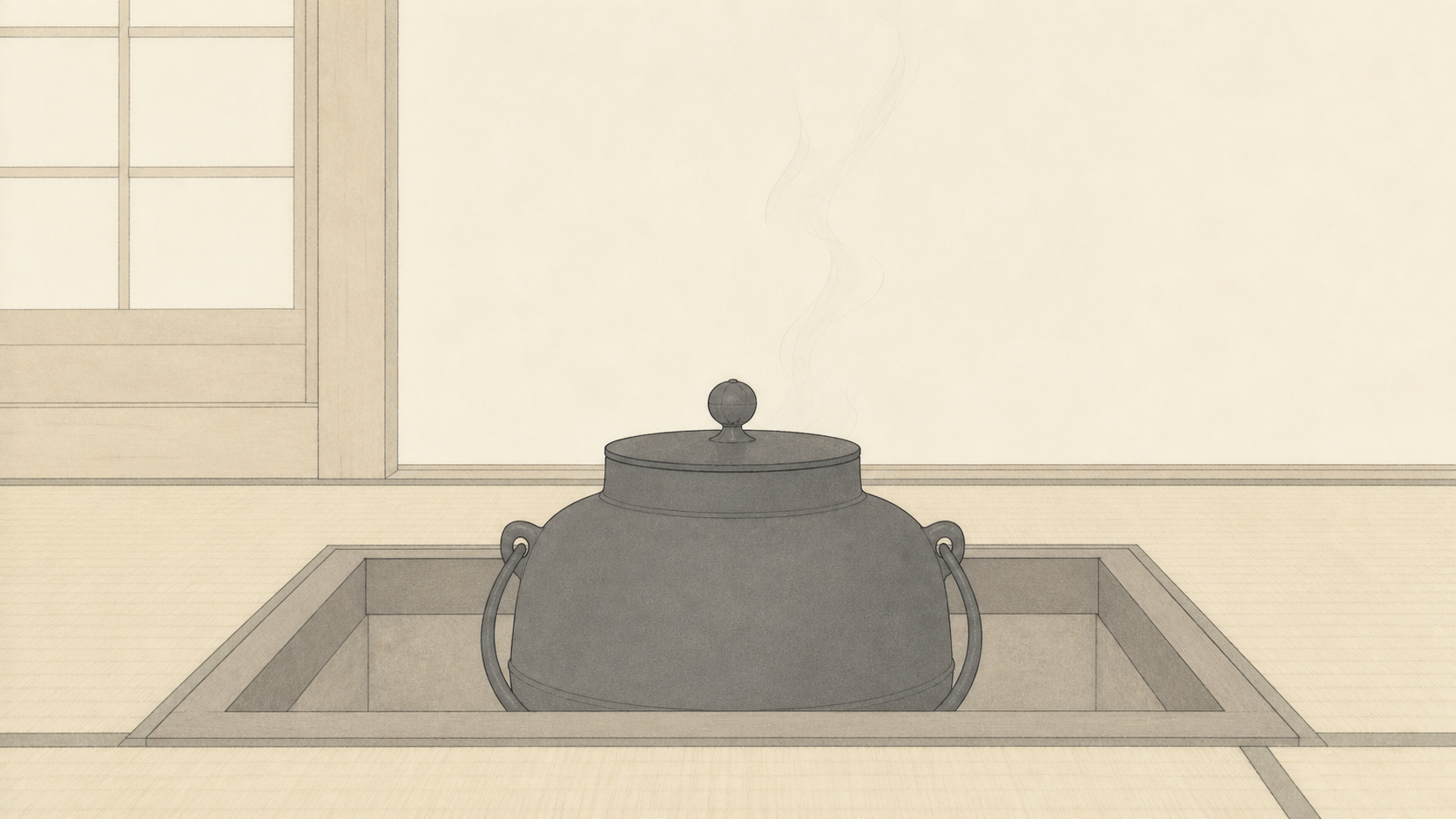
The sound of the kettle tells the host something about the water and draws the guests’ attention. Listening to what a kettle does beyond heating water reveals a part of tea room design that we cannot see.
What a Kettle Does Beyond Heating Water
In the tea room, silence alone does not account for the sound of the kettle or its importance. The sound tells the host how the water is doing, prompts a movement, and gives the guests something to attend to together. Though invisible, it helps set the pace of the gathering. Following what it does brings another side of chanoyu design into view.
A kettle’s first job is to heat water. The thickness and shape of the iron, the amount of water, and the state of the fire change how the water boils and sounds. In a tea gathering, that work takes place at the center of the room’s attention.
A famous or old kettle alone cannot deepen the gathering. Its maker, provenance, and the formality of its shape matter alongside the choice of hearth or brazier, the guests, and the tea. What the kettle has been and what it does both matter in the room.
How the Word Matsukaze Changes What We Hear
The sound of water coming to a boil is sometimes called matsukaze, or “wind in the pines.” The name lets a distant landscape come to mind as we hear the water. It is an example of language directing attention. The sound itself is the same, but we listen differently once we know the name.
Names for sweets can do something similar. A name can direct what someone notices or remembers. An evocative word works when there is a connection to the sound and the experience of the room.
What the Sound Tells Us About the Water
The kettle gives the host information. Along with the steam and the state of the fire, its sound helps the host read the water and decide what to do next without checking a thermometer.
Because the signal is quiet, guests can pick up on changes while continuing a conversation or looking at the utensils. It takes no large display and interrupts no one. The information comes from the room itself, where it can sharpen the senses and help the person using it decide what to do.
Quiet Takes More Than Silence
A tea room has the kettle, the sound of water being poured, the whisk, the rustle of clothes, and the sound of someone crossing the tatami. Quiet comes from being able to hear these sounds at the appropriate distance without having one drown out the others.
In a film, one sound left in can suggest a stretch of time or a space beyond the frame. Muting everything may achieve less. In the tea room, the sounds arise from the actions themselves.
Where the Kettle Sits Changes Where Guests Listen
The hearth and brazier give the kettle different positions. The distances between host and guests, the way the steam appears, and the way the sound travels change too. To understand what people hear, consider where they sit in the room.
I watch where the kettle is, when the guests notice its sound, and what the host does in response. What happens outside the guests’ line of sight also gives the room depth and shapes the gathering’s timing.
When Atmosphere Takes Over
A recording of a kettle and dim lighting do not by themselves convey chanoyu. The sound is made by actual water, fire, and iron. Once it is detached from what produced it, all that remains is a cue for atmosphere.
I find more to appreciate when we can see the materials and the work they do plainly.
How a Kettle Communicates Without Words
The kettle tells the room something without anyone having to speak. The fire builds, the water moves, and the change inside the iron reaches host and guests from where they sit. Several people become aware of the same change without directions or an explanation.
The kettle, poured water, the whisk, the rustle of clothes, and the sound of movement on the tatami can all be heard without one masking the rest. Each action can be heard from the distance it needs. The result is a form of quiet that keeps the sounds of the room audible.
In creative work it is easy to measure communication by the number of words or screens. A kettle quietly draws attention to one thing. The room lets people notice a change for themselves and leaves them room to use their senses. That way of arranging the encounter connects chanoyu to design. During the gathering, we can hear the sound build from still water and see the host’s hands respond.
Listening During a Tea Gathering
I listen for when the sound changes. The same kettle sounds different when guests arrive, when the charcoal starts to take effect, and when the water is sufficiently hot. A hearth or brazier, the distance to the kettle, and the materials of the tatami and walls can change what reaches the ear.
The name matsukaze brings a landscape to mind as the water heats. Before putting a name to the sound, listen to it emerge faintly, build in layers, and settle again. You can hear the change that prompted the name.
Sources can give us names, dimensions, origins, and rules for kettles. After checking those facts, I ask what the rules do to the speed of a hand or the distance between people. Historical details and editorial interpretation each have their place. Together they can help us see how a form or practice fits the objects, people, seasons, and time around it, and give us something to notice in daily life.
Listening for What the Sound Tells Us
Behind what we hear are the strength of the fire, the amount of water, the thickness of the kettle, and the host’s decisions. All of them matter to the tea the guest finally receives. Listen for a sound and watch what the host does immediately after it, and the timing of the gathering comes into view.
I also listen for the pause after a sound dies away. Like waiting for an answer to a question, the gap between the sound and the next movement gives someone time to take in what has changed. I think the room feels quiet when there is time to hear, respond, and decide without being interrupted.
Labels like “Japanese” and “minimal” can cover up what a kettle has to show. I start with the marks on its surface, where hands touch it, the space around it, and the order of the host’s movements. I check those first impressions against historical sources and reconsider them. Moving back and forth between observation and research helps keep familiar assumptions from taking over.
Conclusion
The kettle signals how the water is doing, helps the host decide what to do next, and gives the guests something to notice at the same moment. Its formality and provenance matter, as do the ways the fire, water, iron, room, and people’s senses come together. I see a design that makes information available without pressing it on the people who receive it.
The next time you encounter a kettle, try listening first. Alongside what you know about its maker and shape, remember what it sounded like with water in it and when you heard it. An object you might have admired for its appearance becomes a tool for pacing the gathering.
Listen for changes in the amount of water, the strength of the fire, and the quiet of the room even after learning the names given to the sounds. Host and guests hear the water changing together. The sound tells them where they are in the gathering.