
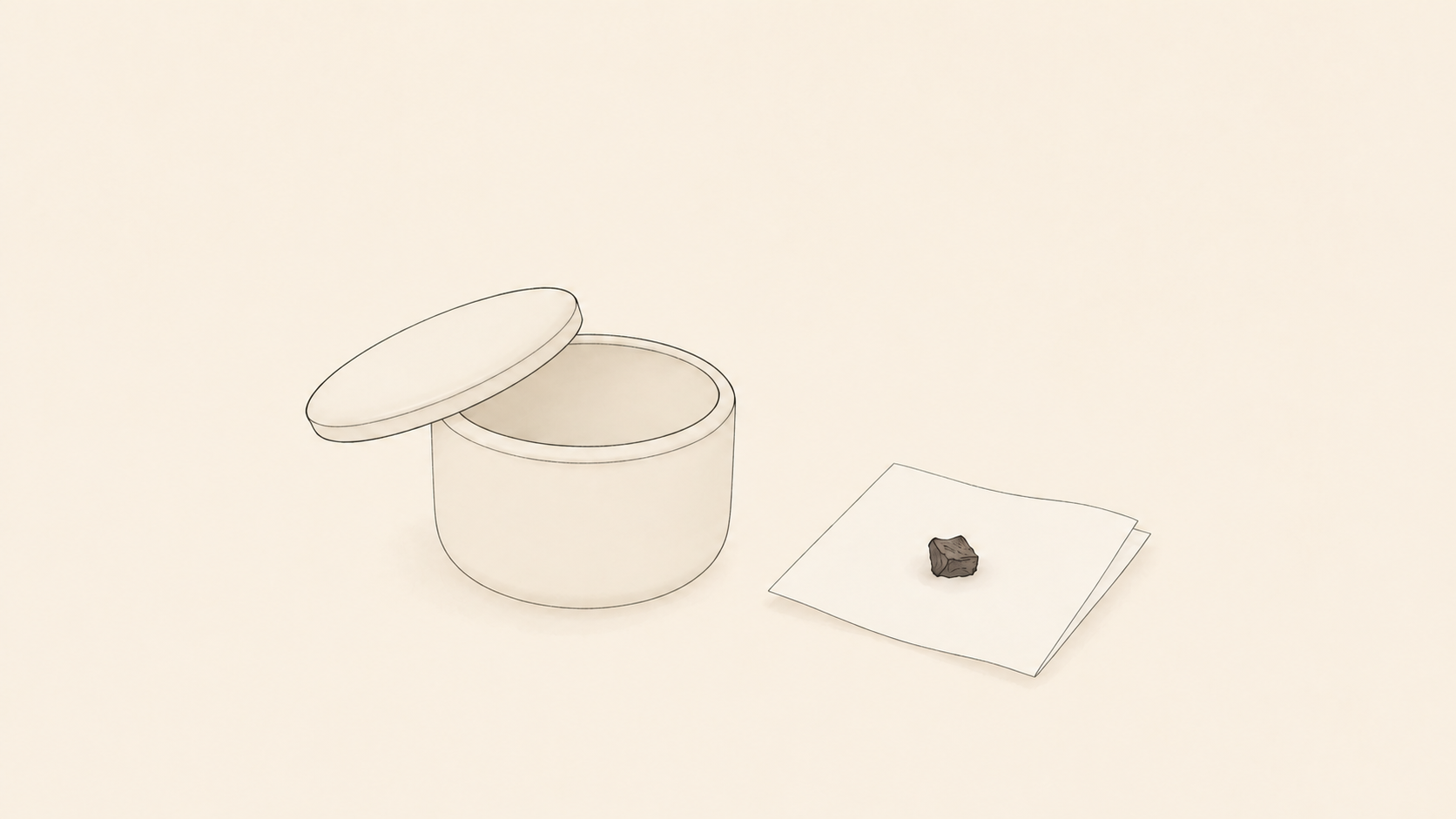
A photograph of a tea gathering cannot convey scent. Yet incense is burned during the first charcoal procedure and spreads through the room with the warmth of the fire. We follow it beyond the incense container to see how that invisible presence works on time, air, and memory.
Incense appears when the charcoal is laid
In Omotesenke’s account of the first sitting of a formal gathering, the host performs the first charcoal procedure after the guests have entered and exchanged greetings. The host adds charcoal to the hearth and burns incense, and the guests examine the kōgō, the container that held it. Incense belongs to the work of tending the fire that heats the water. As the charcoal catches and the water in the kettle begins to move, the scent rises. Guests see the arrangement of the charcoal and the shape of the container, hear the kettle, and smell the incense.
Several senses meet around the same fire. Incense belongs to the setting for tea, where there is room for the other senses to register alongside it. Kneaded incense in the sunken hearth and fragrant wood in the portable brazier are familiar pairings. Practice varies by school and procedure. In a particular gathering, the host’s choice and explanation matter more than imagining the scent from the category alone.
The incense container holds only part of the experience
The kōgō is a lidded container for incense. Its material and form are selected for the hearth or brazier, the season, and the theme. After the procedure, guests take it in hand and look at its shape, the way the lid fits, its design, and its provenance. The container alone does not convey the whole of the encounter with incense. What started in a closed vessel loses its shape when transferred to the fire and spreads through the room. A small object can have an effect that reaches well beyond its size.
Photographs tend to draw attention to prominent objects. The incense container becomes the focus, and the change in the air disappears. In the tea room, it helps to move back and forth between the utensil and the effect it makes possible. The kōgō is valuable both for how it holds incense and for its part in releasing scent into the room. Look at the inside when the lid comes off, the small space for the incense itself, and the movement of the hand carrying it to the fire. The container is something guests can admire and something the host uses.
A strong scent can crowd out the room
Scent reaches us with our eyes closed. It spreads across a room and can overwhelm other sensations. A tea room already holds the scents of matcha, charcoal, wood, tatami, flowers, and food. Too much incense can make the tea and these materials harder to sense. In chanoyu, incense quietly signals the presence of the fire and adds depth to the air.
Designing with scent means considering the amount, heat, timing, room size, and ventilation as well as the kind of incense. Excess is hard to judge precisely because it is invisible. Unlike perfume or an air freshener intended to hold an even scent, incense rises differently as the fire changes. That variation draws attention to the particular fire and air of the moment.
A strong scent can make the faint smells of flowers, tea, tatami, and charcoal all seem alike. When incense plays a supporting role, it can sit at the threshold of notice and leave room for the other sensations.
Scent tells time on a delay
A flower or scroll has a form you can take in as soon as you look. Incense rises slowly after it meets the heat, reaches each person, and eventually fades. The change gives a sense of time passing even if you never see the source. A guest who noticed nothing at first may catch it on an ordinary breath. The delay means guests do not all receive the same impression at the same strength or moment.
Scent also attaches itself to memory. A similar smell encountered later may recall the light and sound of a particular gathering. A tea record can list a kōgō and other utensils, but it cannot preserve that day’s scent. What disappears continues in the bodily memories of those who were there. Those memories differ. The same incense can bring back different places for different people. The host leaves the meaning open while keeping the scent in balance with the other elements of the gathering.
Scent moves gradually from its source into the room and into clothing. The delay before a guest notices it is part of deciding when to burn the incense and when to bring guests in.
The season can be felt in the air as well as seen in the design
Flowers and sweets carry traces of the season in their shapes. Season also changes the position of the fire, and the choice of incense and the material of its container become part of the toriawase, the arrangement of utensils. The air around a fire close to the guests in winter differs from the air around a fire set farther away in summer. Turning every seasonal theme into a visible motif can fill the room with explanations. Scent can suggest the time of year through temperature and air without giving it a particular shape.
Think about the balance between fire, utensils, flowers, and tea before treating “an autumn scent” as a product category. Distributing seasonal cues among several senses gives them room to work together. When flowers in season have a fragrance, consider how it will overlap with the incense. More elements will only enrich a gathering if each is still perceptible.
The same incense reaches a guest differently in dry autumn air, beside winter charcoal, and in a tatami room on a rainy day. The strength of the scent can suit the air without adding more seasonal motifs.
What to check when working with things you cannot see
When people design a space, furniture and color draw attention because they show up in photographs. Sound, temperature, and smell may be considered later. A little scent can change an experience, and it can also be unwelcome depending on a person’s preferences and health. The practice of incense in a tea room suggests considering the tea or food first, then the size of the space and the time people will spend there. Leaving the air as it is may be the right decision.
A photograph of the finished room cannot tell you how these elements work. Spend time there and notice what changes between the entrance, the time spent inside, and departure. Bringing scent into a room means taking some responsibility for the people who share its air. Ventilation and allergies also matter in a traditional setting. A host can put the guests’ comfort first, including when that means leaving out the incense.
Temperature, sound, humidity, and scent reach the body, often without being noticed. The incense in a tea room adjusts that invisible layer with care and leaves room for what is already there. Knowing how much to hold back is as much a part of working with scent as knowing what to add.
Conclusion: The scent opens out beyond the object
At the first charcoal procedure, incense rises with the fire. It leaves a small kōgō, loses its shape in the heat, and spreads gently through a room that already smells of tatami, wood, tea, and food. Guests view the incense container with their eyes and receive the scent bodily. The next time you enter a tea room or exhibition, notice what changes as you breathe, as well as what comes into view.
The scent appears, fades, and can link the time spent there with a memory. The care of chanoyu lies in handling a tangible utensil and an intangible effect in the same sequence of actions. In a medium built around photographs, a dramatic image of smoke cannot tell the story by itself. Words can give readers a sense of the distances between fire, container, kettle, and guests, and let them imagine how the invisible part worked.
 The Kōgō: A Small Container Connecting Incense, Season, and Fire