
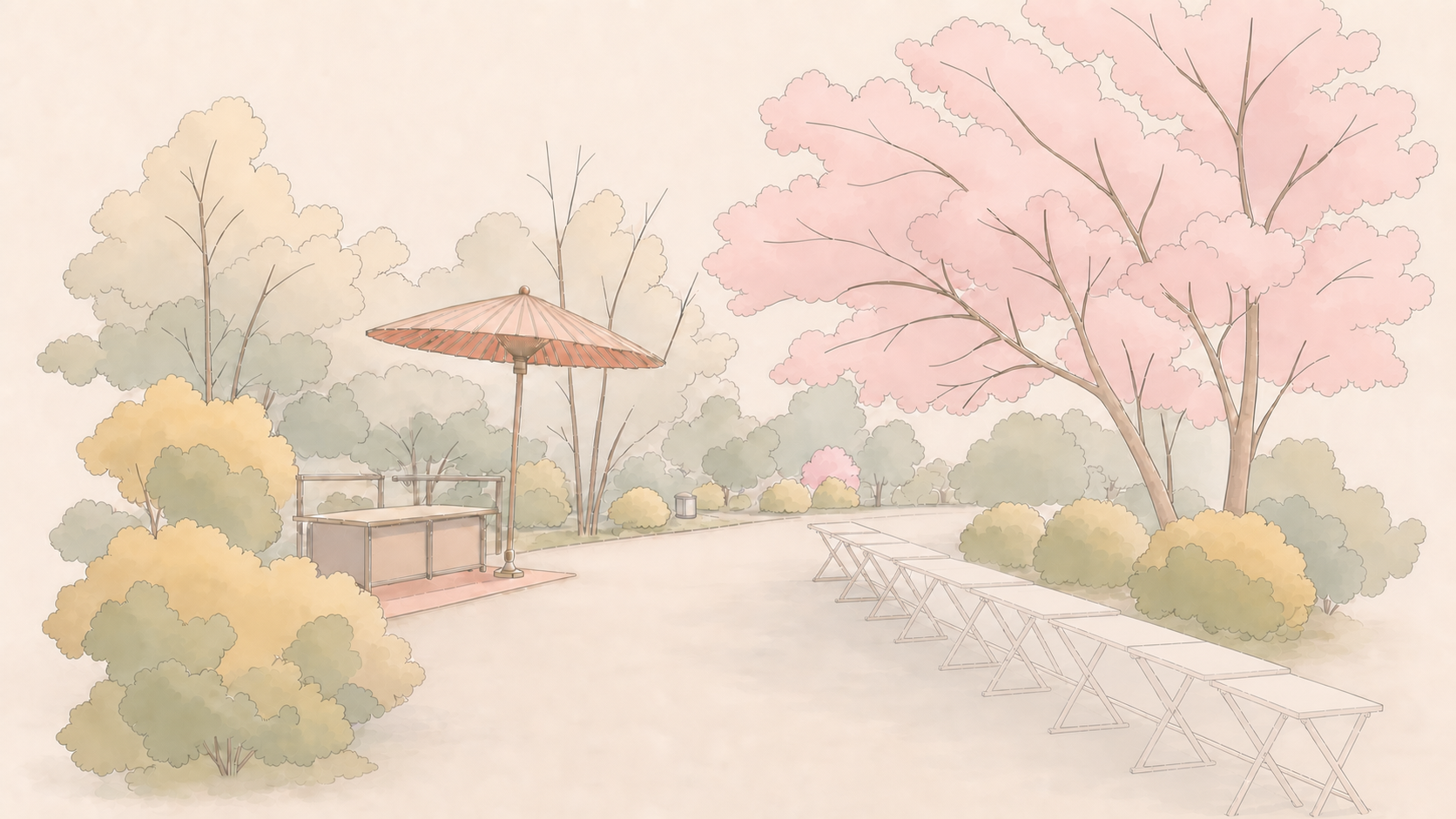
Going to a chakai and being invited to a chaji sound similar, but the time unfolds differently. One might be a sitting for a sweet and thin tea. The other could be formal hospitality including a kaiseki meal, thick tea, and thin tea. The two terms show how much can take shape around one serving of tea.
What is the difference between chakai and chaji?
Today many events called chakai are large gatherings known as ōyose, welcoming many people at a shrine, temple, or cultural venue. Guests come in at a designated time and receive a sweet and thin tea, or sometimes thick tea. A chaji welcomes a small group for a longer, formal occasion. It proceeds from the yoritsuki and roji into the first sitting, kaiseki, the main sweet, a break, thick tea, and thin tea. Omotesenke explains that chakai once also referred to chaji. In current usage the term chaji distinguishes a formal gathering that includes a kaiseki meal.
The line between the words has moved over time. To understand a gathering, ask how much time is set aside and what it includes. An invitation that says “twenty minutes per sitting” tells guests they will receive their sweet and tea within that span. In a chaji, the relationship extends from contact before arrival to an expression of thanks after departure. The comparison shows what falls within the time of each gathering.
One serving of thin tea can make a complete gathering
An ōyose chakai has a form of its own. To welcome many people in a limited time, the staff have to coordinate reception, seating, sweets, tea preparation, viewing the utensils, and leaving. Guests make room for the groups before and after them and take cues from the principal guest. Each role is concentrated into a short time. A sweet and a bowl of tea can give a newcomer a good sense of how people sit on tatami, where utensils are placed, and how the host and guests respond to one another.
A chakai broadens access while retaining the gathering of people around a bowl. That takes preparation. Over successive sittings, the mizuya staff coordinate the washing of bowls, the replenishing of sweets, and the next guests’ arrival. A simple-looking tea service can reach each guest only if the work behind it runs smoothly.
Even a single serving of thin tea has a beginning and an end: entering, receiving a sweet, watching the preparation, viewing the utensils, and leaving. A shorter time makes especially clear what can be left out and what needs to stay.
A chaji makes a meal and a break part of the gathering
Making tea is part of a sequence. Guests get ready in the yoritsuki and change their pace in the garden. The first charcoal procedure prepares the fire, kaiseki eases hunger, the main sweet comes before thick tea, and nakadachi marks a change of scene. These moments lead toward the bowl. While adding charcoal, the host considers what the water will be like hours later, attends to the temperature of the food, and adjusts the pace to how quickly the guests eat.
The guests enjoy food and conversation, and the utensils and flowers give them a sense of the theme. A chaji takes substantial preparation because its different sensations and intervals have to follow one another coherently. The structure reflects the idea that the taste of tea is affected by the time that came before it. Keeping people in the room for a long time is of little value on its own.
Flavors build on one another, the light changes, and guests come to understand the utensils better. The duration comes from the order those experiences require.
The number of guests changes the relationships
At an ōyose, the host cannot spend long speaking to each guest. The principal guest’s questions and the assistant’s explanations connect the larger group to the host. At a chaji, a small group shares the same meal and gathers around a bowl, and the host can take in each guest’s response at close range. The numbers affect how far voices carry, how long people wait, how close they can approach the utensils, and how far a conversation can go.
Changing the headcount alone changes the experience. A large group needs good directions and a clear assignment of roles. With a small group, everyone needs room to take part, and that includes room for silence. Chakai and chaji show ways to shape relationships at different scales. A large group needs the explanation to reach everyone, while a small gathering can make room for an individual question or a pause.
Both formats work best when the host anticipates the difficulties of that particular scale and considers the guests as individuals.
The number of steps tells us only so much about the care
A formal chaji has a long history and detailed conventions. Those deserve respect, but counting the steps does not measure the care. A short chakai can communicate the host’s attention through a sweet suited to the season, a warmed bowl, and directions guests can follow. A gathering with many dishes and utensils can lose sight of the people if it disregards their pace and how they are feeling.
The range of gatherings Omotesenke describes shows that chanoyu can work at multiple scales. Who is coming, where will they be received, and for how long? Consider those conditions and choose the form in which a bowl of tea will reach them best. Hatsugama, a tea offering, a local event, and a small gathering of friends have different guests and aims. Even where the name is the same, whether the purpose is to celebrate, learn, pray, or deepen a friendship helps explain the choice of utensils and timing.
At a first gathering, notice how the whole time is used
Before a chakai, check the invitation or ask at reception whether the setting serves thin or thick tea, how long it lasts, what to wear, and what to bring. If invited to a chaji, allow several hours from start to departure and prepare by communicating with the host and taking care of your own well-being. Inside, notice when the sweets arrive, in what order the tea is served, and when people start talking. These observations can matter more than trying to perform every gesture perfectly.
The difference becomes something you feel in how densely the time is used. In a short sitting one gesture may carry several things at once. In a long chaji an earlier moment prepares you for the next taste. Instead of watching the clock, notice how fire, food, light, and people’s movements tell time. A newcomer who misses a step can take their next cue from the host or principal guest.
The form gives people a way to share the same sequence with each other.
Once that purpose is clear, both a short sitting and a long chaji can have depth. The same holds for present-day events. What stays, and what can become simpler? The choice depends on what people should be able to take away. Comparing these formats shows how each part of the time can have a purpose.
Conclusion: Giving a bowl of tea the form the occasion calls for
“Abbreviated” and “formal” capture only part of the difference. A chakai organizes a short period so many people can share it. A chaji receives a small group for longer and brings the garden, food, break, thick tea, and thin tea into one flow. Both depend on the host sharing a good stretch of time with the guests, beyond displaying a personal style.
At your next chakai, consider what this particular format makes easier to share as well as what it leaves out. A bowl of tea can stay at the center while the form changes with the people, place, and time. That flexibility has helped the hospitality of chanoyu endure. Through any change of scale, its core is the relationship between someone who heats the water and makes tea for others, and the people who taste it together.
 The Host’s Work: Bringing Utensils, Fire, Water, and People into a Tea Gathering
 What Is Sadō? How the Japanese Practice of Tea Designs Relationships
 Reading Tea Records: Reconstructing a Gathering in Words
 Where Is the Scent in a Tea Gathering?