
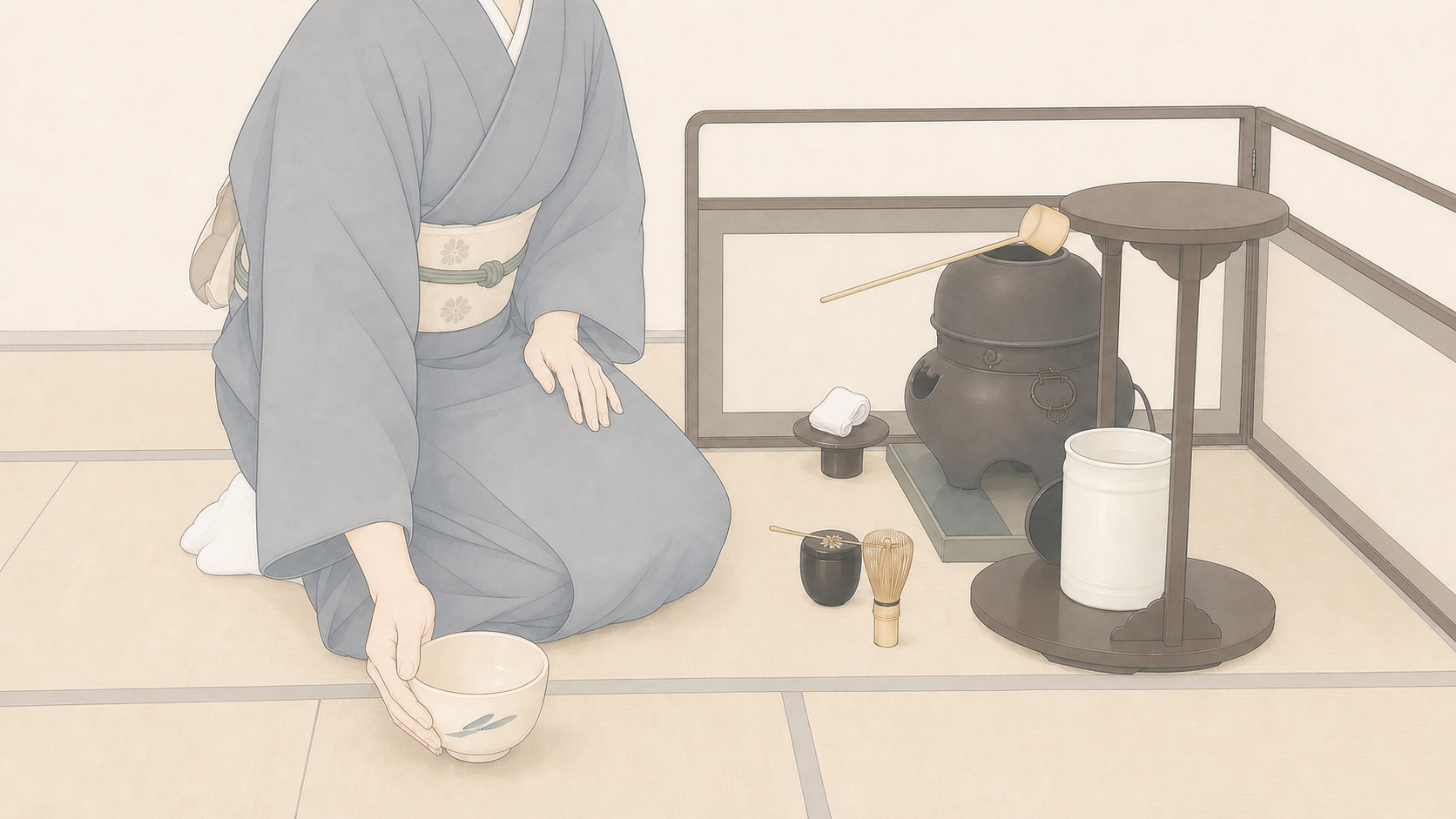
A host’s work includes deciding on a theme, choosing utensils, tending the fire and water, and responding to the guests’ pace. Making tea in front of the guests is one part of bringing these things into a gathering.
A Gathering Begins with a Theme
A formal tea gathering can have a theme particular to the day: the season, a celebration, a memorial, or a relationship with the guests. Omotesenke explains that the host’s feeling toward those they receive comes through in the choice and pairing of utensils. If the scroll is the focus, the flowers, kettle, caddy, and bowl can support it from other directions. The host arranges what guests will encounter so that it makes sense as one gathering.
The theme may never be handed to the guests as an explanation. It takes shape as they go from the gate and garden path to the scroll, flowers, food, and bowl. The host gives clues in several places, letting the order of the experience do work that a sentence in an advertisement might do all at once.
Room for guests to make connections is part of the theme.
The theme comes through in what the host puts at the center and what they keep in the background, whether the focus is on the scroll, flowers, utensils, or sweets.
Tending the Fire and Water Before Guests Arrive
Tea needs hot water. The host looks ahead to the arrival of the guests, the meal, and the times for thick and thin tea when preparing the charcoal and kettle. The fire does not keep time like a clock. Weather and the condition of the charcoal affect it. Water prepared too soon can lose its freshness, and water prepared too late makes guests wait. The host watches the fire now while thinking about a bowl that may be served some time later.
A beautiful kettle still needs water at a suitable temperature. Physical conditions have to support the host’s ideas for the gathering. I see part of the appeal of tea in the skill of judging the charcoal, the water in the kettle, and the time that has passed. Hospitality becomes something the guest can feel as heat.
Putting Utensils in Order in the Mizuya
The utensils are readied in the mizuya. The cloth, whisk, and scoop are arranged with the bowl. The waste-water vessel and lid rest are set out. Food and sweets are prepared for their place in the gathering. When the right object is to hand, the host does not have to stop in front of the guests to look for it. The order of the preparation room helps the host stay calm.
The arrangement also gives the host’s memory a place outside the mind. The position of the next utensil leaves more attention free for the guests. Good preparation leaves room for dealing with what was not planned. The host can change course if a guest runs late, the fire is low, or something is wrong with a vessel.
Taking the Guests’ Pace into Account
A chaji has an established sequence, but guests move at different speeds. The length of a walk through the garden, the pace of a meal, and the time people spend looking at utensils can differ from one gathering to the next. The host pays attention, neither rushing nor letting a pause drag on, and speaks when something needs to be said. Hospitality includes adapting the schedule to the people in front of you.
The host keeps the whole gathering in mind and chooses when to wait and when to move on. Guests can find their way without feeling managed. The same idea applies to designing an experience today: notice the person’s situation and make the next action easy to find.
If a guest spends longer looking at a utensil, the host can leave time for it. When conversation pauses, the sound of the kettle can come forward again. Part of the work during a gathering is noticing where the guest’s attention is now.
The Work Guests See and the Work They Do Not
Preparing tea in front of guests is one part of the work. Cleaning, shopping, checking vessels, preparing ash and charcoal, cooking, and putting the mizuya in order mostly stay out of view. The host does these things quietly and in advance, leaving guests free to receive the gathering as it happens. A stretch of time in which nothing goes wrong can show the host’s care as much as a visible gesture does.
Knowing about that work can show how many decisions lie behind a simple movement. Editing and design can work in a similar way. When a finished piece feels natural, the proposals left out and the marks of revision are less visible. The host’s work takes a similar kind of restraint to leave the guests’ attention on the tea.
Guests see the preparation of tea and hear the greetings. Behind them, someone is adjusting the fire, replenishing the mizuya, and getting utensils ready. Keeping that work in a place of its own lets the guests attend to the gathering.
A Gathering Made Together
The host leads, while the first guest chooses what to ask, the guests leave room for one another, and the work of makers and those who prepare the food comes into the room. The host gives these contributions a way to come together without getting in one another’s way. Being at the center can mean giving other people room to act.
The phrase ichiza konryū suggests a gathering that host and guests bring into being together. A host who controls every detail can leave the guests passive. Giving no direction can leave the room without a focus. The host sets a direction and the guests’ responses change what happens. The gathering takes shape when the people enter it.
Closing | The Host Prepares for People to Meet
The host chooses a theme and utensils, tends the fire and water, arranges the mizuya, and adjusts the timing to the guests. Much of the work is unseen. Its effect is that the guests can give their attention to a bowl of tea. Notice what might have happened before a movement in front of you and what that movement makes possible afterward.
The host arranges a time in which people and objects can meet. Good utensils alone cannot tell us how well a host works. Can they narrow down choices for the guests and leave room for a response? Can they bring the different speeds of fire, water, utensils, and conversation into one course? The host makes the conditions in which the gathering can take shape.