
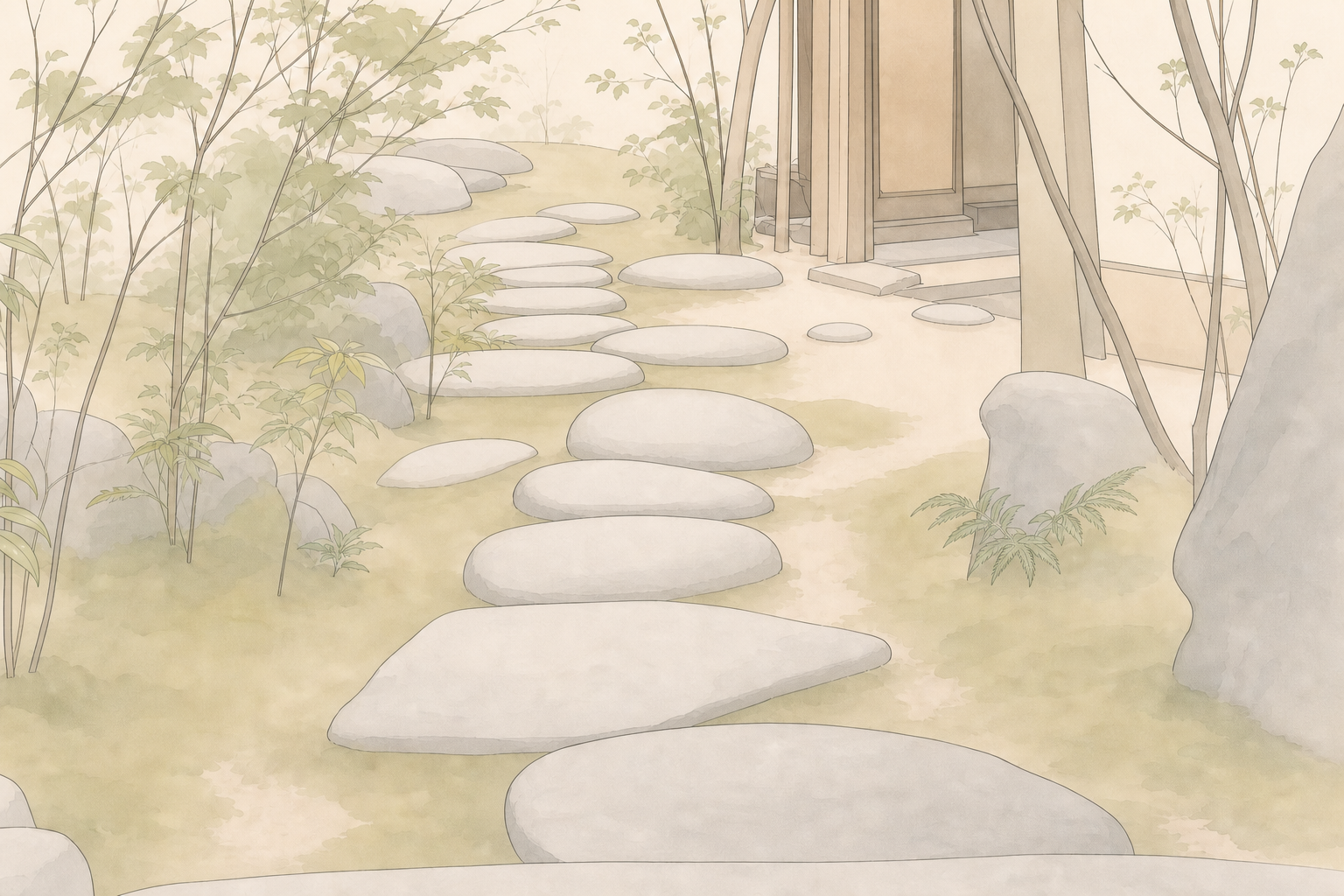
The stepping stones of the roji lead guests toward the tea room. Their spacing changes the stride, a bend shifts the gaze, and moss and water come closer to view. The garden shows a guest how to walk through it before they get a chance to take in the scene. Start with the roji as a garden you walk through.
The Roji Is a Garden You Walk Through
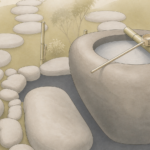
Some Japanese gardens are composed to be seen from a room. The roji is also a way to reach the tea room. Guests follow stepping stones, cleanse their hands and mouth at the basin, and go to the low nijiriguchi entrance. Walking is central to the experience. With each step, guests discover where the plants, stones, lantern, and water are. The garden gradually comes into view as the body moves through it.
The value of a garden can be felt in something other than a view. In the roji, the time it takes to reach the entrance, the points at which guests turn, and the order in which they come to the basin matter as much as the scenery. A photograph can only show part of an experience made up of movements. Reading the garden as a passage in time brings the role of the stepping stones into focus.
In a garden you pass through, the center of the view can keep changing. A stone at your feet, a glimpse beyond a short screen fence, and the water in the basin appear in the order in which you walk.
The Distance Between Stones Shapes the Stride
The stones are placed for a comfortable step, with shorter intervals and turns where the path calls for them. As the length of the step changes, the pace changes too. A broad stone may give you a place to put your feet together. A series of small stones can slow you down. The places for your feet offer a cue without a sign asking you to walk slowly.
The placement is a way of guiding an action through the surroundings. Even spacing at the length of an average stride would miss some of what the path does. A wider interval asks for a longer step. A narrow one can slow the pace. Two stones side by side give the body room to stop. The intervals work a little like punctuation. Imagine where the guest’s body is between the stones to see what the arrangement asks of them.
Close stones make for short steps. With a longer gap, you look for the next foothold and stretch a little farther. The change breaks the quick rhythm of going straight from one place to another.
Look Down and the Garden’s Details Come Closer
Guests look down to avoid missing a stepping stone. That brings shades of moss, reflected light on wet stone, and the shapes of fallen leaves closer to view. Attention moves to small changes near the feet. Looking down also prepares for lowering the body at the nijiriguchi. The garden reduces the scale of what you see before you go into the room.
A lowered gaze can be explained as a sign of humility, but looking down does two practical things at once. It helps you avoid a fall and makes smaller details visible. The way you look for safe footing is also the way you discover a patch of moss or a drop of dew. I think that overlap is one of the strengths of the roji.
A Bend Keeps Some of the Path Out of Sight
When the path turns, you cannot see straight through to the tea room. As you look for the next stone, the basin or the waiting shelter appears from behind a tree. The scene changes with each turn and gives even a short passage a sense of time. A bend lets people leave an everyday view behind and begin to look forward to the tea room.
When the tea room cannot be seen all the way from the gate, the guest’s attention returns to the step ahead. A short distance gains time because the garden offers only part of the view at once. A web page can make things quick to find by putting them all at the start, but that can lose the order in which people see them. In the roji, keeping part of the view back can help people stay attentive.
Natural Stone and the Choices People Make
Stepping stones can be natural stone. Each piece differs in shape and thickness, so someone has to choose which face goes up and how the stone is set. It takes a different kind of work from laying uniform paving. Fit a surface to the foot while noticing the character of the stone, then set it into the flow of the path.
A natural stone does not come with a front. The gardener turns it to find a footing, a direction that makes the next stone reachable, and a position that fits what is around it. Working with less cutting can require more care in selection. Respecting what is particular to a stone means finding where it can work in relation to a person’s movement.
The stones are all different. Their flat areas, slopes, and places where water collects help determine which way each one goes. The arrangement can keep those differences and still make the path safe to walk.
A Different Path on a Rainy Day
Rain darkens the stones and can make them slippery. Fallen leaves, the state of the moss, and the light in the morning or evening can change what it feels like to place your foot. The path needs care as conditions and seasons change. Guests will not always walk quite the same way. Maintaining the roji means looking after both how it feels to walk and what can be seen.
Steps get shorter in rain. A path designed only for dry conditions can show its weaknesses when it gets wet. A caretaker checks for loose stones, spreading moss, and drainage. The balance between safe footing and the view has to be found again as the seasons change. The garden’s design continues after the day it was laid out.
In rain the stones darken and their edges can blend into the moss. A path has to make the next stone legible in wet conditions as well as look good in the dry.
Closing | The Next Step Changes How You See
The spacing changes your stride, the turns guide your body, and looking toward your feet makes moss and water visible. The bends open up the destination a part at a time and the stones feel different under each step. Before taking a photograph of the whole garden, notice where your foot landed and when your gaze moved.
The stones can affect how a person walks even if the person knows nothing about the design. Without reading a sign, the guest changes their stride and looks down. The design gives the action somewhere to happen. In the short time it takes to step to the next stone, the garden becomes part of the way you enter the tea room.
 The Roji: How a Garden Changes Your Pace before Tea
 What Modern Design Can Learn from Rikyū’s Tea Rooms
 The Garden Waiting Bench: What Are the Guests Waiting For?
 The Tsukubai: Water and the Gesture of Lowering the Body