
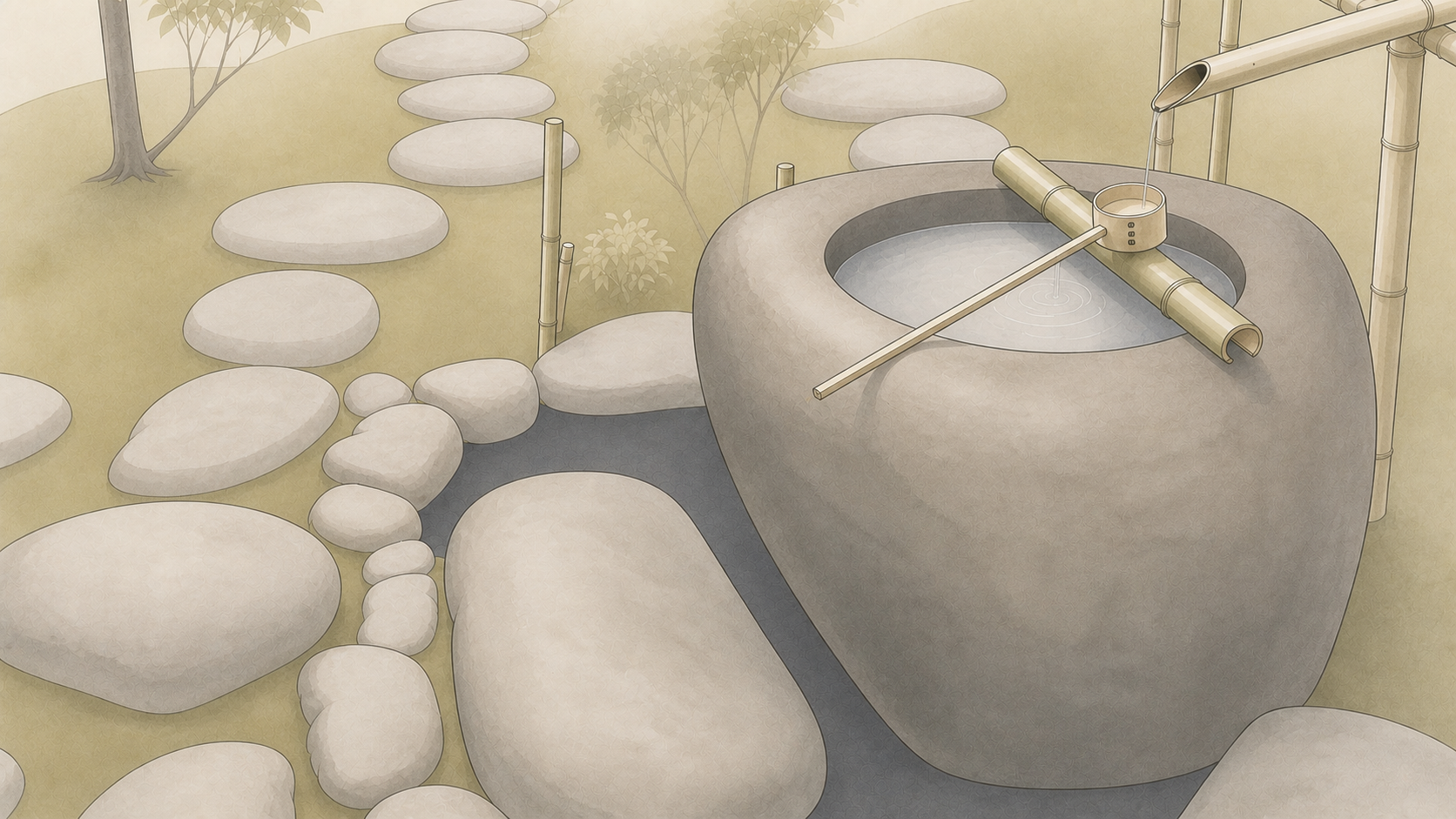
The water basin in the roji is too low to use standing upright. A guest bends in front of the tsukubai, washes their hands, and rinses their mouth before entering the tea room. The clean water matters, and so does the way its height makes the body move.
The tsukubai is where guests cleanse themselves in the roji
The tsukubai is the place for cleansing in the roji garden on the way to a tea room. A low basin holds the water. Guests use a ladle to wash their hands and rinse their mouths. Omotesenke describes filling the basin as one of the host’s first tasks. The guests acknowledge that care by cleansing themselves with the cold water. In a garden photograph, the tsukubai can merge into a composition of stones and moss. It is also a place people actually use.
People walk up to it, scoop water, and move with wet hands. The basin, the stone in front, and stones for a hand lantern or a hot-water vessel all have a place determined by the actions and the occasion. How those elements look is inseparable from how they are used. The idea of cleansing has something in common with water basins at temples and shrines. In the garden of a rustic tea room, the height and arrangement let a small group use the basin in turn.
There is a closeness here distinct from that of a public water station.
The tsukubai brings together the basin and stones for standing and setting down a hand lantern or hot-water vessel. It gives footing to the guest, places to the utensils, and room for a sequence of movements.
Why set the water so low?
At a tap you can turn while standing, washing your hands takes little time. At a tsukubai, guests bend the knees or waist and bring the body close to the basin. The Japanese verb tsukubau means to crouch. The height of the basin changes the posture. Crouching interrupts the momentum of walking and lowers the gaze to the stones and the water. The gesture begins with the practical need to reach the water safely.
As the body draws in, the mind begins to settle before entering the tea room. The form communicates through what people do with their bodies. A low basin leads them into a particular action. At gatherings today, people who find it difficult to lower themselves also need consideration. How the basin is used should preserve the meaning of that height while accommodating bodies that move differently.
Place the water low and guests bend at the knees and waist, bringing the face nearer the surface. Lowering the body is part of the practical gesture of cleansing, without anyone having to call for a display of respect.
Cleansing goes beyond removing dirt
Washing the hands and rinsing the mouth have a hygienic purpose. The roji basin provides only a small amount of water, taken with a ladle and used in a short set of movements. The guest leaves behind what they were touching or talking about outside and becomes aware of the hands and mouth that will meet a bowl of tea. Cleansing calls attention to those points of contact before entering a shared place and using shared utensils.
Cold water conveys the season and weather directly. It makes fingertips tighten in winter and leaves a cool feeling in summer. Cleansing is felt on the skin and in the mouth. Rinsing takes little water. With a limited supply to share, guests keep their lips off the ladle and handle it with the next person in mind. The practice depends on using the basin together.
Cleansing the hands and mouth does more than remove dirt. It makes the guest aware of a change in how they will use their body before coming into contact with the utensils and other people.
The host fills the basin and the guests use the water
The host replaces the water before the guests arrive, so it is ready for them. A guest takes what they need and makes way for the next person. There is a small exchange: the host prepares, and the guest responds. Clear water, a clean ladle, and secure footing are enough to communicate care without costly utensils.
If the stone is too wet or the approach too narrow, guests pay more attention to avoiding a fall than to the gesture. Arranging the stones involves making a place where people of different ages can bend, use the water, and rise as well as composing a view. The tsukubai is where the look of a garden and the way people use it meet. Renewing the water just before guests come leaves a trace of timing. The host has made it ready for these guests, now.
Freshness has more to do with when the water was changed than with how much there is.
The arrangement of stones sets the area for movement
Stones in the roji communicate where feet and hands go in place of written directions. A stone in front of the basin shows where the guest stands and the direction from which to approach. Other stones make places for light or for a hot-water vessel when they are needed. You can appreciate the arrangement by asking more than what each stone is called. When someone crouches, will a sleeve or the kimono touch the water? Can the ladle move freely?
Can the next guest wait nearby? Read the arrangement in relation to the body and the stones begin to look like supports for a sequence of actions as well as a garden view. Their natural forms are irregular, yet their positions leave little doubt about how to move. That balance reflects care in the design of the roji. Wet stone can be slippery. Drainage, footing, and where the ladle rests all help keep a picturesque place usable.
At an entrance with water, the body takes its cues from the setting
An entrance may have a sign asking people to wash their hands or be quiet. The tsukubai invites movement through the position of the water and the ladle. First-time guests may still need guidance. An entrance that puts newcomers to the test will shut them out. Offer the instructions they need clearly, and let the physical arrangement guide them from there.
When the water is at a natural height for the gesture, the reach comfortable, and the footing clear, the encounter remains an experience rather than just a sign. In bending down and using the water, guests prepare themselves physically and mentally for the tea room. For someone new to the gesture, watching the person ahead can help. One action is passed on to the next guest. Consistent placement and a recognizable sequence show what to do without words.
The amount of water, the height of the stone, the shared ladle, and consideration for the next guest all connect bodies to the setting. To collect yourself, you first move the hands and change posture. The tsukubai makes an idea something the body can experience.
Conclusion: Leaning toward the water before receiving a bowl of tea
At the tsukubai, a guest leans toward the low basin, washes the hands, and rinses the mouth. The short gesture interrupts the pace of walking, lowers the gaze, and draws attention to the body that will touch the utensils. The guest receives the water the host prepared and then gives the next person room. That quiet exchange takes place at the entrance to the tea room. When you see a tsukubai, take in the weathered stone and then imagine where you would put your feet, how low you would bend, and how much room you would need to move the ladle.
Water is part of the view and a material that changes posture and attention. Cleansing before tea begins with bringing the body close to it. Seen from a distance, the stone and moss may be what you remember. Imagine putting your own body there and the reach to the water, the movement of the sleeve, and the act of getting back up become part of the scene. Seen only as a matter of the spirit, the tsukubai can seem like an old ritual.
 The Roji: How a Garden Changes Your Pace before Tea
 What Modern Design Can Learn from Rikyū’s Tea Rooms