
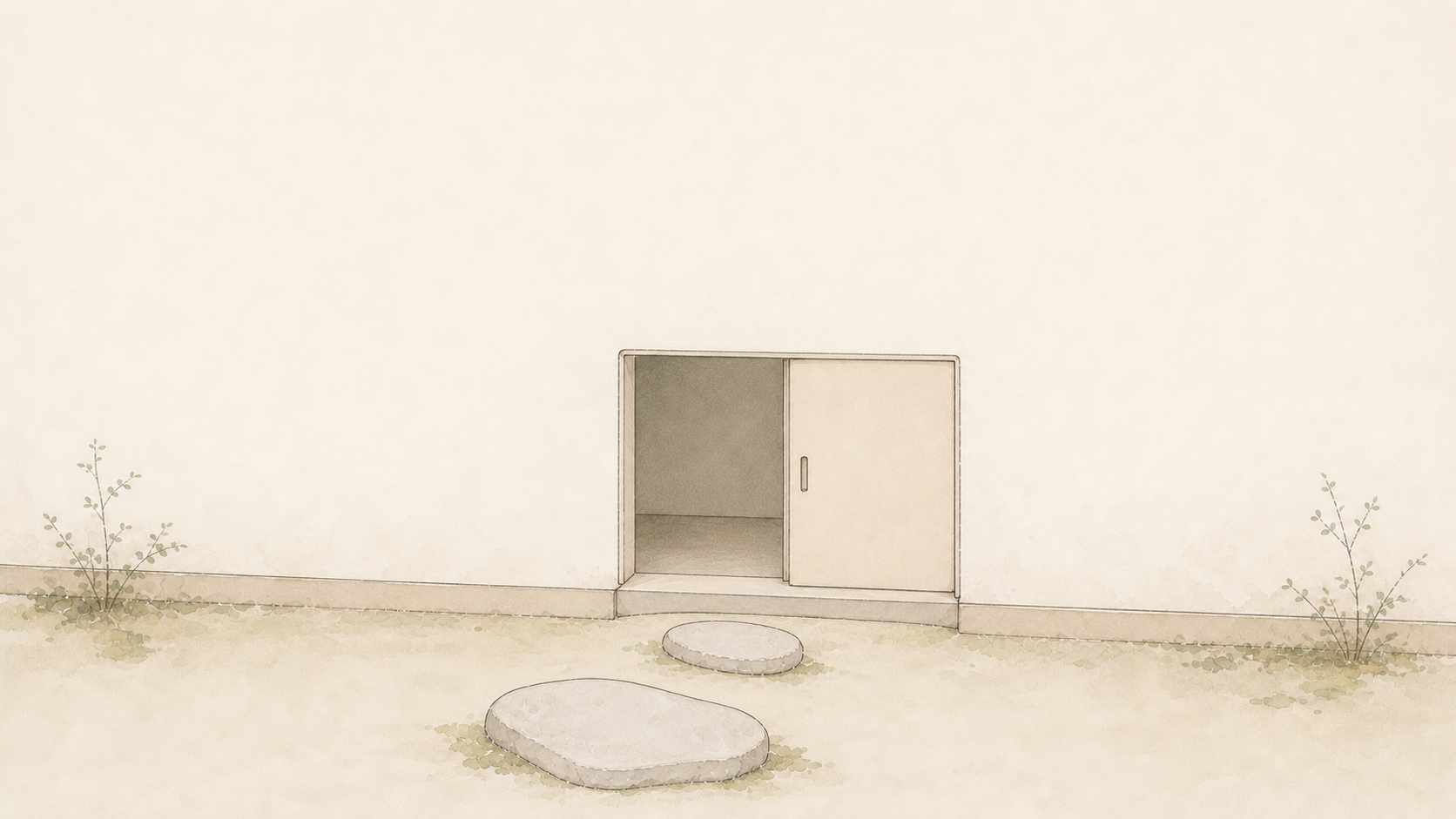
The nijiriguchi is often read as a symbol of equality. It also changes the way people move, where they look, and how they enter the relationships of a tea room. How does such a small entrance act on the body?
Smallness works on the body as well as carrying a meaning
At a nijiriguchi I first consider what will happen to my body. I cannot pass through standing. I have to lower myself, and I cannot see the whole interior at once. It is only an entrance, yet the pace and eye level I brought from daily life change. A small opening changes how I make the passage from outdoors to inside.
The nijiriguchi is often described as an entrance through which everyone, regardless of standing, lowers their head. That symbolism matters, but alone it leaves out the experience. People have to change posture, put a hand down, and go through one at a time.
An idea reaches the body through the dimensions of the building. I find that a stronger way of communicating than asking someone to read a message.
The entrance changes eye level
The eye drops at a low entrance. Tatami, the alcove, utensils, and the other guests’ knees come into view first. The room appears in a different order than it does to someone standing.
The opening frames what people see first. Like the first view of an advertisement, an entrance can direct how people read what follows.
The entrance withholds the full view
A large glass door can show the interior before you enter. The nijiriguchi reveals it bit by bit as the body moves inside. Taking longer to understand the room gives the experience more density.
Many modern spaces make themselves legible by showing everything up front. Here, the question is which delays deepen attention, without treating inconvenience as a virtue.
The garden has already begun to change the senses
The nijiriguchi does not change someone all at once. At the waiting place, on the stepping stones, and at the tsukubai, the guest’s stride and attention have already shifted. The low entrance is the last stage of that sequence.
Small changes accumulate, drawing the guest toward the room. Designing in stages can also shape the path through an exhibition or an encounter with a brand.
Equality needs a closer look
Passing through the nijiriguchi did not simply erase the distinctions of rank. Chanoyu has long been connected with politics, power, and formality.
I want to keep the tension between the symbol and historical life in the picture. We can then ask how an entrance that calls for the same action from every body changes people’s relationship within the room.
The question of accessibility
Reproducing the nijiriguchi in a modern building would leave out people who cannot pass through it. That physical limit matters even when the small opening carries a spiritual meaning.
What can carry forward is the change of attention at an entrance. Contemporary design has to find ways to make that change possible for bodies that move differently.
How an entrance communicates the conventions of a place
An ordinary doorway is tall and wide enough for a person to go through upright. At a nijiriguchi, a guest lowers their hips, sets down a hand, and ducks their head. The dimensions tell the body what to do without a sign.
The eye drops and the pace slows. Before setting aside any title or manner by saying so, the guest changes posture. The conventions of the tea room reach the body first.
As a design, the nijiriguchi is an interface between outside and the tea room. In this case, that means a point where crossing from one place to another changes how people move. Height, width, and sill invite people to slow down, lower themselves, and notice what is around them as they enter.
The dimensions tell people that they will move differently here. A sword or luggage is left outside. Guests duck and enter one at a time, setting aside for a moment both standing and the pace of daily life.
Moving differently changes the experience of entering
Understanding the opening means imagining the order of the movements as well as looking at its shape. Stop in front and take in its height. Lower the hips, steady yourself with a hand, and duck. Once over the sill, settle your posture inside. In this short sequence the change from outside to inside takes place.
A broad door might have a sign asking people to come in quietly. The nijiriguchi gives the guest a sense of the place through their own movement. An impression learned by the body can affect the volume of the voice and the distance kept from the utensils inside.
Design can let people read what to do next from shape and distance without directing them forcefully. The nijiriguchi shows how the dimensions of a building give rise to a gesture, and how a gesture can change where attention goes.
After passing through, the eye rises from the floor to the tatami, the alcove, and the other guests. Lowering the body first lets a person feel the height and closeness of the room. Moving becomes a way to get ready to understand the space.
Seeing the tea room from a lower eye level
The nijiriguchi also changes the first view of the room. You see farther when you enter upright. From a low entrance, the mat, sill, and shadows on the wall come up close. The room becomes familiar gradually as you straighten.
If you have a chance to see a tea room, look at both sides of the opening as well as the opening itself. Where do the feet stop, where does the hand go, and how does the height of the head change? What appears just inside, and what appears after you adjust your posture? The opening and the view from it belong together.
The small opening changes pace, posture, and eye level. In doing so, it makes the time it takes to enter part of the tea room’s design.
From a low eye level, the tatami border, the hearth, and the bases and feet of utensils come close. The things we normally look down on are closer to eye level. The small opening temporarily changes the scale at which we look.
Conclusion
The nijiriguchi takes up the change of attention that started in the roji. It changes posture and sight, revealing the interior in stages. Its meaning as a symbol of equality can be considered alongside the history and the limits of different bodies. I read it as a design that shapes how a person meets a place through an action.
Set belongings down, lower the body, and go through one at a time. These movements alter the actual pace and level of the gaze. The dimensions of the entrance prepare each guest for the way the room comes into view beyond it.
 What Modern Design Can Learn from Rikyū’s Tea Rooms
 The Roji: How a Garden Changes Your Pace before Tea