
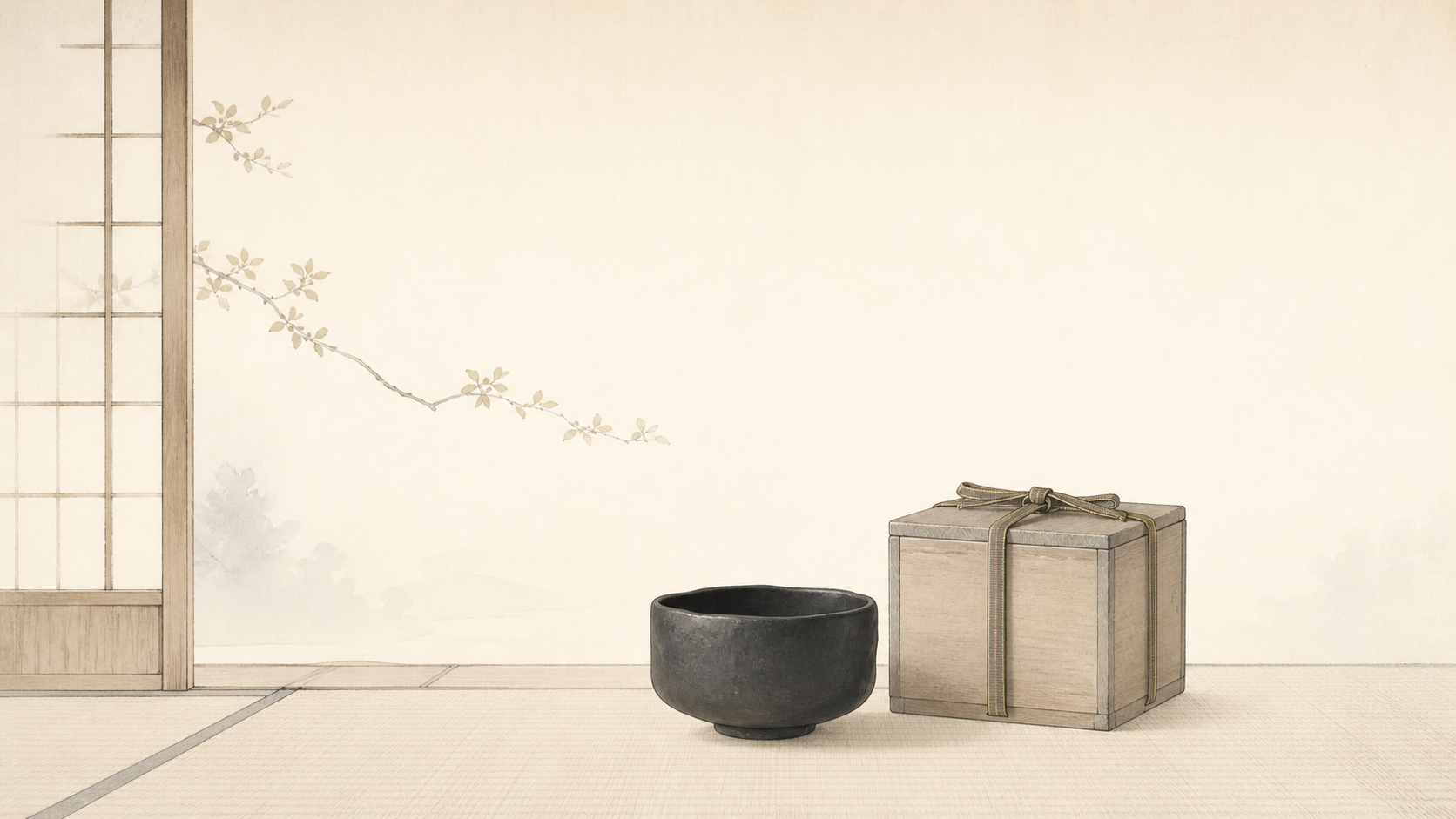
A tea bowl is a vessel you touch with your hands. It can also be kept in a box, bear a name and pass from one person to another with the memory of its maker and former owners. The value of a bowl takes shape in both.
A Tea Bowl Has More Than One Measure of Value
Faced with a tea bowl, we tend to fall into two ways of looking.
One is to notice its shape, colour, clay, glaze and feel in the hand. The other is to ask who made it, when it was made, who owned it and which tea practitioners valued it.
Separate these ways of looking and the bowl quickly becomes less interesting. Its form has been discovered over time, and its standing passes from one person to another. The host chooses it before it comes into the guest’s hands. In the bowl, material and memory meet, as do authority and the body.
Look at the slight unevenness of the rim, the rounded body in the palm or the weight as a finger catches under the foot. Notice how the green of the matcha looks against the glaze. The bowl offers details the hand and eye can test.
Two bowls of the same apparent shape can mean different things in tea, depending on their makers, dates, kilns, provenance, names, box inscriptions and use in gatherings. Those details matter alongside what you can see and feel.
Price is one way that value appears in a market. A bowl’s standing has been built over time by the people who noticed it, cared for it, used it and passed on its story. That history helps shape how we see the bowl today.
Do Standing and Provenance Sit Outside the Bowl?
A tea utensil may be accompanied by a box, a fitted fabric pouch called a shifuku or an accompanying letter. Kyoto National Museum uses the term shidai for the set of materials that go with an object. Some were commissioned when ownership changed and were passed down with the object itself.
Boxes and written records tell us where a bowl has travelled, whose attention it caught and how it was treated. Provenance is the record of the connections that have gathered around the object.
A bowl loses something whether we dismiss standing and judge it by touch alone, or give standing all our attention and pass over the vessel. In tea, looking at a bowl means moving between its story and its form, between what we know and what we feel.
Knowing who held the bowl, which gatherings it entered and which box or letter came with it can change how a rim or an area of glaze looks. A celebrated provenance still leaves the form to be examined. The object and the records need to be read alongside each other.
Ways of Seeing That Travelled Across China, Korea and Japan
The bowls used in chanoyu come from several places. Chinese imports known as karamono included tenmoku bowls. Japanese tea practitioners took up so-called Kōrai bowls made on the Korean peninsula. Raku, Shino and Oribe developed in Japan in connection with tea. Vessels from different places, made for different uses, have all found their way into the tea room.
Beyond learning the places of origin, notice what happens when tea practitioners choose a vessel that began in a different setting or served another purpose. It gains another meaning as a tea bowl. Chanoyu has made new objects and changed how existing ones are seen.
The large Ido-type bowl named “Kizaemon” was made in the Joseon period, passed down in Japan and is now protected as a National Treasure. Chōjirō’s black Raku bowls are bound up with Momoyama-period tea, with the maker and his time. A bowl’s standing helps tell us who noticed it, how it was used and how it was passed on.
A Bowl Comes into Its Own in the Hand
A tea bowl comes out of its box to be used. Tea is made in it, the host passes it to a guest, and the guest lifts it with both hands until the rim touches the lips.
Weight is more than a number. Two bowls weighing the same can feel different depending on the centre of gravity, how the foot catches against a finger and how the rim meets the lips. The depth of the body and the size of the mouth affect the movement of the whisk and the way the tea looks.
This is where the bowl’s precision as a designed object shows. A bowl that asks for a little extra care in handling can also carry that sense of attention into the season, the formality of the gathering and the relationship with the guest.
How the Other Utensils Change a Bowl’s Presence
A bowl is complete as an object, but at a tea gathering it has a life among other things. Black glaze deepens the apparent green of matcha. A white surface brightens it. A wide, shallow bowl can suggest coolness, while a cylindrical bowl holds warmth in the hands.
Consider the scroll, flowers, sweet, tea container, scoop and the sound of the kettle, as well as the season, time of day and the guests’ experience. Choosing a bowl also means choosing its relationship with everything around it.
A celebrated bowl is not always the best choice. The higher its standing, the more it matters where, to whom and with what you present it. The host’s work is in giving the bowl’s presence a place in the gathering.
Choosing a Bowl Means Shaping Its Relationships
Communication design is concerned with who receives something, what they receive, in what order and from what distance. A distinctive shape is only one part of that work.
Choosing a tea bowl asks similar things of the host. Understand its standing and provenance, read the season and theme, give it room beside the other utensils and imagine the moment a guest takes it up. The bowl is a medium placed between host and guest.
That is why a simple ranking cannot tell us what makes a good tea bowl. History, form, use, the body and the combination of utensils all offer measures of value, and the balance between them has to be worked out for each gathering.
Where to Begin Looking
Start with the description of the name, maker, period, place of production and provenance, even if you cannot remember every name. Then bring your eyes back to the shape of the object.
Is the rim even, or does its line wander? Where does the body swell, and how does the foot support it? What colour stands out once the tea is in the bowl? If you can, hold a bowl used in practice and notice its balance and the way it feels against the lips.
Knowledge lets us see what we had missed. The senses let us test in our own bodies an appreciation that has been passed down to us.
How Does Knowing the Background Change the Bowl?
At first I want to know who made the bowl, who held it and which gatherings it passed through, alongside its price or feel. Then I want to see what changes in my own perception when I take it up with that knowledge. Its background and my sense of it can deepen one another.
In the rush to make something new, history can seem like a restriction. Standing and provenance give the form in front of us a context that helps us see it more precisely. I want to respect that context and still find words for what comes back to me through my own hands.
Closing | A Tea Bowl Gains Value in Its Relationships
A bowl has a shape and a feel in the hand, as well as a maker, period, kiln, name, provenance and the objects and documents passed down with it. It carries the regard of tea practitioners who understood that history. Its standing matters to the way we see it in tea.
That history settles upon concrete things: clay and glaze, rim and foot, the colour of tea, the hands holding the bowl, the guests sitting together, the season and the other utensils. The bowl’s presence grows from those things together.
Look for where received authority and what the senses register come together. Who made the bowl? Who first recognised it? How did it pass down, and whose hands will hold it today? The vessel gives those relations a form we can see.
When a host selects a bowl, they bring its history into a relationship with the people now in the room. That is where the design of tea around the bowl takes place.
 What Is Sadō? How the Japanese Practice of Tea Designs Relationships
 What Did Sen no Rikyū Design? The Relationships Inside a Tea Gathering