
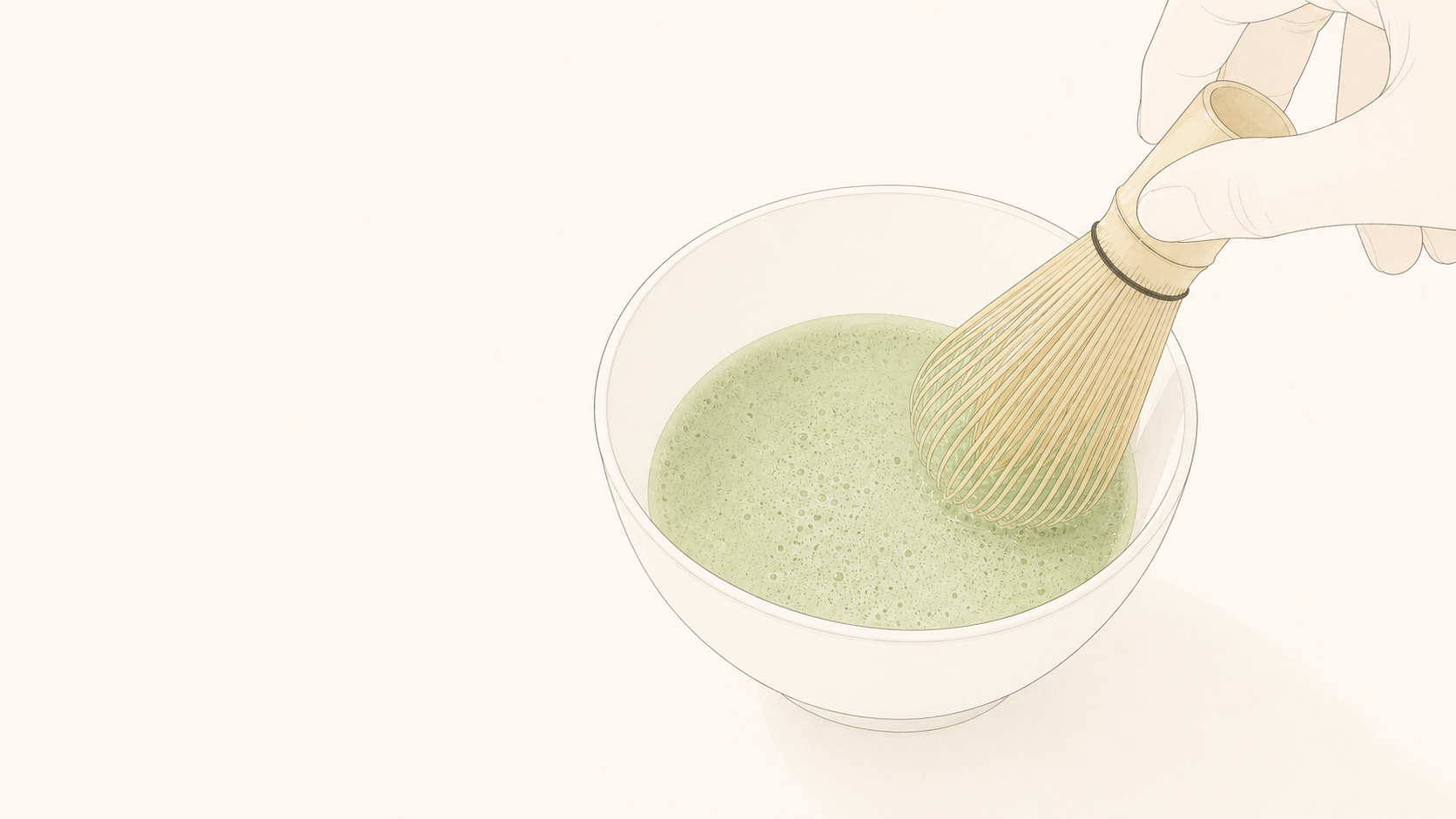
Usucha, or thin tea, has a lightness that comes from serving a bowl to each guest in turn. Each bowl helps set the pace for the person who receives it and for the conversation around them.
Thin Tea Has Its Own Time After Thick Tea
When the whisk falls quiet, a bowl with bright green foam is brought to one guest. Thin tea moves at a different pace from thick tea. The ease comes from the way each guest has their own turn without breaking the flow of the gathering.
In a formal chaji tea gathering, thick and thin tea play different parts. Thin tea eases the tension in the room and gives each guest a bowl of their own.
Even with the same matcha, changing the quantities, the water, the movement of the whisk, and the way people drink changes the experience. Each form brings people into a different relationship.
A Bowl for Each Guest Lets the Host Respond to Each Person
As a rule, the host makes thin tea separately for each guest. Each bowl makes room for a small exchange between host and guest within the same gathering.
The bowl can change, and no two bowls are whisked at the same moment. Those differences give each guest some time of their own.
The Amount of Foam Tells Us Only So Much About the Whisking
Schools and individuals differ in how much foam they prefer on thin tea. Finer foam is not a universal measure of skill.
What matters is the aroma and texture intended for the occasion. If appearance becomes the only measure, the whisking itself starts to crowd out its purpose.
How Dry Sweets Set the Tone of the Conversation
The dry sweets served with thin tea are small, easy to pick up, and lighter in character than the main sweet. Their shapes, colors, and names can open a brief conversation.
The pairing affects what guests taste and how much is said. A short explanation leaves guests room to bring up what they notice for themselves.
A Different Bowl Changes What the Guests See
When different bowls are used, a guest can notice features of the neighboring bowl as well as their own. Its shape, glaze, season, and formality can become part of the conversation.
Changing the pairing of guest and bowl gives people different ways to see the same part of the gathering.
A guest unfamiliar with the forms needs enough explanation to feel at ease. The utensils and their history still deserve care. A clear way in can preserve the depth of the practice.
A bowl and a conversation can show how to welcome people while keeping that care. Usucha offers a way to think about how an open gathering works.
What Changes When a Gesture Is Repeated
The host repeats the same sequence of movements for each guest. With each bowl the water, the vessel, and the guest’s response may differ. The host keeps the form and makes small adjustments.
Repetition helps maintain a shared standard while allowing a response to each person. Both come into play in the way usucha is made and served.
Ease Takes Preparation
What looks effortless to a guest depends on the order of the utensils, the management of the water, and the choice of bowls. Much of the work has already been done out of sight.
Like a well-run service, usucha lets the guest receive the tea without having to take on the work behind it.
Making one bowl at a time does not make them all identical. The temperature of the water changes little by little. The movement of the whisk, the fineness of the foam, and the warmth of each bowl vary as well. The host can adjust for the guest’s place in the sequence and the condition of each bowl.
What Usucha Can Teach Us About Welcoming Each Person
Communicating with a group while making each person feel addressed is hard to do. It is a problem in everyday communication as much as in a tea gathering.
By repeating the act of making a bowl, usucha gives the whole gathering a rhythm and keeps the host attentive to each guest.
What Gives Usucha Its Ease?
Notice how the pace changes when the host prepares tea for one guest at a time. Each new bowl moves the host’s hands and the guests’ attention in slightly different ways.
Alongside the foam, notice the aroma, temperature, texture, and the practice of the school. A single visual measure can miss much of what the tea has to offer.
When the gathering seems to run most naturally, careful preparation is usually doing its work in the background. The effort behind that ease gives thin tea some of its depth.
A separate bowl gives the host time to notice each face and each guest’s pace, and to adjust the pauses in the conversation. Everyone gets a turn with the host’s attention.
How One Bowl per Guest Keeps Conversation Easy
Usucha can feel informal and still be served with care. With a bowl to themselves, guests can drink at their own pace. The host keeps track of the number of guests, the conversation, the temperature of the tea, and the movement of the utensils. The guests feel the ease that comes from the work without having to think about it.
At a large gathering, bowls may come out in quick succession without making the guests feel hurried. I look at whether there is still room for a response to each person. One guest comments on the differences among the bowls. Another drinks quietly. Each has their own time while remaining part of the same occasion.
Giving people more options does not by itself make it easier to take part. They need a way in, a sense of where the encounter ends, and a way to relate to others. One bowl per guest makes room for each person’s time within the time of the whole gathering.
The natsume caddy, tea scoop, dry sweets, bowls, and amount of conversation give thin tea a character of its own. Its degree of formality differs from thick tea, and that difference is part of how its ease is made.
Listening to the Conversation One Bowl Can Start
When the conversation takes off, I watch whether the utensils are giving people an opening to speak. A design on a bowl, the name of a sweet, or a sign of the season can prompt a short remark that goes on to the next guest. The occasion offers something worth talking about without the host having to direct the conversation.
Serving one bowl to each guest gives the host some freedom in choosing vessels. When the bowls differ, what matters is how each selection works for its guest and for the gathering. I like a choice that leaves guests room to find a connection themselves.
Usucha can feel at home in daily life while still keeping some of its forms. Whisking the tea carefully, handling the bowl, and handing it to another person help an informal encounter stay attentive. In design too, clarity comes from showing the structure people need.
For me the ease of usucha comes from the host carrying the tension that guests need not feel. Guests can attend to their own bowl and the conversation. See how much care goes into that, and thin tea takes on a significance of its own.
Conclusion
In usucha, the host prepares a serving of thin tea for each guest, with sweets and conversation alongside. Each person gets time within the shared occasion. The host repeats the form and adjusts a little for the person receiving it. The feeling of ease is something that takes care to make.
Whisking, serving, and receiving one bowl at a time gives each guest a distinct place in the same gathering. Pay attention to the adjustments within the repetitions and you can see what gives the conversation room.
Noticing how the foam, temperature, and pauses differ from bowl to bowl is one way to take part as a guest.
 Choosing a Chasen: What Changes with the Number of Tines?
 Why Does a Natsume Sit So Quietly in the Hand? Lacquer, Form, and the Thin-Tea Caddy