
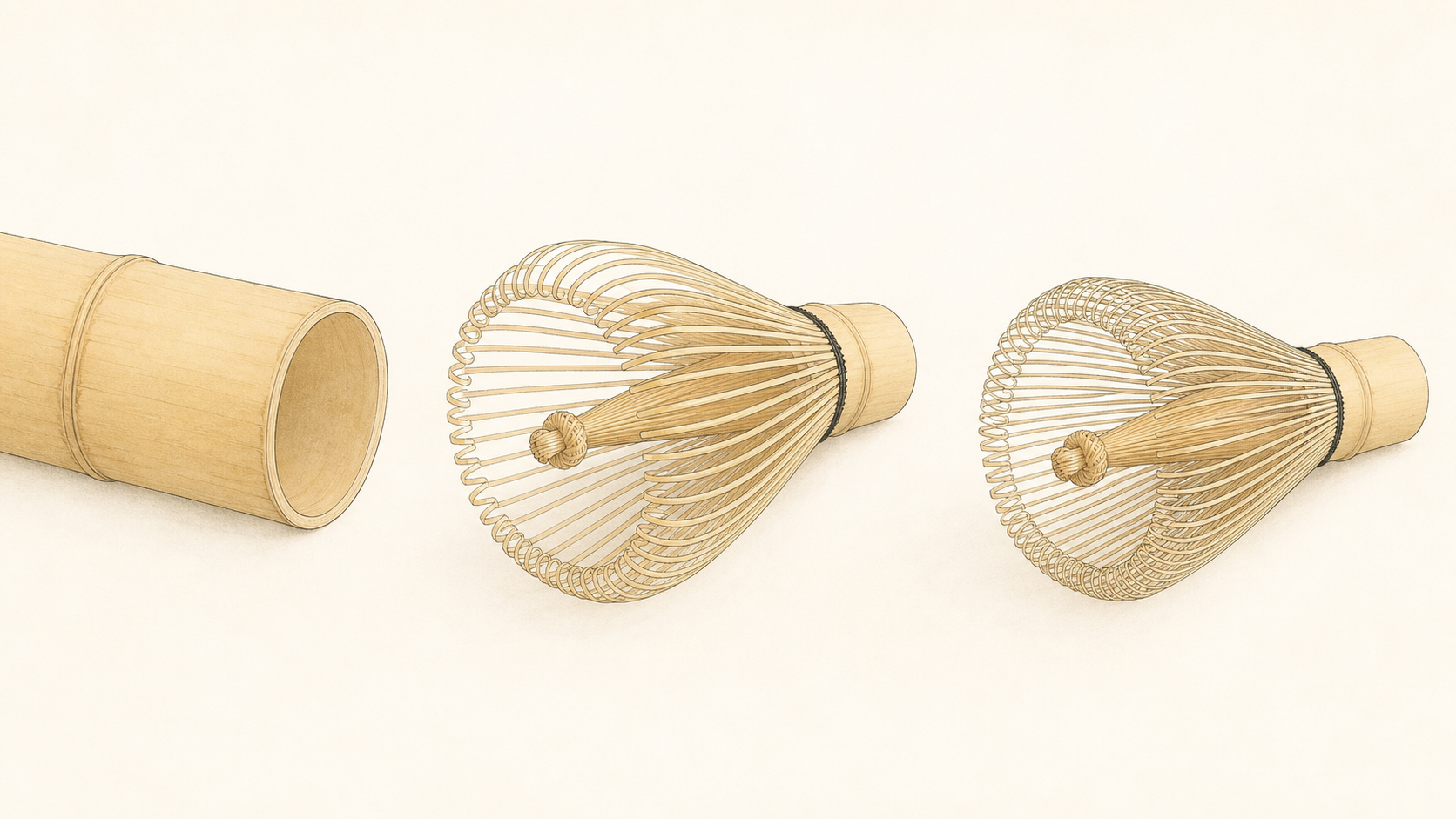
A chasen brings together bamboo, the shape of its tines, the practice of a tea school, the kind of tea being made, and the movement of the hand. All of them matter when choosing a whisk. Start with the work the bamboo does in the bowl.
A Bamboo Tool for Making Matcha
It can be tempting to assume that a whisk with more tines is better and makes more foam. That tells us only part of what the whisk does. A chasen is light, wears out, and gradually changes shape as it is used. It has an immediate effect on the bowl because it carries the hand’s movement into the water and tea.
Urasenke describes the chasen as a bamboo tool for making matcha and notes that the kind of bamboo and the shape differ among schools. Those differences matter to the way the whisk is handled and the tea it produces.
The fine splits transmit force to the water and matcha. The bamboo, its flexibility, and the arrangement of the tips shape how the liquid moves.
A Tine Count Makes Sense When You Know the Use
A whisk with many fine tines tends to make it easier to produce fine foam in thin tea. Thick tea is worked into a dense mixture, so the same standard of foam does not help you choose a whisk for it.
A listed tine count is a guide. The shape, thickness of the tines, arrangement of the inner tines, and flexibility of the bamboo can change how the whisk feels. Numbers alone cannot rank them by quality.
Choosing Within a School’s Practice
Pale bamboo, smoked bamboo, and dark bamboo are among the materials used by different schools. Their choices belong to systems of practice with histories of their own. If you are new to chanoyu and buying a whisk, ask your teacher first.
Reading a whisk as design can help you understand what a school’s conventions do before making a choice.
What It Means for the Whisk to Suit Your Hand
The thickness of the handle, the spring of the tines, and the width inside the bowl all affect how the hand moves. See whether you can bring the tea to the state you want without using too much force or damaging the tips.
Choice depends on how the whisk works with the tea, the bowl, the school’s practice, and your hand. Its qualities become apparent in that combination.
Consider the Bamboo, Where It Was Made, and the School
A maker splits, shaves, threads, and shapes the tines from a single piece of bamboo. The selection and drying of the bamboo and the maker’s handwork matter to how the tines flex and spring back, along with the evenness of the finer splits.
Pale, smoked, and dark bamboo have different qualities, and schools use different shapes. A product comparison based only on tine count leaves out that history and practice.
An expensive whisk has limits, and a tool that wears out still deserves care. Consider what you will use it for and the practice of your school. Then find a whisk that suits your hand, with attention to its maker and place of manufacture.
Using, Washing, and Resting the Whisk
Let the tines of a new whisk soften in warm water. After use, rinse off any remaining tea, put the tines in shape, and let the whisk dry. What you do before and after making tea can affect how the tines open and how long they last.
A whisk’s performance depends partly on the person using it. The strength of the grip, the motion of the wrist, and the distance to the bowl’s base all affect what even a well-made whisk can do.
The whisk carries the movement of the hand to the water and matcha. The bamboo also pushes back. A good tool lets the person using it feel that response and adjust the movement.
What the Numbers Can Tell You
Tine count gives you somewhere to start comparing whisks. A higher count or price does not necessarily make a whisk easier to use.
A suitable degree of flex and an arrangement of tines depend on whether the tea is thin or thick, what the school expects of the foam, how wide the bowl is inside, and how broadly the hand moves.
After comparing specifications, return to the bowl and the tea. The way the whisk will be used gives those numbers meaning.
The Work That Remains Visible in a Chasen
The thin splits have subtle differences that give away their making by hand. Shaping the tips, assembling the inner tines, and threading them produce the three-dimensional form.
A finished whisk may look like a light object that can simply be replaced. It carries the time it took to grow and dry the bamboo and the judgment the maker developed with practice.
Knowing its background reminds us that even a tool we use up comes from people, places, and time. That can change how we look after it.
A Tool That Develops Your Sense of Touch
When the whisk moves, the water’s resistance and the nearness of the bowl come back through the handle. Your hand can adjust its force and speed in response.
A good tool leaves enough feedback for the user to feel the condition of the material as they work.
The shape of the chasen lets the hand learn through repeated contact with bamboo, water, and tea.
Each tip comes from splitting and shaving the bamboo, smoothing the edges, and passing thread through the tines. Look at the height of the inner and outer tines, the curve of the tips, and how they align at the base. The work that supports the motion of whisking is still visible.
How Tine Count Changes the Movement of the Hand
Because whisks often look similar, it is easy to treat tine count as a specification that settles the choice. With the same matcha and bowl, whisks with tines that bend and spread differently return a different resistance to the hand. The number lets you start a comparison, and you can finish it in use. The school, the kind of tea, the shape of the bowl, and the user’s habits all matter. It helps to describe what a whisk suits before looking for one to do everything.
A good tool gives the user finer information. As the chasen moves, the state of the water and matcha can be felt through the handle. That is another reason for the fine divisions of the bamboo, alongside the appearance of the foam.
Compare How the Whisk Feels in the Hand
Before choosing from a list, consider the bowl and tea you are going to use and the kind of usucha you want to make. Starting with the occasion makes it easier to find a tool that fits your hand, the materials, and the result you want.
Conclusion
Tine count matters alongside the kind of tea, the practice of the school, the shape of the bowl, and how the hand moves. The chasen transmits movement from the wrist to the matcha and tells the hand how the tea is coming along. The useful comparison takes in the bamboo, where it was worked, the purpose, the bowl, and the care the whisk will receive.
Beginners often want to know which tine count to buy. Start with what your teacher and school use, which kind of tea you will prepare, and how you will care for the whisk. It wears out in use, and once the tips are worn, differences between models are beside the point.
Washing and drying the whisk are part of using it well.
 Why Does Each Guest Get a Bowl of Usucha? Thin Tea and the Pace of Conversation
 How to Choose Matcha: What Price, Color, Aroma, and Storage Tell You