
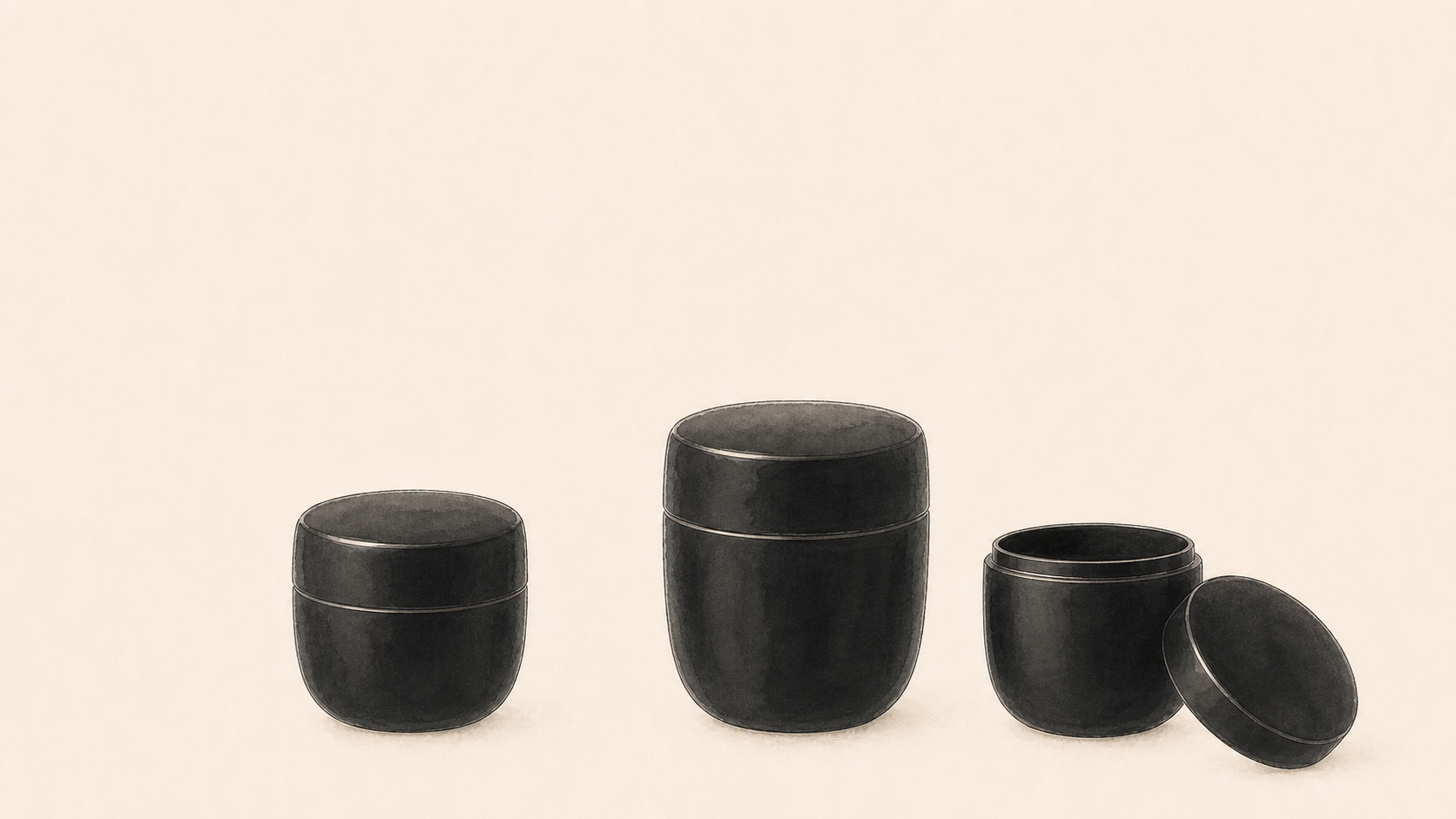
A natsume keeps matcha ready for thin tea. Its form guides the hand, and its lacquer and decoration can reflect the season and formality of the gathering. Its quiet appearance begins with the work of a tea caddy.
The Natsume Is One Form of Thin-Tea Caddy
A narrow line of light appears on a rounded shape small enough to sit in the palm. Its quiet comes from more than black lacquer. The layers of lacquer, the seam of the lid, the fingers that hold it, and the scoop that goes inside all meet on one small surface.
The natsume is generally used for thin tea. Its name is said to come from its resemblance to the fruit of the jujube tree, also called natsume. Examples vary in shape, size, lacquer finish, and maki-e decoration.
Many forms exist alongside the black natsume. Each makes sense in relation to its use and the things set around it.
I would choose light that shows both the depth of the lacquer and how close the vessel sits to the hand. What stays with me is how that quiet depends on the way someone handles it.
Natsume names a caddy shape with a profile like a jujube fruit. Other thin-tea caddy forms include nakatsugi and fubuki, while a hira-natsume is a low, flat form of natsume. The swell of the body and the placement of the lid change how each looks and where the hand can grip it. Distinguishing shape from use gives you something to see beyond the decoration.
How Its Rounded Shape Takes the Hand’s Movement
The host picks it up, opens the lid, inserts the scoop, and closes it again. With few sharp corners, the shape lets the palm and fingers move from one action to the next.
The shape has a beauty in use as well as at rest. It lets one movement flow into another.
Black Lacquer Has More Than One Tone
Lacquer can read as a dark surface and still pick up a fine reflection of the light around it. The depth of the finish, the gloss, and the marks of use all affect how close or remote the same black can feel.
Look at how the lacquer reflects light and changes with handling. Those are qualities of the material itself.
A caddy with maki-e can look quiet, and a plain black one can command attention. It depends on the gathering’s formality, the season, and the other utensils. What matters is how prominently it should appear in that particular arrangement.
Consider the seam, the swell of the body, and the dimensions that make it fit the hand, alongside the name of the design. The quiet makes more sense once you see how the way it is made suits the movements of temae.
How Maki-e Fits a Season onto a Small Surface
A natsume with maki-e or another design can convey the season or theme. On such a small surface, the balance between the motif and the space around it is easy to see.
Elaborate decoration can share a room with a scroll, tea bowl, and sweets without dominating. Each contributes something to the season.
What Gives a Natsume Formal Standing
A natsume’s formality and handling depend on its shape, lacquer, maker, provenance, and the occasion. The amount of decoration alone tells us little about its standing.
Its background helps us understand the part it plays in that gathering. Formal standing matters to the way it is paired with other things.
Where the Lid Goes Is Part of the Form
Once opened, a natsume becomes a body and a lid. Where the host puts the lid and which side faces up affect what the next movement looks like and how it proceeds.
The design of one object becomes an arrangement of separate parts in use. The full form appears through temae.
Use Changes the Surface
Time and handling change lacquer. The changes deserve attention, and the surface still needs careful treatment. A scratch does not automatically add value.
Craft has a long design life that takes in the years of use after an object is finished.
What Goes into a Quiet Form
The outline is simple. Within it are the tea, the scoop, the hand, the light, the season, and the maker’s history.
The caddy holds these things in one shape and reveals aspects of its character when needed. Its form, lacquer, season, and handling let it convey much with little on display.
Follow the Light and the Movement
In a display, notice what light does on the lacquer as well as the outline. In temae, the hand touches the caddy, the lid comes off, and the scoop goes in. The form opens out in time.
If it has maki-e, look at the empty space around the motif, its colors beside the other utensils, and the season. A small surface can speak more or less strongly.
A simple appearance is easy to imitate. To understand the caddy, look at how it preserves the tea, guides the hand, and gives a small sign of the season.
Turning the wood, fitting the lid to the body, laying down lacquer, adding maki-e, and scooping the tea all matter to this quiet outline. When so much of the work is hidden, a precise fit and feel in the hand become especially important.
The Natsume’s Quiet Comes from the Way It Is Handled
In the hand, I notice a curve and the join of the lid that were hard to make out in photographs. Lacquer with this much gloss might stand out, yet the caddy can sit quietly in a tea gathering. I see its quiet in the whole movement, from lifting the caddy to removing the lid and scooping tea.
A product photograph can arrange the reflection to make a finish look perfect. The caddy has more to show in the presence of the season conveyed by the maki-e, the depth of the lacquer, the care taken to avoid fingerprints, and the distance to the tea scoop.
A simple shape does not enter the present by itself. The natsume owes its form to a use, techniques for making it, preferences within particular schools, and a long history of handling. Borrow its outline alone and its quiet can become blankness.
In a gathering I watch when it comes into view, when the host closes a hand around it, and when the lid opens. The natsume reveals its character over time as it is handled. That is where I see the design most clearly.
Watching the Lid Open
The feel of closing the lid is hard to convey in a photograph. There is the precise fit, the pressure needed to close it quietly, and the care the hand takes around the lacquer.
On a maki-e caddy, the design may run beyond what looks like the front. As the object turns in the hand, the lid comes off and the angle changes, the scene unfolds. The image is arranged for the time it takes to handle the object, with more than one view.
Black lacquer takes its depth from the application of the layers, the base beneath them, age, repair, and the maker and tastes behind it. The gloss is a visible result of time spent making and caring for the surface.
In temae the natsume is opened, some tea is removed, and it is closed again. The form makes these changes possible without calling too much attention to itself. Seen in use, the reason for its quiet in the hand becomes clearer.
Conclusion
The natsume’s quiet grows out of how it keeps the matcha, fits the palm, catches the light, and opens. Its maker, provenance, and seasonal decoration are part of that quiet too. The caddy fits all of these things into a simple form.
The user’s hand helps preserve that quiet. The character of the caddy comes through in the way someone handles it.
Look at the join between lid and body, the curve of the sides, and the balance in the palm as well as the gloss and the maki-e. On a caddy with little decoration, the precision of the form shows as the host opens it, sets the lid down, and scoops tea. Those movements show what gives the caddy its quiet.
 Why Does Each Guest Get a Bowl of Usucha? Thin Tea and the Pace of Conversation
 How to Choose Matcha: What Price, Color, Aroma, and Storage Tell You